Mountain shape a key factor in species surviving climate change
One way animals and plants can cope with climate change is to relocate. Research shows some species are already shifting to higher ground or towards the poles in search of cooler climes.But for creatures already living in mountains, the solution is not so simple. A new study of 182 high-altitude regions across the world shows how mountain shape is critical in determining whether a species will find refuge from rising temperatures further uphill.
This means the odds of survival are better for some species than others, say the authors.
Habitat range
The typical image of a mountain is a pyramid shape – a broad base that tapers to a peak. In theory, as species move upwards the habitat available to them shrinks, the paper explains.
But the study, published in Nature Climate Change, finds that over two-thirds of mountains don’t follow this rule. In fact, mountains fall into one of four shapes: diamond, pyramid, inverse pyramid and hourglass, as the diagram below shows.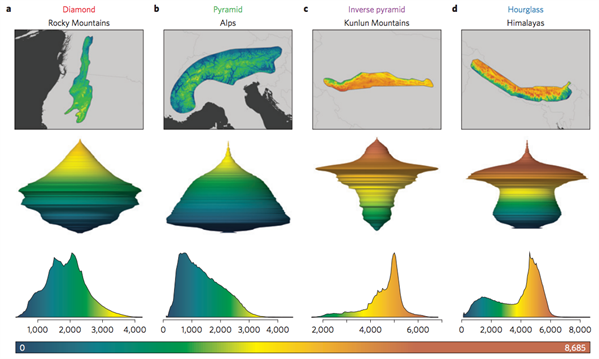
Moving on up
The graphs below from the paper show how the amount of available habitat would change for each mountain type if global temperatures were 2C warmer than during a 1986-2005 baseline period.You can see that while habitat decreases with elevation with the traditional pyramid, for other mountain shapes it increases (inverse pyramid) or plateaus before decreasing again (diamond and hourglass).
§ Winners and losers
The Himalayas are an hourglass mountain range. That means species living in its foothills will encounter a bottleneck as they move higher, squeezing their potential habitat, lead author Paul Elsen from Princeton University tells Carbon Brief.
The bird species Beautiful Nuthatch and Ward’s Trogon could face an increased risk of extinction if they moved to a higher elevation, for example.
However, for species already living in the narrow bottleneck, the potential habitat increases as they move to higher ground, Elsen notes.

The Alps are a traditional pyramid shape, so species would find less available habitat as soon as they moved uphill, say the authors.
Mountaintops
For truly mountaintop species, such as the snow leopard and alpine ibex, mountain shape won’t make any difference to future habitat because there’s no space to move higher. These species remain a high priority for conservation efforts, the researchers say.
For species that are living at ground level, they too will find their habitat diminishes once they move uphill, no matter what the shape of the mountain.
The overall height of a peak can plays a role in how much ‘refuge’ habitat it can offer to shifting species, says co-author Prof Morgan Tingley, from the University of Connecticut.
However, for very large mountain ranges, getting to higher elevations may mean moving a long way, which not all species can manage, the paper notes.

Conservation
The study’s findings could help target where mountain species are most threatened by climate change, say the authors. At-risk regions could then be first in line for conservation efforts, such as establishing a protected area or a biological corridor as a link to suitable habitat elsewhere. Elsen tells Carbon Brief:
Main image: Sunrise at Moulton Barn in the Grand Teton National Park, Wyoming.
Article information
Elsen, P.R. and Tingley, M.W. (2015) Global mountain topography and the fate of montane species under climate change, Nature Climate Change, doi:10.1038/nclimate2656