The implications of $50-a-barrel oil for the worlds energy mix
Oil prices keep sliding, sending economic shockwaves around the world. Analysts are scrambling to try and understand what it means for the world’s future energy mix and efforts to cut emissions. But the relationship between oil prices and energy investments is complex.
Much depends on how low the price goes as, beyond a certain point, lots of projects are no longer economically viable.
We take a look at what may happen to the oil price, what it means for the industry, and how it could affect the world’s efforts to move towards a zero-carbon energy system.Oil pricesOver the past year, oil prices have gone from a high of about $115 to a current low of about $50 a barrel, far below many analysts’ original expectations.Those same analysts are now busy revising their projections. While most seem to think the oil price has hit or is nearing rock bottom, there’s a wide range of projections for where it may rebound to in 2015.This chart shows just how varied those predictions are. They’re not all like for like – some are estimates of a low point, some are average price projections for the next twelve months, or predictions for particular financial quarters – but they do give an idea of the spread of projections:Image - Screen Shot 2015-01-09 At 11.38.53 (note)Source: Data collated and graphed by Carbon Brief.As you can see, hardly any analysts expect the oil price to dip below current levels. Most expect the price to recover to somewhere around $70 a barrel by the end of the year.The projections have major implications as companies use them to decide if current and future oil projects are profitable. If the price of oil drops below a particular point, companies may decide to abandon or scale back their activities.Breakeven pricesCompanies’ investments are vulnerable to volatile oil prices, so they stress-test their projects by working out how much a barrel of oil needs to cost for them to remain profitable. The reference point for whether companies persevere with the projects is known as the “breakeven price”.A range of analyses suggest the majority of the world’s oil projects struggle to break even with the oil price hovering around the $50 mark. Citigroup has collated the breakeven price of all the oil projects in the world. As you can see from this chart, most projects need the oil price to be much higher than $50 per barrel:Image - Screen Shot 2015-01-08 At 12.17.25 (note)Source: Citigroup Carbon Tracker, a thinktank focusing on the financial risks facing fossil fuel companies, separately focuses in on the different types of projects.It calculates that almost $10 trillion of company investments are potentially at risk if the oil price is below $60. Arctic oil exploration projects potentially worth $2.8 trillion in capital expenditure have a breakeven price of at least $100, it estimates.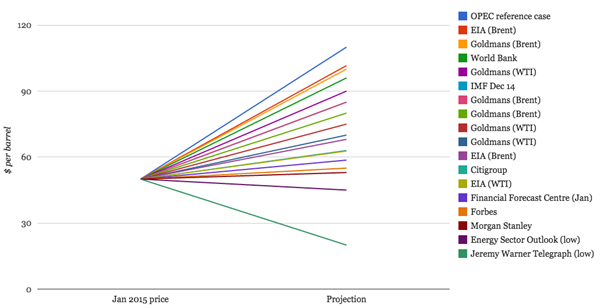
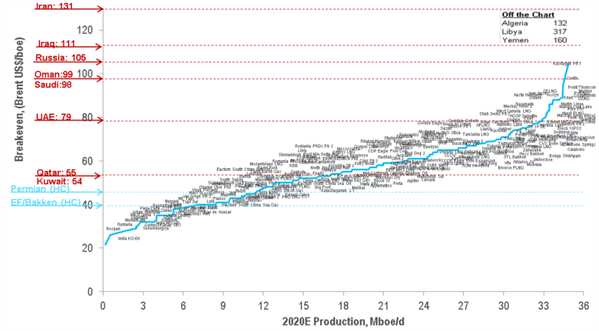
Image - Carbon Tracker Oil Breakevens (note)
Source: Carbon Tracker.
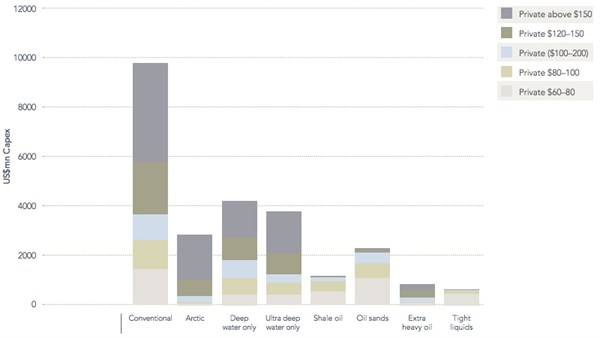

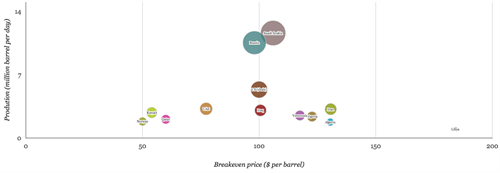
Image - REnewables Oil Breakeven (note)
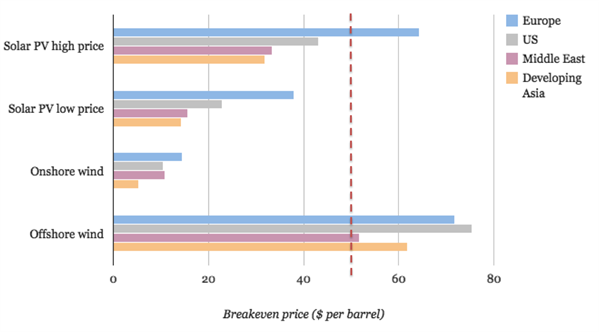
Source: Data from Energy Intelligence. Graph by Carbon Brief.
But renewables are more vulnerable to a falling gas price. No renewable technologies can directly compete with the current gas price of about $3 per million British thermal units (mmBtu), according to Energy Intelligence’s data. Offshore wind is the most vulnerable, with an average breakeven price of about $13:
Image - Renewables Gas Price Breakeven (note)Source: Data from Energy Intelligence. Graph by Carbon Brief.
But the falling oil and gas prices are unlikely to affect investment in renewable energy in the long term as the industry continues to be bolstered by government subsidies and support, Energy Intelligence argues. The industry is also well established enough in many parts of the world to be able to see out a short-term price drop. “These technologies are no longer fragile infants”, it says.The oil price may rebound soon anyway, bringing gas prices with it. If the Saudi’s plan to squeeze production in other countries works, supply rates may drop, and the price may rise again. That certainly seems to be what most analysts expect to happen.So renewable power sources are unlikely to be greatly affected by falling oil and gas prices in the long term. In contrast, the data suggests that the majority of the world’s oil projects, particularly costly new exploration in the Arctic, are most threatened by oil priced at $50 a barrel.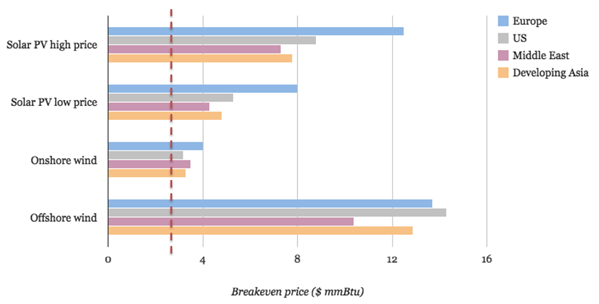
Main image: Stacked yellow oil barrels.
Article information
Updated 09/12/15, 12.45: The graph showing breakeven costs for different types of oil projects was changed.