Scientists respond to the Register on Antarctic ice shelf melt: This is the equivalent of turning the statement the cancer is not as bad as we thought into you don’t have cancer.
“Crafty boffins” have discovered “no ice is being lost at all” from the eastern Antarctic, the Register claimed in delighted tones on Monday.
Is it right? Not if you take a look at the research discussed by the IT blog – which has quite the penchant for publishing skeptic takes on new climate science. In fact, the research’s lead author of told us it reveals a slower melt rate than previously thought for one ice shelf – the Fimbul ice shelf in Antarctica, but doesn’t contradict or undermine research which shows the continent losing mass.
Under the headline ‘Antarctic ice shelves not melting at all, new field data show’. the Register says:
“Twenty-year-old models which have suggested serious ice loss in the eastern Antarctic have been compared with reality for the first time – and found to be wrong, so much so that it now appears that no ice is being lost at all.”
But what did the “boffins” do, and were their conclusions as dramatic as suggested?
Scientists drilled through the vast Fimbul Ice Shelf in eastern Antarctica to see if they could find out how fast the shelf’s underside is melting and determine what is causing it. They concluded that models estimating that ice shelves in this region are losing significant amounts of ice are overestimating the melt rate. Ice shelves are floating bodies of ice that connect continental ice sheets like the East Antarctic ice sheet to the sea. They range in thickness from 50 metres or so up to a couple of hundred metres.
The scientists placed recording devices in the holes they drilled in the ice, which collected data over two years. They supplemented the data from the drilling with temperature, salinity and depth readings from sensors fitted to a group of elephant seals, which were being monitored as part of a project by biologists from the Norwegian Polar Institute.
Image - Elephant -seal -fimbul -ice -shelf -eastern -antarctica -lg (note)
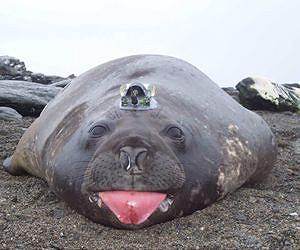
It’s a very clever way to get continuous data on conditions in the area – the seals spend the entire winter around the Fimbul ice shelf. So the data from their sensor packs gave the scientists nine months’ worth of detailed information about circulation changes in the water surrounding the ice sheet – how warm and salty it was at different locations and depths.
According to the paper, the combined data from the sensors on the seals and the sensors in the ice helped the scientists understand in more detail how ocean circulation patterns heat the underside of the ice shelf, something which they note had been a “major source of uncertainty” in previous attempts to assess the melt rate of Antarctic ice shelves. Previous models simply assuming that the warm deep ocean alone caused ice shelves to melt from beneath, so this is a more sophisticated approach.
Says lead author of the sturdy Tore Hattermann: “It has been unclear, until now, how much warm deep water rises below the Fimbul Ice shelf, and previous ocean models, focusing on the circulation below the Fimbul Ice Shelf, have predicted temperatures and melt rates that are too high, suggesting a significant mass loss in this region that is actually not taking place as fast as previously thought.”
Slow ice shelf melt doesn’t mean Antarctica’s not losing ice
Based on this, the Register concludes not only that “no ice is being lost” “in the Eastern Antarctic”, but also that the research casts doubt on satellite observations of ice loss in the Antarctic full stop.
According to one of the authors of the research, this isn’t the case, and the conclusion doesn’t accord with other research from the region. On a continental scale, satellite data from the whole of Antarctica show the continent has been losing ice in recent years, and that the ice loss is accelerating. Most of this ice loss has been from the West Antarctic ice sheet, particularly from the Antarctic Peninsula. This study doesn’t undermine those conclusions.
The East Antarctic Ice Sheet is losing ice as well – it had been thought to be reasonably stable, but more recent satellite measurements indicate the body has been losing ice since around 2006, particularly along parts of the coastline.
The new research reports that its findings agree with satellite data showing a “steady state mass balance” on the Fimbul ice sheet. This means that the ice on the shelves is currently building due to snowfall while it’s also melting – processes that currently balance out. But the finding that there isn’t any net ice loss at present on the ice shelf isn’t the same as saying the ice isn’t changing, or that there’s no ice loss in the wider region.
Hatterman pointed out to us:
“In west Antarctica there is continuing rapid ice loss. Direct inflow of warm deep water is eroding some ice shelves there, such as the Pine Island glacier ice shelf“
Indeed, this paper shows that the inflow of warm deep waters is the primary control of Antarctic ice sheet loss. But, Hatterman says, the findings show it’s important to differentiate between different Antarctic regions to fully understand what’s happening to the continent. He adds:
“Our results do not change the overall conclusion that Antarctica is currently losing mass.”
Finally, one of the authors of the paper has just responded directly to the Register, saying the story “misled” readers:
“Our results suggest that the rate at which *some* ice shelves are melting is less than previously thought. We did not question the overall conclusion that the Antarctic ice sheet as a whole is currently losing mass, which has consistently been concluded from several different methods.
A few days after our article was published, a piece profiling our work appeared at the Register of the UK written by Lewis Page entitled, ‘Antarctic ice shelves not melting at all, new field data show.’ This is the equivalent of turning the statement “the cancer is not as bad as we thought” into “you don’t have cancer.”
The severely distorted version of our study’s conclusions then spread rapidly across the internet. It is a pattern that climate researchers have unfortunately observed many times, part of a widening gulf of misinformation between scientists and society.
As one of the authors of this study, I can only repeat: this is not what we said. We have been misrepresented, and you, the reader, have been misled by some of those who claim – as scientists and journalists both surely should – to provide you with facts.”
It seems particularly difficult for outlets to accurately report ice shelf melt in the Antarctic. We’ve seen occasions when the research has been overplayed to suggest too much ice loss. Now it seems the balance has swung the other way.