Guest post: Climate change before the court
A guest post from James Thornton and Howard Covington, chief executive and trustee, respectively, of the environmental law NGO ClientEarth.Just over a week ago, representatives of 196 parties around the world filed into a final plenary session at the Paris climate talks. After a last-minute hiccup, the gavel came down, and the Paris agreement on climate change was finally adopted.The agreement requires countries to update and enhance their targets to cut greenhouse gases every five years, but the targets themselves are not legally-binding. In the absence of enforceable commitments to reduce emissions, concerned citizens may look to the courts for an alternative way of driving emissions cuts by countries or companies.We take a look at how litigation – the process of resolving disputes in a court of law – could have an important role to play.Two aspects of causationConsider this example: how could climate litigation be used to prove liability for a company, say a fossil fuel giant, towards a claimant for climate change damage?A case like this would fall under tort law, which is used to determine liability when actions by one person or company have caused some specific harm to another. A claimant in a climate change case will have to convince the court of two things.First, the court will have to accept that greenhouse gas emissions from human activity are the principal driver of climate change. A few months ago, we saw judges in the Netherlands do exactly that. A case was brought against the Dutch government by the Urgenda Foundation and 900 Dutch citizens, who argued that the government was in the wrong for not taking sufficient action to prevent foreseeable harm from climate change.The judges declared human-caused climate change as beyond dispute, and ordered the Dutch government to strengthen its plans to cut emissions. The government is currently appealing the decision.The second aspect of causation is more complicated to prove. The claimant needs to convince the court that human-caused emissions are behind the climate event alleged to have caused harm.Such a case would also need a defendant. In our example, let’s say it’s a coal-burning utility company.If the court agrees that its emissions contribute to climate change, under tort law, the crucial question is then whether the utility company has a duty of care to the claimant. In the case of climate change, a court could rule that the utility company contributed to the harm in a way that can potentially be quantified with reasonable certainty.However, this raises a problem: the utility company isn’t the only contributor to climate change.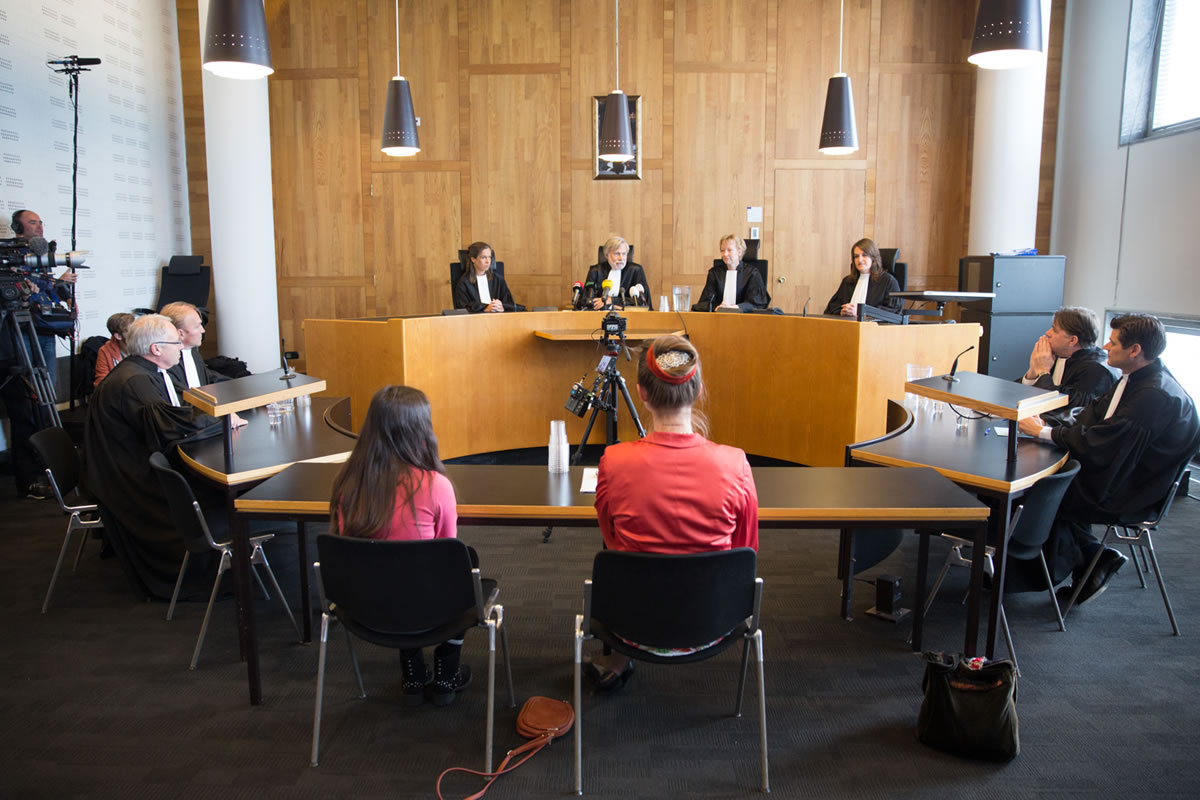
Main image: Statue of justice. Credit: sebra/Shutterstock.com.
Article information
This guest post is based on the following peer-reviewed article:
Thornton, J. and Covington, H. (2015) Climate change before the court, Nature Geoscience, doi:10.1038/ngeo2612