Clouds dampened warming since 1980s, study shows
A new study helps unravel one of the biggest uncertainties for scientists making climate change projections – how clouds will be affected as the Earth’s warms up.Clouds can have both a warming and cooling effect on the Earth. They insulate the Earth’s surface like a blanket, while simultaneously cooling it by reflecting away energy from the sun.Overall, scientists expect that changes to clouds will amplify human-caused warming in the long-term. But a new study, published in Nature Geoscience, shows that they can have an important short-term cooling impact.Previous research using satellite data has identified an increase in low-level clouds in the tropics over the eastern Pacific Ocean since the 1980s. The authors of the new study say this has likely reduced the pace of recent warming – and they’ve worked out why it’s happening.But the effect will be short-lived, the researchers tell Carbon Brief, meaning global warming is likely to accelerate again when it reverses.§ Uneven warming
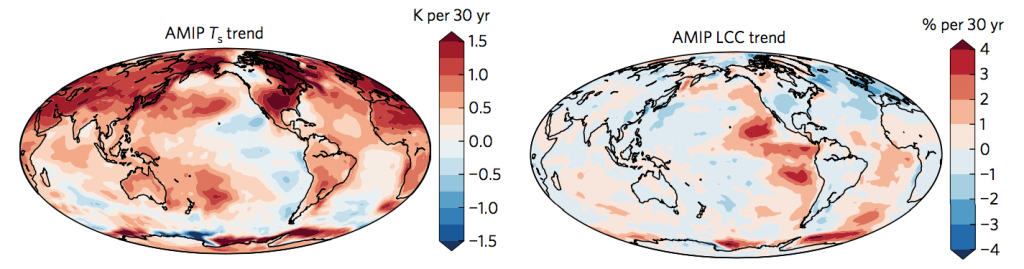
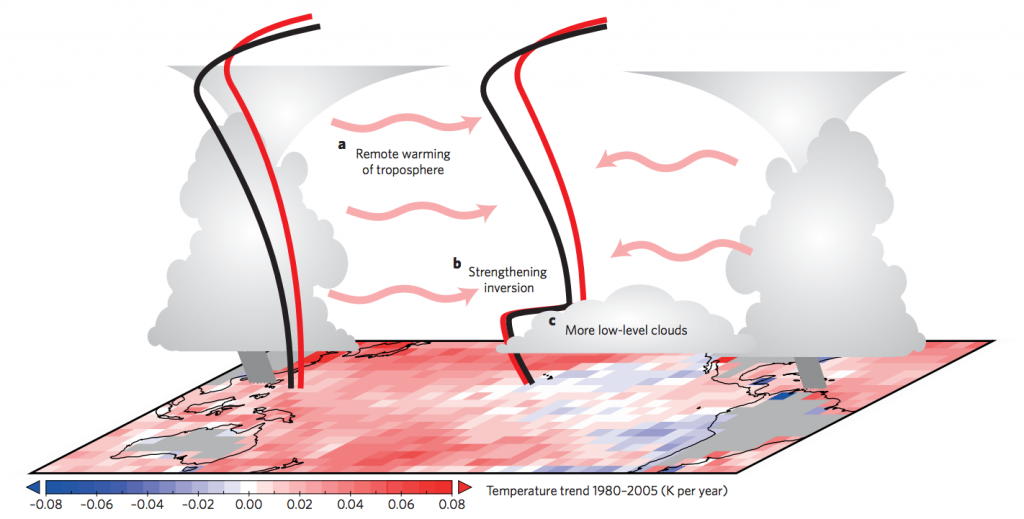
“I expect it will reverse at some point, and the eastern Pacific will warm and clouds will decrease. Based on this study, this will likely increase the rate of global warming when it occurs.”
previous research§ Climate sensitivity
climate sensitivityestimatedequilibrium climate sensitivity1.5 and 4.5C“This transient behavior makes it harder to assess equilibrium climate sensitivity from only a few decades of temperature change.”
Dr Chen ZhouLawrence Livermore National Laboratory“One could be badly misled by taking observed trends and extrapolating into the future, because we do not expect this particular warming pattern to persist.”
Prof Steven SherwoodClimate Change Research CentreUniversity of New South Wales“The real significance of these results is that they make it much more likely that estimates of climate sensitivity based on historical warming have been biased low compared to reality.”
§ Reinforcing impact
hiatusfluctuations in the Pacific Oceanhuman-caused aerosol emissionsvolcanic eruptions“The cloud changes we’ve diagnosed have been driven by the observed pattern of warming; they are responding to it, and in so doing, are modifying the planet’s energy budget in such a way as to reinforce the hiatus.”
Article information
Zhou C. et al. (2016) Impact of decadal cloud variations on the Earth’s energy budget, Nature Geoscience, doi:10.1038/ngeo2828
Mauritsen, T. (2016) Clouds cooled the Earth, Nature Geoscience, doi:10.1038/ngeo2838