On the 14 December 1911, explorer Roald Amundsen and his team planted the Norwegian flag on the snow-covered South Pole. They had beaten the British team, led by Captain Robert Scott, by 33 days.This was the Heroic Age of Antarctic Exploration, where explorers ventured into unknown parts of Antarctica, and many – including Scott – lost their lives in the process.A hundred years later, a new study describes how the records kept during these expeditions provide insights into how sea ice around Antarctica has fared over time.The findings suggest that while the response of Antarctic summer sea ice to human-caused climate change may be less dramatic than in the Arctic, sea ice cover may have declined by as much as 14% over the last 100 years.
“Relatively little is known about the state of Antarctic sea ice before continuous satellite records began in the 1970s, making it hard to understand if [the increase] is a trend.”
“These records were very diligently kept by trained meteorologists onboard ship, so the quality of the record keeping is high.”
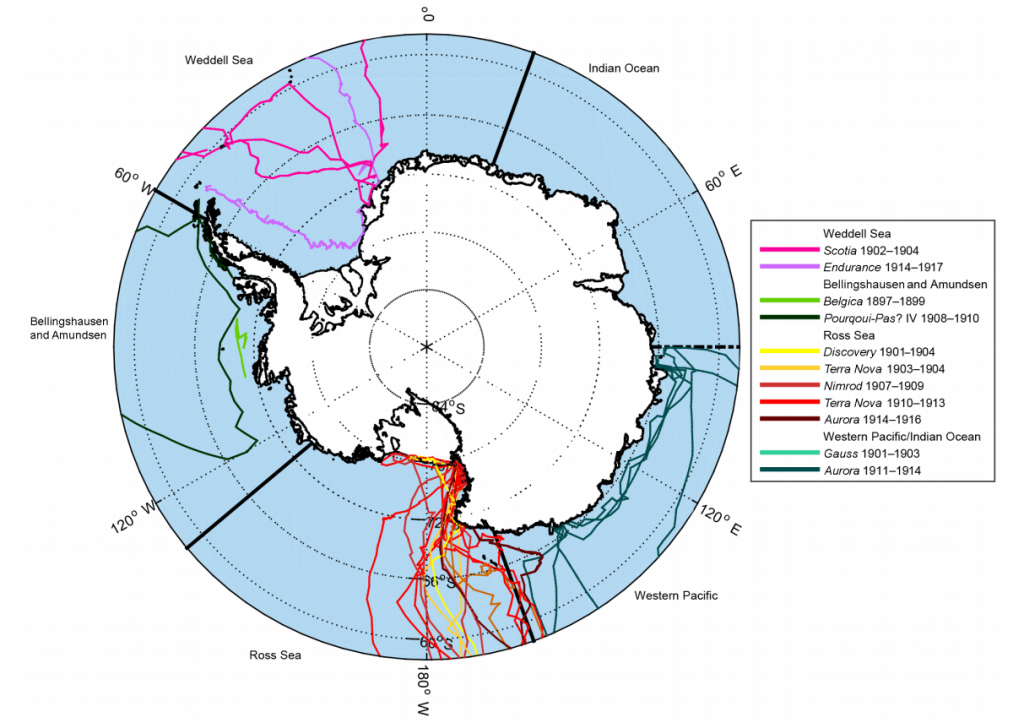
ICOADSImage - Map of expedition routes taken by ships used in the study. Source: Edinburgh & Day (2016) - Map of expedition routes taken by ships used in the study. Source: Edinburgh & Day (2016) (note)The researchers digitised the logbooks from 11 expeditions and added the data by hand into spreadsheets. They were helped by various other research groups as part of the International Comprehensive Ocean-Atmosphere Data Set (), a worldwide effort to recover weather data from ships’ logbooks.You can see the routes that the explorers took in the map below.The sea ice records are predominantly for the southern hemisphere summer – from November to March – because that’s when the explorers tended to sail to the Antarctic, taking advantage of the seasonal lows in sea ice extent.From these records, the researchers created a dataset of 191 sea ice edge positions, providing “an almost circumpolar picture of the Antarctic summer sea ice edge” for 1897-1917, the paper says.Comparing the dataset with modern satellite records, the researchers find that Antarctic summer sea ice extent was “surprisingly comparable” to what it is today.That said, the logbook records also suggest that Antarctic summer sea ice has declined by up to 14% between the Heroic Age and the present day.And the results do show some dramatic changes, the researchers note, particularly in the Weddell Sea. The ice edge positions recorded by expeditions in the early 1900s reveal that sea ice extended much further north than any time in the last 25 years, says Day.
“What this study shows is that summer sea ice in the Antarctic might not be particularly sensitive to a warming climate compared to the Arctic, however it does leave open the possibility that there has been a decrease in ice extent of at most 14%.”
“The study reinforces the idea that looking at Arctic and Antarctic ice separately is the best way to understand decadal and long-term trends, because it suggests significant decadal and inter-decadal variability in southern hemisphere ice extent going back much further than the last 30 years.”
“I hope it will bring attention to international projects like Old Weather that are working to ensure that the observations are not lost.”
Article information
Edinburgh, T. & Day, J. (2016) Estimating the extent of Antarctic summer sea ice during the Heroic Age of Exploration, The Cryosphere, doi:10.5194/tc-10-2721-2016.
While a 14% loss is not an insignificant amount, it’s smaller than some of the changes in Antarctic sea ice recorded during the middle of the 20th century, as , the paper says.The findings suggest that Antarctic sea ice has fluctuated substantially through the last century, rather than experiencing the sort of steady trend seen in the Arctic .This indicates that summer sea ice in the Antarctic is heavily influenced by natural fluctuations in the climate system, which can mask the impact of human-caused climate change, says Day:Day discusses his study in the video below.The study highlights what’s happening to sea ice can be quite different in each of the Earth’s poles, says , principal investigator at the National Snow and Ice Data Centre (), who wasn’t involved in the study, but peer-reviewed the paper. She tells Carbon Brief:Fetterer – who recently wrote a for Carbon Brief on piecing together a record of Arctic sea ice back to 1850 – also says the study highlights how important it is to find and preserve old observations:
![Image - Photograph entitled: ‘With Captain Scott [Royal Navy] to the South Pole (British Antarctic Expedition)’. Steam Yacht ‘Terra Nova’ with dogs and men standing on ice near by’, by Herbert Ponting (1870-1935). c1911. - Photograph entitled: 'With Captain Scott [Royal Navy] to the South Pole (British Antarctic Expedition)'. Steam Yacht 'Terra Nova' with dogs and men standing on ice near by', by Herbert Ponting (1870-1935)](http://www.carbonbrief.org/wp-content/uploads/2016/11/Steam_Yacht_Terra_Nova.jpg)