Guest post: The challenge of defining the ‘pre-industrial’ era
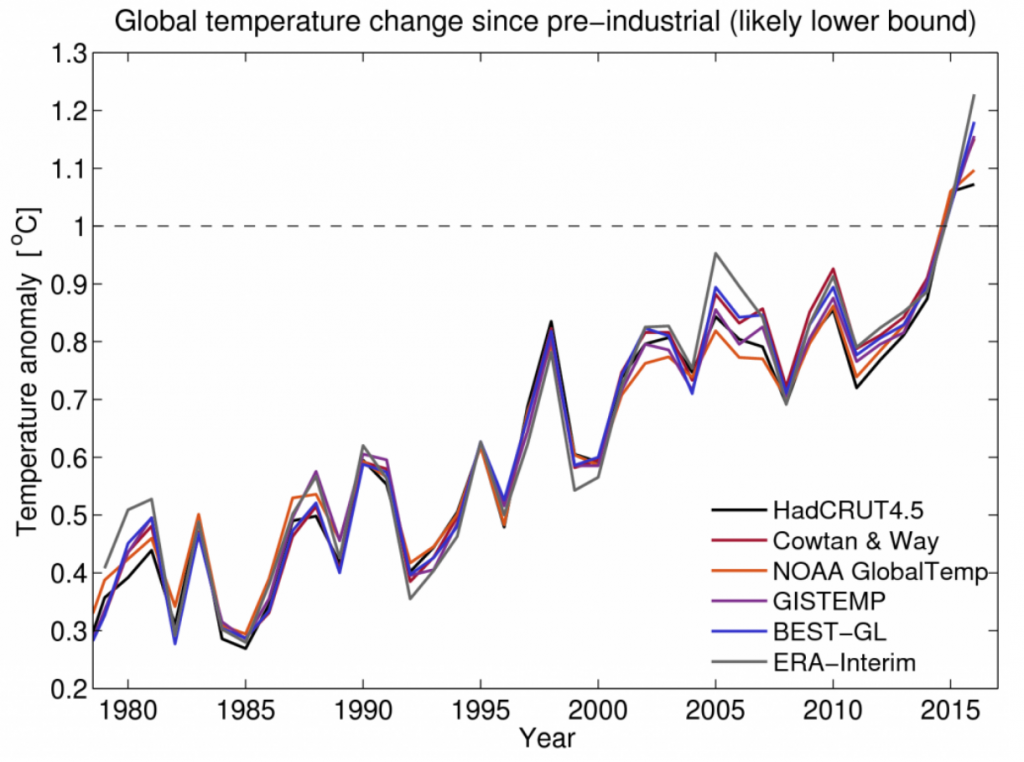
This is a cross-post from the Climate Lab Book blog, written by Dr Ed Hawkins, associate professor in the Department of Meteorology at the University of Reading.The UN Paris Agreement on climate change aims to ensure increases in global temperature are less than 2C above pre-industrial levels, with an aspirational limit of 1.5C. However, the starting line of the “pre-industrial” era is not defined by the UN agreements, or by the Intergovernmental Panel on Climate Change (IPCC).A new analysis by an international team of researchers aims to better define the pre-industrial baseline, informing the world’s decision makers on the required limits to greenhouse gas emissions needed to meet the terms of the Paris Agreement.The study concludes that 2015 was likely the first time in recorded history that global temperatures were more than 1C above pre-industrial levels.§ Which period is ‘pre-industrial’?
We suggest that the earlier period of 1720-1800 is a better choice for this baseline. This is because the major natural factors that also affect Earth’s climate – the levels of both solar and volcanic activity – were both at similar levels to today (see Figure 1).
§ What does this mean for the Paris agreement?
There is also more to learn. We need volunteers to help rescue additional observations of climate from various undigitised sources to better understand the climate of the 19th century. Collection of additional palaeoclimate data for the 1720-1800 period may also help constrain estimates of warming since the pre-industrial era.Article information
This guest article is based on the following paper: Hawkins, E. et al. (2017) Estimating changes in global temperatures since the pre-industrial period, Bulletin of the American Meteorological Society, doi:10.1175/BAMS-D-16-0007.1