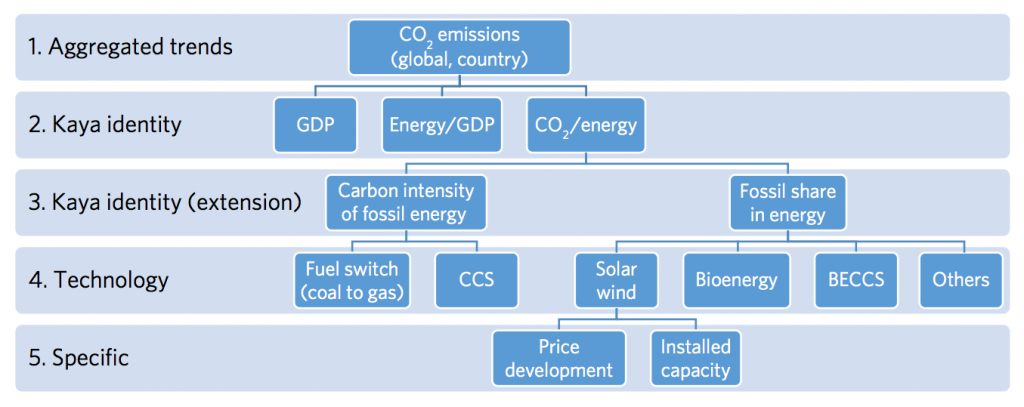
Our energy systems appear to be changing in ways that are broadly on track with limiting global temperature rise to 2C, a new study says, but will soon lose ground without rapid deployment of new technologies.In the study, just published in Nature Climate Change, researchers measure the collective progress towards the goals of the Paris Agreement.There is a mix of good and bad news, the researchers find, with some particular successes – such as the “extraordinary growth rates” of wind and solar in recent years.But the continued lack of investment in carbon carbon and storage (CCS) technologies puts the 2C limit in doubt, the researchers say.Without CCS, we will either have to cut back on fossil fuels even more quickly to meet 2C, or “accept that 2C is not possible”, the lead author tells Carbon Brief.
“The success of the Paris Agreement is built upon emission pledges submitted by countries, but at this stage there is no agreed method to track progress towards them, and ultimately towards the goals of the Paris Agreement.”
“The slowdown in China is primarily driven by economic factors, particularly a softening of construction activity and exports, and this in turn leads to reduced coal consumption. It is likely that policies on air pollution and renewables played a role in the reduced coal consumption, but not a dominant role.”
“Much of the slowdown is due to power stations running less of the time, which means it is easy for emission growth to return if coal demand increases again.”
Using this approach, the study reveals some insights into how emissions have changed.Globally, the rate of CO2 emissions has broadly been stable . This means we’re still adding CO2 to the atmosphere, but we’re not doing it faster than we were a couple of years ago.This plateau in the rate of emissions has come much earlier than expected, Peters says, and the main cause is :Elsewhere, the paper picks out several other factors that have contributed to a levelling-off of the rate of global emissions in recent years. These include a shift from coal towards gas in the US, rapid expansion of renewables in the EU, and slower GDP growth in the US, EU and China.While this is good news, says Peters, without locking in this stabilisation with tighter climate policies, there is a risk of a relapse. This is particularly true in China, Peters notes:Overall, the paper says there “appears to be an emerging trend of declining carbon intensity” of energy, which is consistent with scenarios that keep temperature rise to 2C. This means that, on average, the amount of CO2 released per unit of energy we generate is falling – albeit slowly.
Carbon Capture and Storage: Where factories or power stations use technology to capture some of their CO2 and store it underground, reducing emissions.
Carbon Capture and Storage: Where factories or power stations use technology to capture some of their CO2 and store it underground, reducing emissions. Read More
“It remains clear that the coming 5 to 10 years will be critical to indicate whether we actually and durably made the turn towards a low-carbon transition or not.”
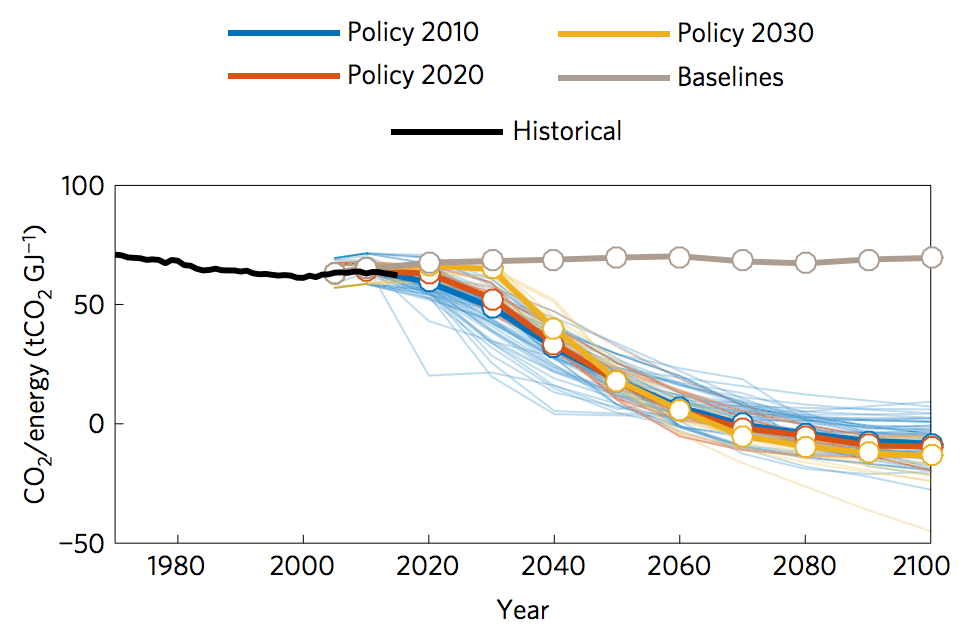
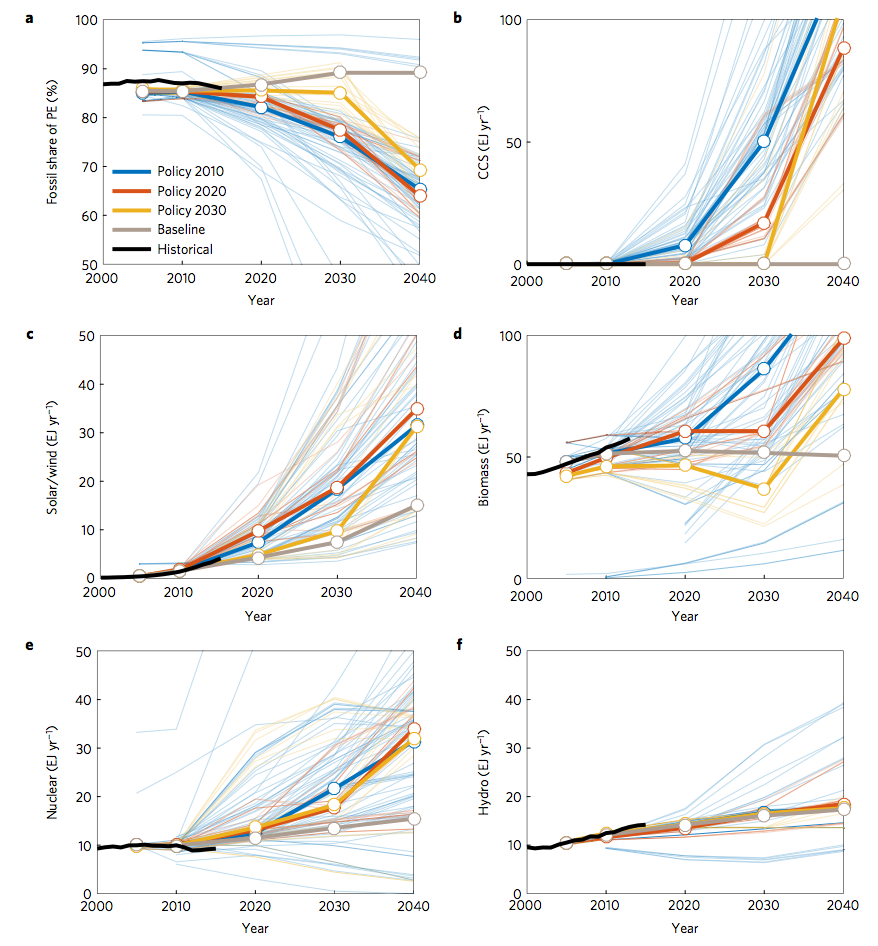
Looking ahead, the study compares current progress against different emissions scenarios that keep temperatures below the 2C limit. These scenarios are grouped into when they start (2010, 2020 or 2030).The scenarios show that the route to significant cuts in global emissions is through “deep and sustained” reductions in the carbon intensity of energy, the paper says.As you can see in the chart below, to keep up with the 2C scenarios (blue, red and yellow lines), the carbon intensity of energy (black line) needs to drop steeply over the first half of this century. The grey line shows a baseline scenario without climate policies.Matching this steep decline depends on various factors, the paper says, such as reducing the share of energy that is generated from fossil fuels, ramping up the use of renewables, and deploying carbon capture and storage technologies (CCS).Overall, many of the current trends for these factors are “broadly consistent” with what is needed to keep temperature rise to no more than 2C, the study says.In the charts below, you can see how recent usage of different energy sources (black lines) are tracking against the 2C scenarios for the near future (coloured lines).Wind and solar, biomass and hydro are currently matching well with the 2C scenarios, the paper finds. Wind and solar in particular has shown “extraordinary growth” in recent years, it says, but “greatly accelerated expansion” will be needed in the coming decades to keep up with the scenarios.Meanwhile, nuclear power is lagging behind, says Peters, and may well stay that way:The findings show how crucial the next decade is for halting emissions growth, says a research scholar at the International Institute for Applied Systems Analysis () in Austria, who wasn’t involved in the study. He tells Carbon Brief:
“There is a clear divergence from current trends and the scenarios. Most scenarios require thousands of CCS facilities by 2030, but there are only tens currently proposed.”
“These pathways may include greater improvements in energy efficiency, more wind, solar, nuclear, or other low carbon energy sources, or technological breakthroughs we currently do not know about.”
Article information
Peters, G. P. et al. (2017) Key indicators to track current progress and future ambition of the Paris Agreement, Nature Climate Change, doi:10.1038/nclimate3202
Despite the positive findings, there is one area in particular that isn’t close to keeping pace with the 2C scenarios: CCS.The lack of development and deployment of CCS schemes remains the biggest challenge for meeting the 2C limit, Peters says:You can see this is chart (b) in the last figure.Without CCS, we either “need to look at alternative pathways to 2C” or “we have to accept that 2C is not possible,” says Peters:To address this lack of focus on CCS, the paper says “a globally-coordinated effort is needed to accelerate progress, better understand the technological risks, and address social acceptability.”