Rate of ocean warming quadrupled since late 20th century, study reveals
The buildup of heat-trapping greenhouse gases is warming the upper ocean four times faster than during the period 1960-1990, according to new research.The paper, published today in the journal Science Advances, is the latest effort to piece together current and historical measurements from ships, self-propelled floats, satellites and even seals to get a global picture of how the oceans are faring under rising temperatures.Since the 1990s, more heat is finding its way to the deep ocean and there has been no change of pace in ocean warming since 1998, compared with the previous decade, the paper notes.The study marks a step forward, but the authors say they are concerned about the future of ocean science, given the political climate in the US. Dr John Abraham, professor of thermal sciences at the University of St Thomas in Minnesota and co-author on the paper, tells Carbon Brief:“We are seeing dramatic cuts planned for climate science. There is every reason to expect these cuts will include ocean-sensing systems.”
§ Big role to play
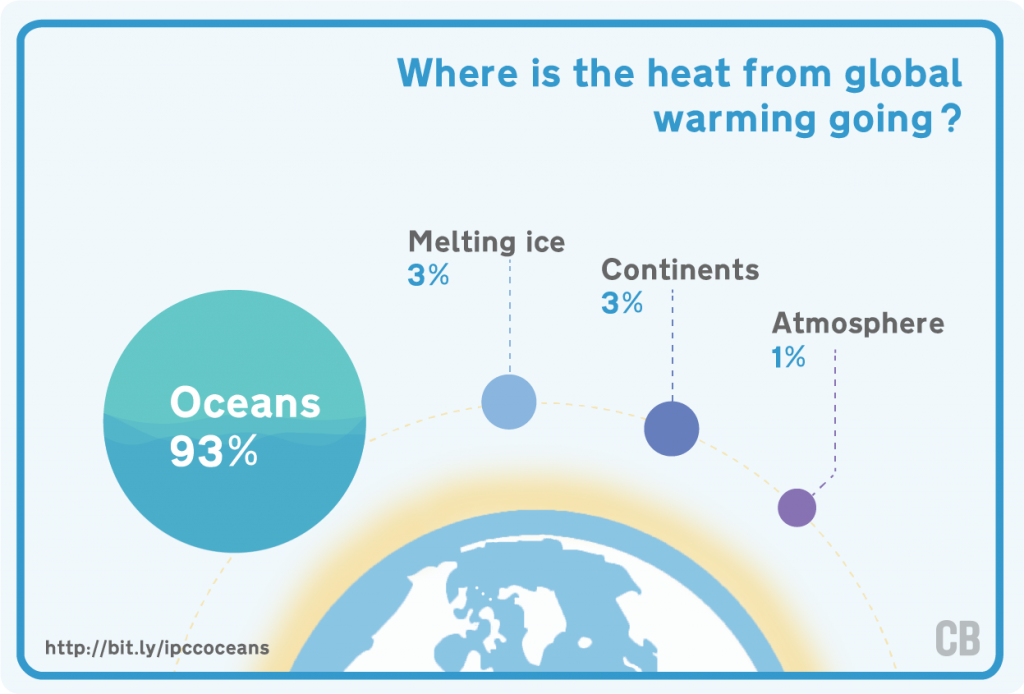
“If you want to know about global warming, you really have to understand ocean warming.”
§ Completing the picture
“Measuring the oceans is challenging because you need enough sensors, in enough locations, for a long enough time to get a picture of the climate.”
World Ocean Circulation Experimentstepped up a gearARGO floatstop 2,000m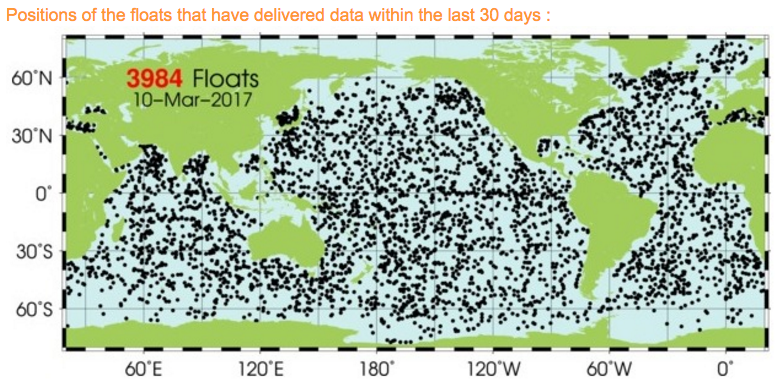
“Our study offers a new method to solve these problems.”
Prof Kevin TrenberthUS National Center for Atmospheric Research“It has been amazing how much we have been able to recover in terms of information about ocean heat content from sparse past data.”
§ Warming signal
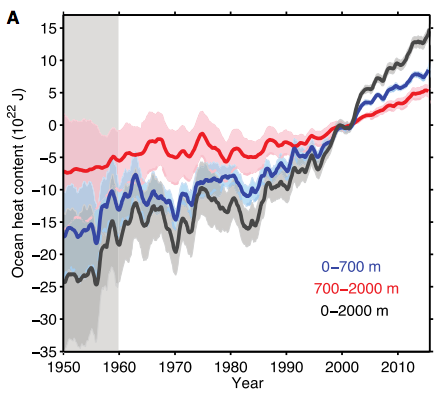
latest reportDr Matt Palmer“The paper represents an important refinement to our estimates of ocean heat content change…While the study does not alter our basic understanding, it does suggest that IPCC AR5 reported rates of ocean warming were underestimated by about 10-15%.”
§ No slowdown
slowed“Our studies show that there has been no slowdown in global ocean heat content change since 1998 compared with the previous decade.”
“Since ocean heat content continued to increase at a time when the rate of global surface temperature rise slowed down, we can infer that a large part of the “slowdown” must have originated from ocean heat re-arrangement.”
All ocean basins experienced significant warming since 1998, with the greatest warming in the southern oceans, the tropical/subtropical Pacific Ocean, and the tropical/subtropical Atlantic Ocean. As the paper puts it:“The Atlantic Ocean and the southern oceans are the major new heat reservoirs (59%) even though their total area is just 48% that of the global ocean.”
Overall, about 32% of the extra heat absorbed by the ocean between 1960 and 2005 found its way to the deep ocean. Over the past decade, however, this proportion jumped to 49%, indicating that the deep ocean is playing an increasingly important role in ocean warming.§ Mystery explained
satellite-based reconstruction“missing heat”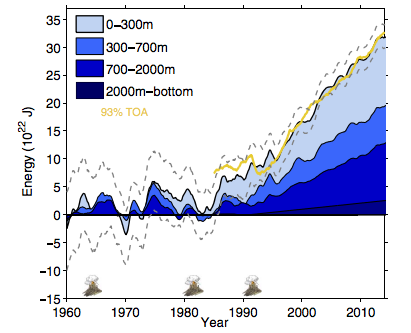
§ ‘A travesty’
“I am not confident that we will have continued coverage. The current system uses state-of-the-art sensors that are spread out across the oceans…It is not clear that there will be continued funding for this absolutely crucial system in the current political climate in the US.”
The Oceanic and Atmospheric Research (OAR) programme at the National Oceanic and Atmospheric Administration (NOAA) is in line for a 26% cut, and ocean observation and ARGO come out of that budget, Trenbeth tells Carbon Brief. What’s more, many other countries provide their contributions as a percentage of the NOAA contribution, he adds:“If NOAA cuts back so do others – and it all goes downhill…Argo is still a research enterprise, not an operational one. It is vulnerable. Such a cutback would be a travesty.”
Article information
Source: Cheng, L. et al., (2017) Improved estimates of ocean heat content from 1960 to 2015. Science Advances. e1601545