Antarctica’s high elevation is slowing rate of warming, says study
Temperatures in the Arctic are increasing around three times as fast as the global average, yet the pace of warming has been much slower at Earth’s other pole.A new study, just published in Earth System Dynamics, suggests the difference might – in part – be down to the great heights of Antarctica’s land surface.The soaring mountain ranges and thick ice sheets put Antarctica’s average elevation at more than two kilometres above sea level. In contrast, the Arctic is predominantly ocean, covered by sea ice a few metres thick.This extra height inhibits the flow of warm air coming up from lower latitudes, the study says, and it accounts for around half of the difference in the pace of warming between the Arctic and Antarctic.The results suggest that warming in the Antarctic could speed up in the centuries to come as the ice sheets flatten out as they melt.§ ‘Important piece of the puzzle’
is instead absorbed by the ocean0.6C per decadeArctic amplification0.12C per decademainly driven byOther researchDr Marc SalzmannUniversity of Leipzig§ Surface height
stay above 400ppm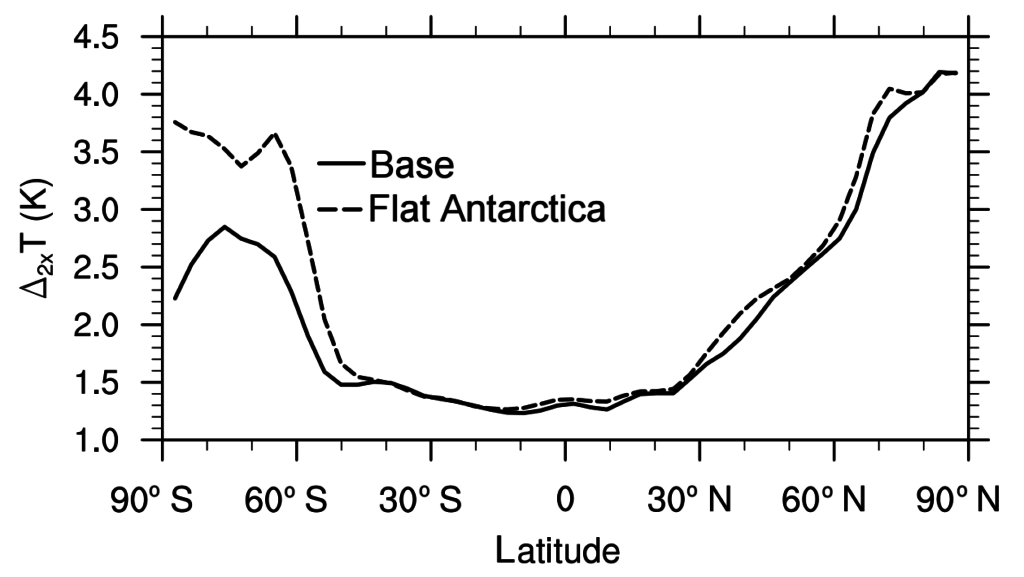
§ Heat transport
“The massive ice sheet and the mountains below prevent atmospheric heat transport [from lower latitudes]. A part of the space that would otherwise be filled by the atmosphere is taken up by the ice sheet and also by the mountains below the ice sheet.”
European Geosciences Union§ ‘More prone to melting’
“In the long run, a successive lowering of the altitude of the ice sheet makes Antarctica more prone to melting.”
Article information
Salzmann, M. (2017) The polar amplification asymmetry: Role of antarctic surface height, Earth Systems Dynamics,doi:10.5194/esd-8-323-2017