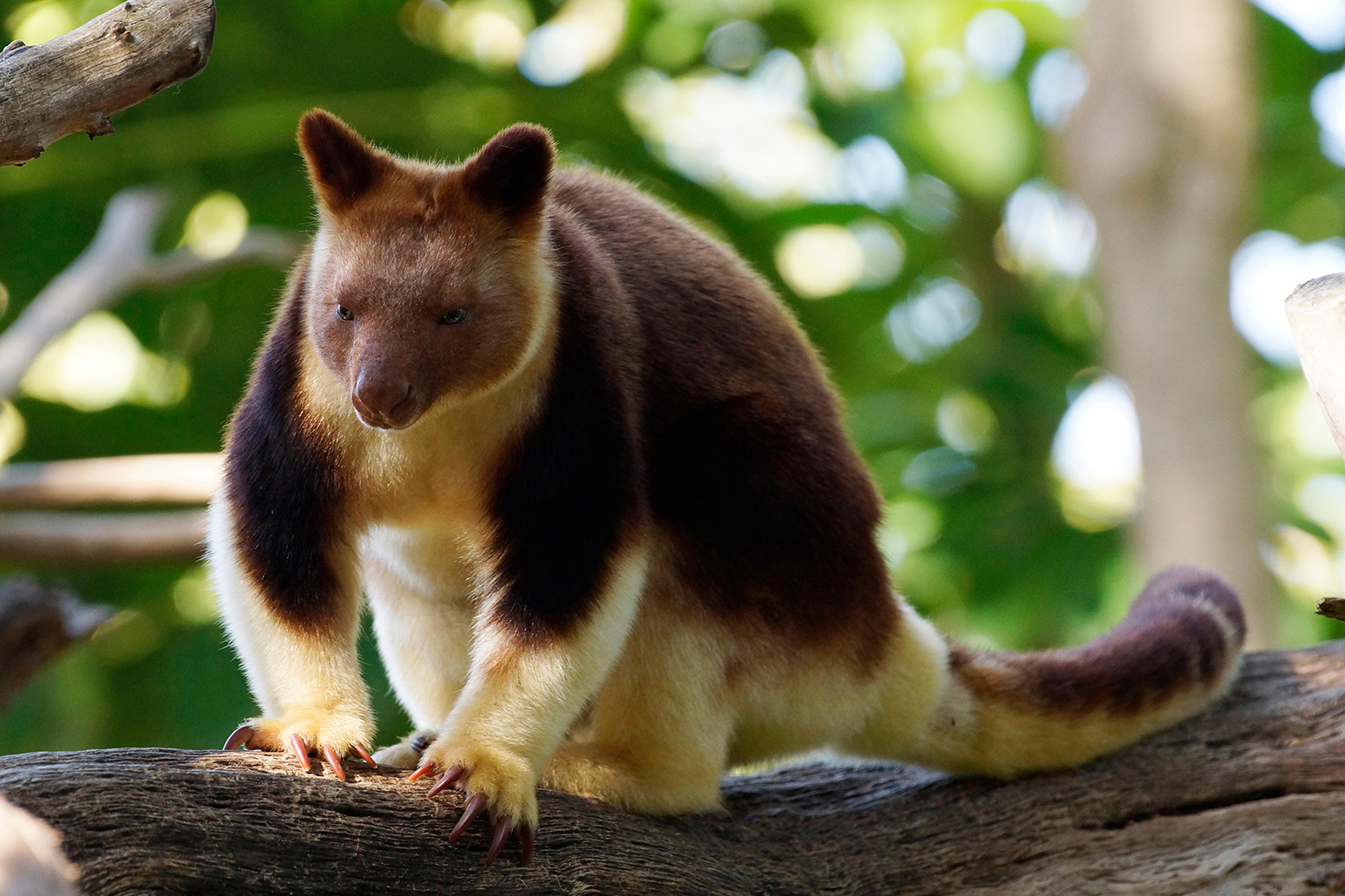
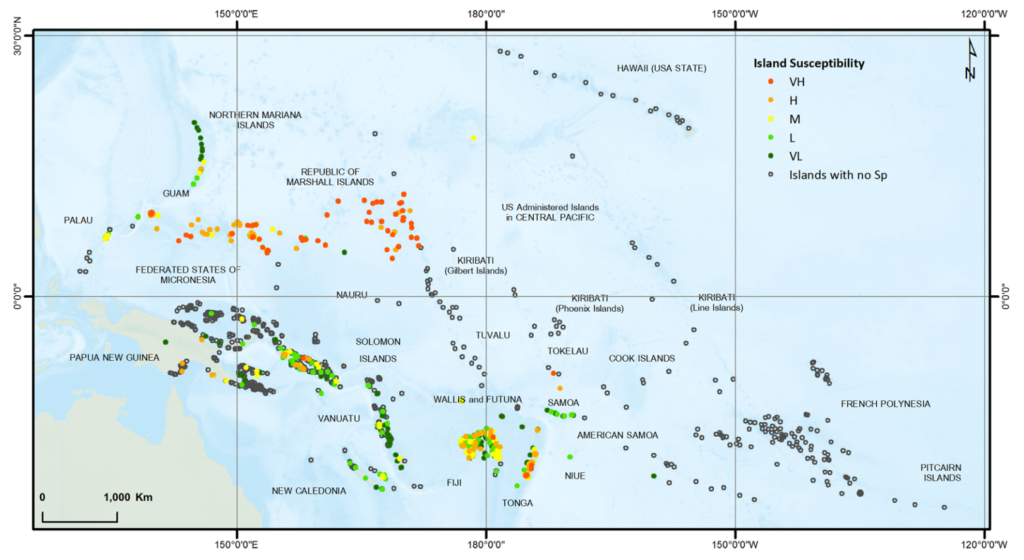
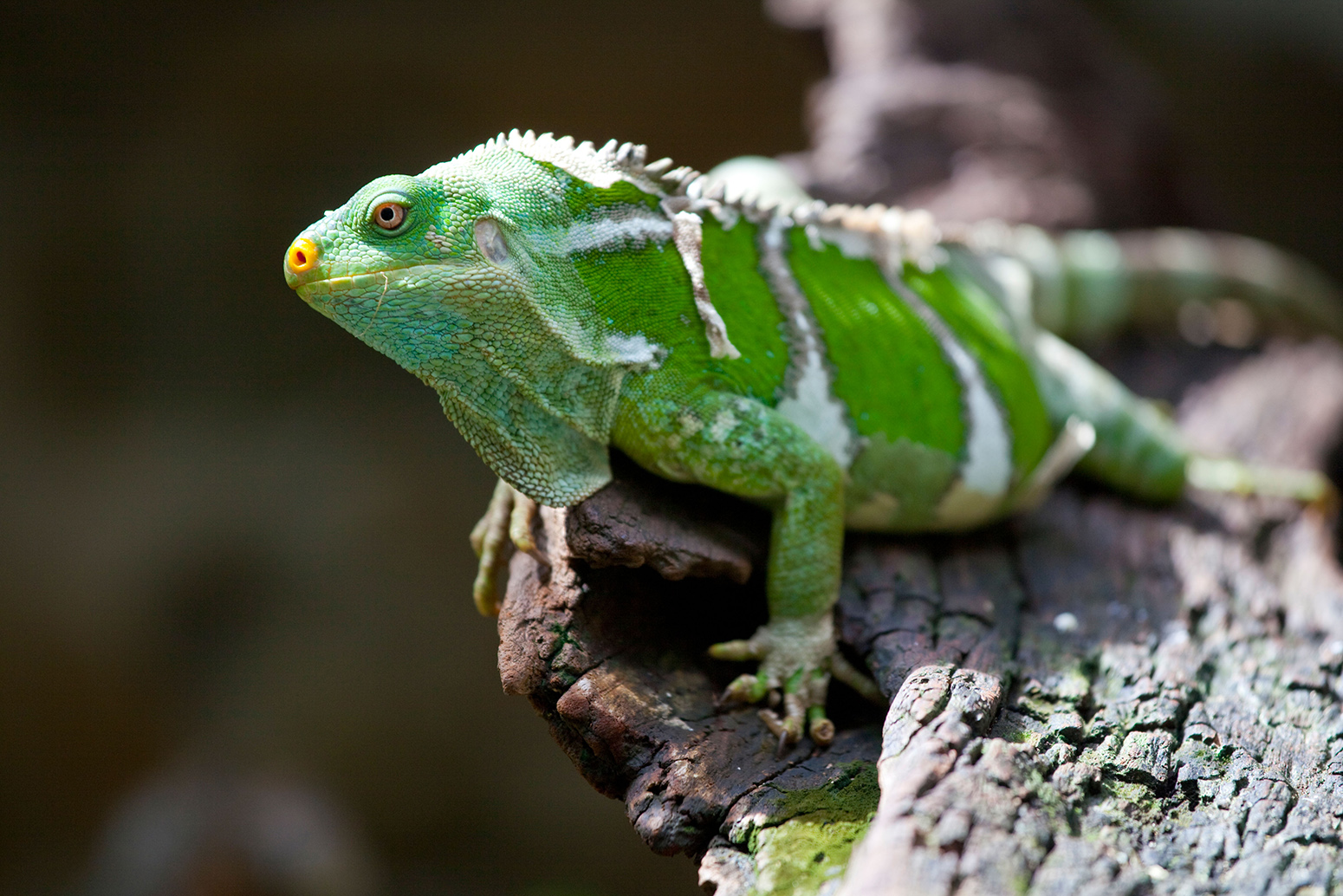
International Union for Conservation of NatureRed List of Threatened SpeciesImage - Goodfellow’s Tree Kangaroo (Dendrolagus goodfellowi). Credit: Minden Pictures / Alamy Stock Photo. - H81NKE Goodfellow's Tree Kangaroo (Dendrolagus goodfellowi), Australia. (note)The new study focuses on a stretch of the southern Pacific Ocean from Palau in the west to the Pitcairn Islands in the east. Within this 85m square kilometre (sq km) area are more than 2,000 islands.These islands come in all shapes and sizes – most are volcanic or reefs – but they are predominantly small and low-lying. Their average size is just 1.3 sq km – some are just a tenth of that size – and 42% of them have a maximum elevation of less than 10m.These characteristics put the islands – and the species that live on them – at particular risk from sea level rise, storms and high waves, the study says.On small islands, land-based creatures have fewer places to move to when their habitats are lost. In addition, through evolution, many island-living species no longer have the traits that would have helped them move on – for example, many birds and insects have lost their ability to fly.Putting all these factors together, species living on these Pacific islands are “highly vulnerable to extinction”, the paper says.Indeed, the 1,779 islands assessed in the study area are home to 150 amphibians, mammals and reptiles that feature on the ’s (ICUN) . Fifty-one of these species are classed as “Vulnerable”, 61 as “Endangered” and 38 in the most at-risk category of “Critically Endangered”.Eighty-four of the 150 species aren’t found anywhere else on Earth. Fifty-four of them – such as the Giant Bandicoot, the Goodfellow’s tree-kangaroo and the Taom Striped Gecko – can only be found on a single island. Eleven species live on two islands and the remaining 29 live on three or more.
“Islands that are of sandy/coral origin, that have low elevations, that are small in size and those that are thin and long are the most susceptible to climate change. Of course, there are other factors, such as where they are located – tropical cyclone paths, significant wave heights, etc – that will also impact the susceptibility.”
RCP8.5: The RCPs (Representative Concentration Pathways) are scenarios of future concentrations of greenhouse gases and other forcings. RCP8.5 is a scenario of “comparatively high greenhouse gas emissions“ brought about by rapid population growth, high energy demand, fossil fuel dominance and an absence of climate change policies. This “business as usual” scenario is the highest of the four RCPs and sees atmospheric CO2 rise to around 935ppm by 2100, equivalent to 1,370ppm once other forcings are included (in CO2e). The likely range of global temperatures by 2100 for RCP8.5 is 4.0-6.1C above pre-industrial levels.
RCP8.5: The RCPs (Representative Concentration Pathways) are scenarios of future concentrations of greenhouse gases and other forcings. RCP8.5 is a scenario of “comparatively high greenhouse gas emissions“ brought about by rapid population growth,… Read More
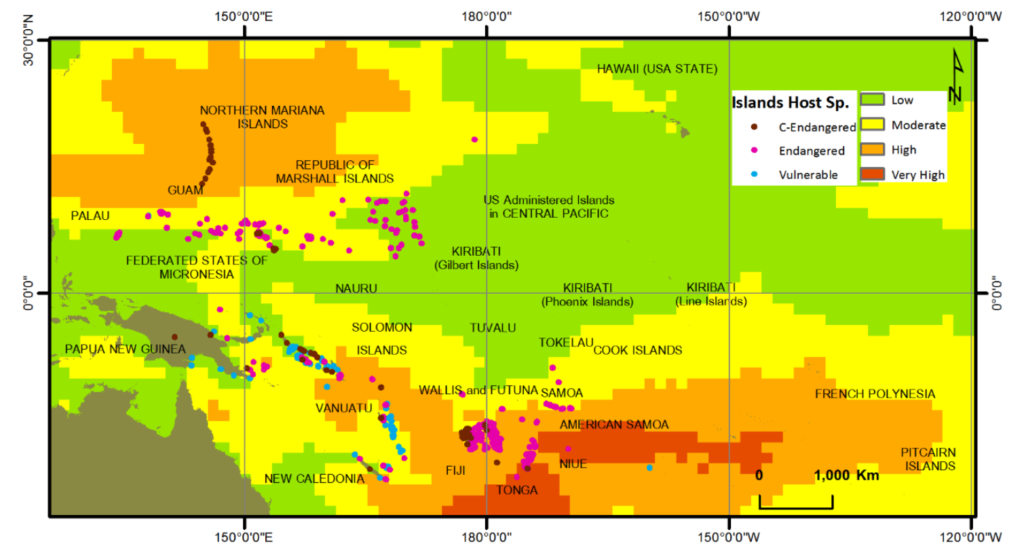
“The Northern Mariana Islands, islands in Fiji, Tonga and New Caledonia host most of the critically endangered species, and Fiji, Tonga and the Northern Mariana Islands all fall in the high and very high categories under RCP 8.5 projections.”
“These species are only found in this region of the world and so deserve extra attention since a loss of any of these species will mean global extinction.”
“We will need to accelerate our knowledge of the world’s natural history as rapidly as climate change advances or we risk losing it entirely.”
Update 14 July: Comments added from Dr Mark Urban.
Article information
Kumar, L. and Tehrany, M. S. (2017) Climate change impacts on the threatened terrestrial vertebrates of the Pacific Islands, Scientific Reports, doi:10.1038/s41598-017-05034-4
Using climate model projections of sea level rise and wave heights, the researchers mapped the regional risks of the islands being inundated with seawater. Local variations in wind patterns, ocean currents and sea surface temperatures mean that sea level change won’t be the same across the region.The map below shows the regional sea level risks under a climate change scenario where global CO2 emissions aren’t curbed (). The risk is categorised according to the maximum sea level for any month during the average year at the end of the century (against a baseline of 1986-2005).The coloured circles show the islands that host threatened species. The background shading indicates the risk from rising seas, from low (green) to very high (red).The map highlights that some of the islands that are home to critically endangered species are at high risk from rising seas, the paper says:Combining the susceptibility of the island with the risk from sea level rise, the study finds that the islands of Micronesia, Tonga, Tokelau and the Marshall Islands are the riskiest place for species to live. These islands are not home to any “critically endangered” species, but they are for many “endangered” species.The study concludes that many of these species may need to be reclassified as critically endangered. If they are lost from these islands, they will be lost to the world, warns Kumar:These sorts of studies that help identify species under threat from climate change are crucial to directing limited conservation money to where it is needed most, says , associate professor in the Department of Ecology and Evolutionary Biology at the , who wasn’t involved in the study.But research methods also need to take into account the and the threats they face, he tells Carbon Brief: