Global warming could cause yield of sorghum crops to drop ‘substantially’
Rising global temperatures could cause yields of sorghum – a cereal crop known for its resilience to heat stress and drought – to fall substantially, new research finds.Sorghum is the fifth most economically important cereal in the world and is grown in some of the most arid parts of Africa and South Asia, where it is a staple food for half a billion people.The new research finds that for every degree of warming above a 1985-2014 average, sorghum crop yields could drop by around 10%. This suggests the hardy cereal may be more vulnerable to heat stress caused by climate change than previously thought, the authors tell Carbon Brief.However, the indirect impacts of temperature might actually be a larger driver of future sorghum yield declines, another scientist tells Carbon Brief. It is likely that environmental factors, such as humidity, will have significant role in crop productivity, he says.§ Why is sorghum so hardy?
UN Food and Agriculture Organisationaround 8,000 years agosuggestedProceedings of the National Academy of SciencesDr Jesse TackDr Krishna JagadishKansas State University“We studied 30 years of sorghum production in Kansas and found that the crop is vulnerable to additional heat stress should average temperatures rise. Our results indicate that climatic change will likely produce an average yield loss of 10% for each degree Celsius of warming.”
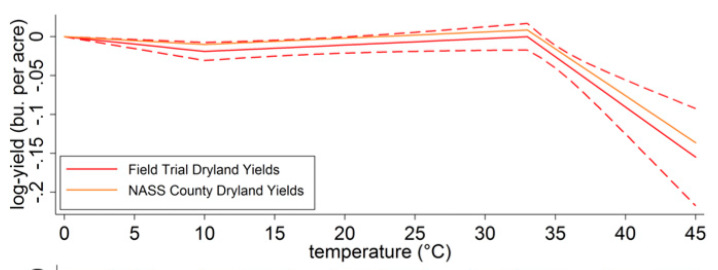
§ Growing problems
The chart below shows the projected drop in yield for each degree of temperature rise above a 1985-2014 average. So, for example, 2C of warming (roughly equivalent to 2.6C above pre-industrial) could cause sorghum crop yields to drop by 17%. Losses increase to 57% for the highest scenario of 5C.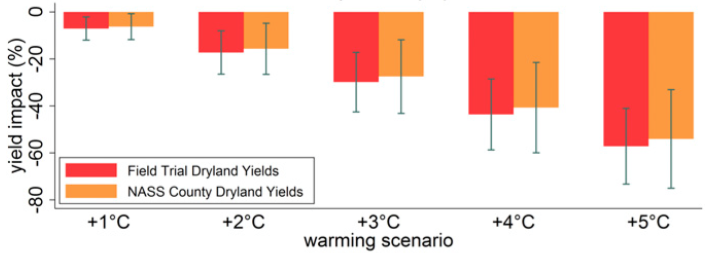
“We show that pre-flowering [when reproductive parts are developed] and post flowering stages [when seeds are produced] to be equally impacted by stress. We can do this because we observe planting and flowering dates for every single observation, another valuable aspect of our data.”
Prof Graeme HammerUniversity of Queenslandresearchincreases in VPD“While I do not doubt the ultimate importance of tolerance to direct effects of high temperature, this is a consequence of “shock effects” of high temperature at specific development stages. The gradual effects of “heat stress” reside in consequences they bring on the dynamic of crop growth and development over the season.”
§ Finding a solution
US corn beltwhere sorghum is a staple food“Our particular focus was on the potential to adapt using currently available seed varieties. We find limited scope in this regard. However, breeding programmes can likely introduce new genetic material from sorghum plants existing in nature in order to boost heat resilience.”
“Some attention to adaptation of phenology (time to flowering) of cultivars [plant breeds] and adjustment of crop management (to deal with changes in water balance) would likely moderate much of the effect observed.”
Article information
Tack, J., Lingenfelser, J. and Jagadish, K. (2017) Disaggregating sorghum yield reductions under warming scenarios exposes narrow genetic diversity in US breeding programs, Proceedings of the National Academy of Sciences, http://dx.doi.org/10.1073/pnas.1706383114