The UK could soon see its first use of hydraulic fracturing since 2011.The controversial technique for extracting shale gas and oil, known as fracking, is set to be used by the end of this year at a site in Fylde, Lancashire, owned by UK company Cuadrilla. The firm says it started drilling on 17 August.(Update 12/10/2018: Fracking firm Cuadrilla confirmed today the first fracking in the UK for seven years will start on Saturday 13th October 2018. The announcement came after campaigners lost a legal challenge for an injunction against the operations.)But how close is the UK to shale gas production on a large scale? And what would the carbon impacts of this be?Carbon Brief breaks down the key climate questions facing fracking in the UK.
tremorsinvolvesusedadvances in horizontal drillingattentiongrantedlikelyearly Julyvast majoritynot expectedapprovalsexpectedenergy dominanceYes, but not since two near Blackpool were caused by Cuadrilla’s fracking operations at its Preese Hall site in 2011.Fracking pumping water mixed with chemicals at high pressure into a well, in order to fracture the surrounding rock and let oil or gas escape. It has been in the oil industry since the mid-20th century.However, the technique has only recently become widespread in onshore gas extraction, after allowed it to be applied to shale resources.The process began attracting in the UK when the government the first onshore exploratory licences for shale gas in 2008.After the Blackpool tremors were identified in late 2011 as to have been caused by fracking, the UK’s then-Department of Energy and Climate Change (DECC) put a moratorium on the practise, until it was better understood.This was lifted a year later by then-energy secretary Ed Davey, who said exploratory fracking for shale gas could resume, subject to new controls to minimise seismic risks.The UK already uses small quantities of shale gas and oil. Anglo-Swiss firm Ineos began importing US shale ethane in September last year, for use in the chemical industry. The Isle of Grain terminal on the Thames estuary took the UK’s first delivery of liquefied natural gas (LNG) from US shale in .However, the North Sea still produces the of UK gas supplies. The UK is to be able to compete for US LNG with Asian markets, where prices are higher.US LNG exports are growing, following a string of granted by the Obama administration. As a result, the US is to become a net exporter of gas later this year. Increasing fossil fuel exports is part of US president Donald Trump’s plan to achieve what he calls ““.
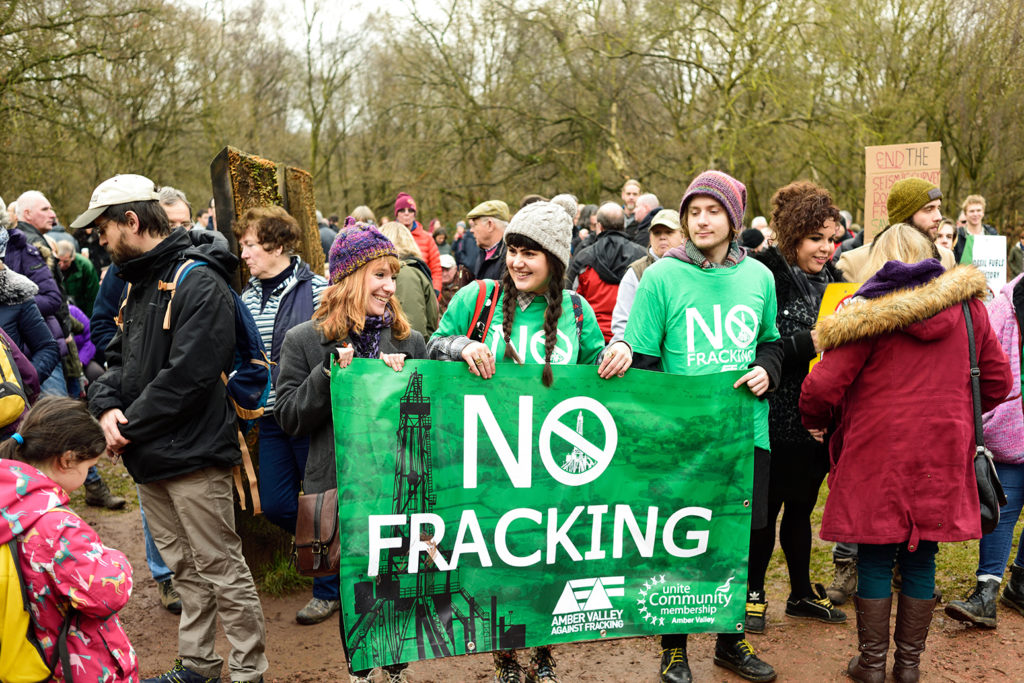
todayOctober 2016local councillors’ rejectionbrought on siteongoing protestanti-fracking protestersvandalisedbreachedfailedCuadrilla expects to conduct exploratory fracking later this year at its Preston New Road site in Lancashire, the firm tells Carbon Brief.(Update 12/10/2018: Cuadrilla said it plans to begin its first fracking on Saturday 13th October 2018, after campaigners lost a legal challenge for an injunction against the operations.)Planning consent for Cuadrilla to explore for shale gas at the site using fracking was granted by the government in , when it overruled .Cuadrilla started work at the site in January, with the main drilling rig at the end of July. A spokeswoman for the firm tells Carbon Brief it plans to begin drilling horizontal wells into shale rock this month, with fracking beginning towards the end of the year.However, the spokeswoman adds that Cuadrilla is unsure how long the process will take, since this is the first time horizontal wells have been drilled into the UK’s shale rock. (The Preese Hall site only had a vertical well). It, therefore, cannot say exactly when the first fracking will take place, she says.Cuadrilla had originally planned to begin fracking by the third quarter of this year. An at the site may be delaying development. Since January, have maintained a continuous presence outside the site.A drilling rig owned by the firm was last month at a facility near Chesterfield, where it was being stored, while Cuadrilla recently its planning permission by delivering a drilling rig overnight, apparently to evade the protestors.If Cuadrilla does use fracking at the site, it would be the first time in the UK since the 2011 moratorium was put in place.Cuadrilla also has an application for exploratory fracking at a second Lancashire site, Roseacre Wood. A public inquiry on the application is set to take place in April 2018, after a legal challenge by protesters to stop it going ahead.It’s worth emphasising that Cuadrilla’s projects are at the exploratory stage and are not yet producing shale gas. However, Cuadrilla’s spokeswoman tells Carbon Brief that gas from its site will be “fuelling Lancashire homes and businesses mid next year”. This statement is based on Cuadrilla already having planning consent for an extended flow test, that would send small quantities of gas into the grid. Again, this would fall short of full-scale production.
(Update 10/1/2018: West Sussex county council’s planning committee yesterday voted unanimously to approve an application by Cuadrilla to explore for oil near Balcombe. The decision comes despite more than 2,700 objections being received against the proposal, with 11 in favour. It does not give Cuadrilla permission for fracking, which would require further consents.)
Julylast monthEnvironment AgencyOil and Gas Authority (OGA)At least five other firms are planning to explore for shale gas in the UK. The interactive map below shows where they hope to operate. (Zoom in/out and mouse over or click on the dots for more information.)Note that fracking is not necessarily set be used at all the sites shown on the map. Cuadrilla has said it will not need to carry out fracking at its oil exploration well at Balcombe, for example, since the rock is already naturally fractured. (It also says it has no current plans to continue exploration at this site, having decided to focus on shale gas extraction in Lancashire.)(Update 24/8/2017: Note however that in a correspondence published this month in the journal , researchers David Smythe and Stuart Haszeldine warn fracking of unconventional oil and gas formations could risk being classed as conventional hydrocarbon exploration, pointing to exploration in the Weald Basin, which Balcombe is situated within. “This results from the government using legally binding definitions of unconventional oil and gas (UOG) resources and of high-volume hydraulic fracturing (HVHF, or fracking) that have little rational or scientific basis,” they write.)The map includes Cuadrilla’s Preston New Road and Roseacre Wood sites in Lancashire, the only ones for which the firm is currently seeking permission to carry out fracking.Also of note are three sites near Sheffield, licenced to Ineos Shale, a UK-based subsidiary of Anglo-Swiss chemical giant Ineos, which aims to drill test wells to assess the suitability of the sites for extracting shale gas. In , Ineos Shale won a broad pre-emptive injunction that will put protesters in contempt of court if they obstruct its shale operations.Meanwhile, Third Energy submitted its final plans to start fracking for shale gas at its Kirby Misperton site in North Yorkshire. It was granted planning permission for the site in May 2016.This plan still needs to undergo a technical assessment from the and requires approval from the government’s . A spokesman for Third Energy tells Carbon Brief it hopes to begin fracking this year.
saysoften argue3tcf of gasEnergy Information Administration2010 BGS estimateResearch Energy Contract Company (ECC)estimatedreserve estimatesPOSTThe British Geological Survey (BGS) says the UK has large amounts of shale hydrocarbons below its surface. However, the precise distribution is not yet well known and there remains significant uncertainty over how much is extractable.The BGS has how much shale resources there are in several areas of the UK (see video below). Its central estimates for these are:Two things are worth emphasising here. First, these are central, fairly rough estimates. The BGS’s range for the Bowland-Hodder shale, for example, is a lower limit of 822tcf and upper limit of 2281tcf.Most importantly, though, these are calculations of the total resources of shale. Only a fraction of this will be commercially extractable reserves, depending on the cost of UK operations and the international market price of gas.The BGS it is too early to know what proportion of UK shale resources are recoverable, although it says US recovery factors are typically around 10%. Note that shale firms they need to begin drilling before they can understand how much of the UK’s shale gas is extractable.The UK uses around each year. Assuming a 10% recovery rate and the BGS’s central estimates, the UK has 138tcf, or around 46 years worth of technically extractable shale gas.It’s worth noting a 2013 assessment by the US (EIA) estimated a far lower technically recoverable resource in the UK of 26tcf, equivalent to nine years of current UK gas use.A for the Department of Energy and Climate Change (DECC) put the “total recoverable reserve potential” in the UK even lower, at just 5.3tcf. This is less than two years of use. by UK-based commercial oil and gas consultancy the, published in 2012, put technically recoverable shale gas far higher than this, at 40tcf, around 13 years worth.Meanwhile, in 2013 the Parliamentary Office of Science and Technology (POST) a potentially recoverable resource of 64-459tcf in the Bowland shale formation alone. This figure is based on a range of recovery rates of 8-20%.There are currently no official . As observes, UK reserves could be anywhere from “zero” to “substantial”. It says: “To determine reliable estimates of shale gas reserves, flow rates must be analysed for a number of shale gas wells over a couple of years.”
“Subject to planning permission, relevant scrutiny and other permits, a proposal for shale exploration could progress on any extant onshore licence, not just ones issued in the 13th or 14th rounds when the potential was first identified.”
Shale oil and gas study areas. Areas which have been surveyed by the British Geological Survey (BGS), a public sector research body, to see if they might contain extractable shale hydrocarbons. These are the main areas that could be used to produce shale oil or gas in the UK, according to the BGS. There are other minor areas that it has not yet studied.
Shale prospective areas Areas of shale rock that the BGS has identified as containing potentially extractable shale gas or oil.
Current oil and gas licences All ongoing licences in the UK for onshore oil and gas extraction, including conventional and non-conventional resources, such as shale. Licenses specifically related to shale resources were first awarded in 2008 and 2015, during the government’s 13th and 14th licensing rounds.
Oil and gas licences awarded in 2015 Blocks awarded in the government’s 14th licensing round, which launched in 2014. This was the most recent offer of onshore oil and gas licences and only the second to explicitly include shale resources.
Total area made available for licence in 2014 All areas opened for bidding in the 14th licensing round. This covers approximately two fifths of the UK.
“Operators may explore for shale gas and also a conventional source of hydrocarbon under the same license. In some parts of the country, shale targets may underlie conventional hydrocarbon reservoirs; as such, it’s not possible to put a figure on how many licenses are for shale versus conventional oil and gas.”
There are 137 ongoing oil and gas licences in UK government licensing rounds. The most recent, the 14th onshore licensing round, was in 2014, the first since 2008. This resulted in another 93 licences being to 22 successful applicants in 2015.It’s worth noting that these do not give permission for operations, but rather grant exclusivity to licensees for exploration and extraction of any hydrocarbon, including for shale gas and oil within the area.A spokesperson for the government’s Oil and Gas Authority (OGA), tells Carbon Brief:However, 63 of the 93 licences granted in 2015 are in areas of potential shale exploration, according to investigative website .The video below shows the areas of shale gas and oil potential in the UK, based on maps from the OGA.Which parts of the UK are open to fracking? (Update: Note that the Scottish Government imposed an effective ban on fracking in October 2016). Animation by Rosamund Pearce for . Maps from the Oil and Gas Authority. Music: ketsa (CC BY-NC-ND 4.0). Sound effect: dshogan (CC BY-NC 3.0).The maps show, in turn:It’s worth emphasising that some of the licences shown in the map above are for firms that intended to explore for conventional oil or gas, rather than shale gas. Edward Hough, a geologist from the BGS, tells Carbon Brief:In addition, companies holding licences still need to go through planning applications to gain consent for drilling, with only a couple of companies currently at this stage in just a few locations (see first map above).
Strict limits on emissions. This means limiting methane leakage during development, production and well decommissioning, as well as prohibiting production that would entail significant CO2 emissions from changes in land use. The CCC says current regulations fall short of these requirements.
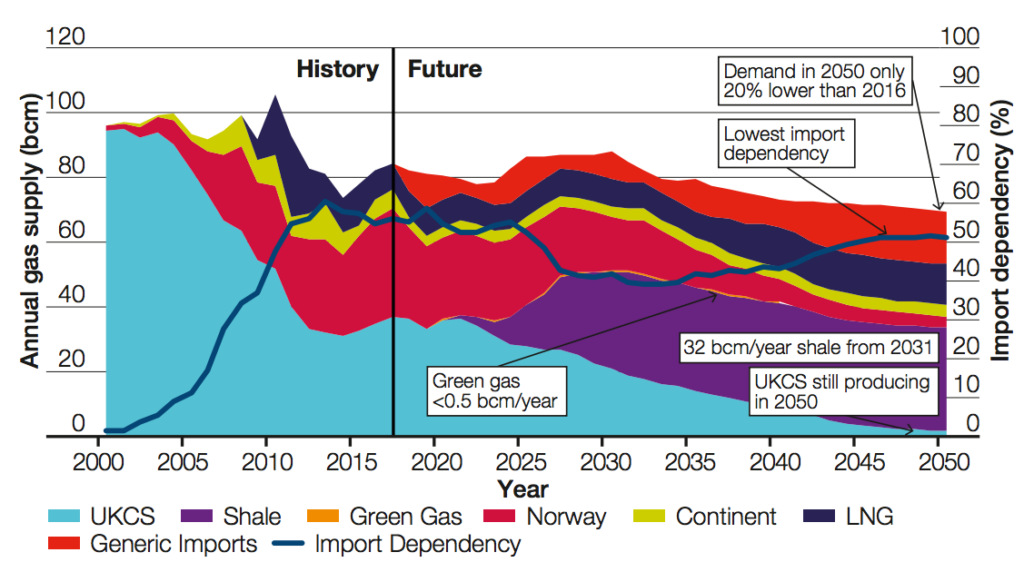
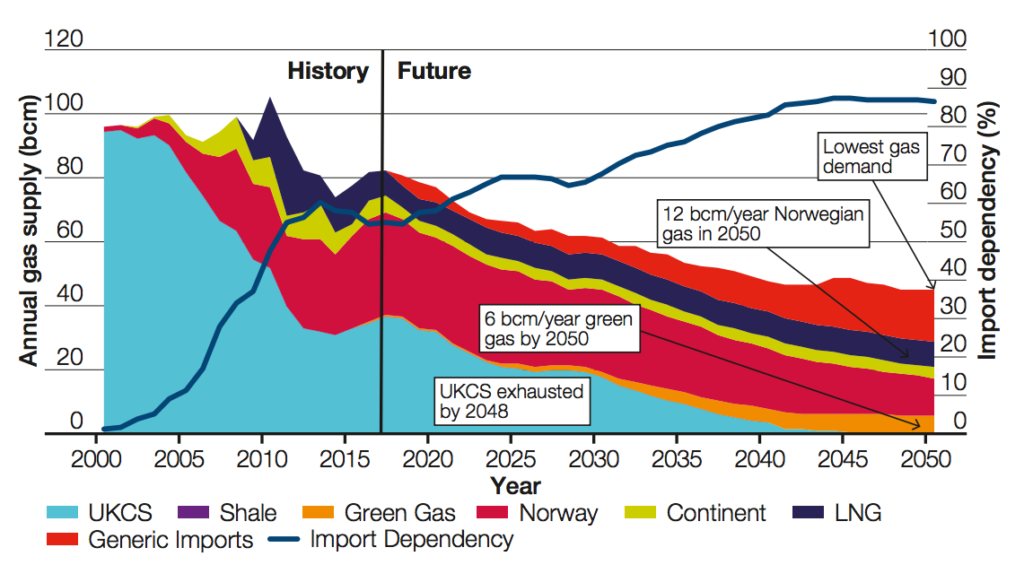
Gas consumption in line with carbon budgets. This means cutting gas consumption at least in half by 2050 and using shale gas to replace, rather than add to, current gas imports. If carbon capture and storage (CCS) is not available, UK gas consumption needs to drop to around 80% below today’s levels by 2050. A separate report, released last year by the industry-funded Task Force on Shale Gas, concluded that CCS will be “essential” if fracking develops at scale.
Shale industry emissions offset by more cuts elsewhere. This means the unavoidable emissions from a UK shale gas industry would have to be matched by cuts in other areas of the economy. Offsetting these emissions through other sectors would be possible, but potentially difficult, the CCC said.
progress reportmethane leaksInternational Energy AgencylimitA (pdf) co-authored by the late Prof David MacKay, then chief scientist to the Department of Energy and Climate Change (DECC), found UK shale gas would have much lower emissions than coal, slightly lower emissions than imported liquified natural gas (LNG) and higher emissions than conventional gas.Like the CCC, this report emphasised the need to ensure UK shale gas production did not lead to an overall increase in international supply and demand for gas.The authors warned that the “production of shale gas could increase global cumulative GHG emissions if the fossil fuels displaced by shale gas are used elsewhere”.They concluded: “The view of the authors is that without global climate policies (of the sort already advocated by the UK) new fossil fuel exploitation is likely to lead to an increase in cumulative carbon emissions and the risk of climate change.”Advocates have that shale gas could help to cut greenhouse gas emissions by reducing the use of coal. This might be possible as long as emissions remain below a certain level, often calculated at around 3%.In practice, however, the UK is unlikely to be able to replace coal with domestic shale gas, given coal is being phased out of the power sector by 2025 and is to fall to very low levels well before then.This leaves the small potential emissions advantage of domestic shale gas over imported LNG.The CCC says that onshore oil and gas extraction, including fracking, is with the UK’s climate targets unless it can meet tough standards on emissions. It laid out three key tests for a UK shale gas industry. These are:The CCC reiterated this advice in its latest annual , published in June. It also said the government should implement new policies to more tightly regulate and monitor shale gas wells, in order to ensure rapid action to address .Meanwhile, the said in 2011 that the significant global development of shale gas could put the world on a trajectory towards a long-term temperature rise of over 3.5C, far above the Paris Agreement of “well below 2C”.
arguedsteam reformation processcut emissionsproceed with hydrogenlast year warnedcancelledunnecessaryclean growth planmanifestoSome shale gas proponents have it could be used to produce low-carbon hydrogen via a , combined with CCS. The hydrogen would replace methane in the gas grid and be used for heating or fuel cells.Depending on how tightly emissions are controlled during shale gas production, however, this might only by 59% compared to fossil gas. The figure also depends on what share of CO2 is captured, with 100% technically possible, but likely to be more costly.The CCC says that CCS must be under active development in the UK before a decision to is made. The House of Commons Energy and Climate Change Committee gas without CCS could put climate targets at risk.In 2015, the government abruptly a £1bn competition to build plants demonstrating CCS at commercial scale. Last year, then-energy minister Andrea Leadsom called a CCS strategy “”.It remains to be seen whether a CCS strategy is laid out in the government’s long-delayed , now expected in September. The Conservative party’s 2017 made no mention of CCS.
“Shale gas could have great potential to be a domestic energy resource that makes us less reliant on imports and opens up a wealth of job opportunities. The economic impact of shale, both locally and nationally, will depend on whether shale development is technically and commercially viable and on the level of production. To determine the potential of the industry and how development will proceed, we need exploration to go ahead.”
(Update 10/1/2018: Ineos Shale yesterday announced plans to challenge Scotland’s fracking ban in court. The firm said it is launching a formal legal challenge to the Scottish government decision later this year, arguing the ban represented a “failure to adhere to proper statutory process and a misuse of ministerial power”.)
WalesNorthern Irelandpermanent banFranceGermanyNetherlandsWhile successive UK governments have been decidedly for a number of years, the devolved administrations are taking a more cautious approach.In Scotland, Nicola Sturgeon’s government imposed a moratorium on fracking in January 2015 and commissioned a series of independent into the pros and cons of shale gas.The Scottish government a public consultation in January 2017, which had attracted by the time it closed in May. The government response, including a decision on whether to allow fracking, is due later this year.In June, Scottish Labour’s environment spokeswoman Claudia Beamish plans for a member’s bill that would outlaw fracking, confirming the party’s continued opposition.(Update 3/10/2017: The Scottish government has now an “effective ban” on fracking. Energy minister Paul Wheelhouse telling MSPs today the moratorium should continue “indefinitely” after its public consultation showed “overwhelming” opposition. While MSPs will be given a vote on the issue later in the year, this is likely to be just a formality since only the Conservatives now oppose a ban.) has also put a fracking moratorium in place, while adopted a “no fracking” policy in 2015. Meanwhile, the Republic of Ireland agreed a on onshore fracking in June of this year.Meanwhile, across the channel, banned fracking in 2011, while has put a moratorium on some forms of fracking until at least 2021. The has also put moratorium on shale exploration in place until 2020.
“[People] pay little attention to whether the country’s geology is suitable for shale oil and gas production. The implication is that because fracking works in the US, it must also work here. In fact, the UK’s geological history suggests this is probably wrong…
“The inherent geological complexity of the [UK’s] sedimentary basins has not been fully appreciated or articulated. As a result, the opportunity has been overhyped and reserve estimates remain unknown.”
21/8/2017 update: This article was updated to note that Wales and Germany have moratoriums, rather than a bans, on fracking. In addition, Republic of Ireland agreed, rather than finalised, its permanent ban on onshore fracking in June of this year. The Netherlands’ moratorium on fracking was also added to the piece.
22/8/2017 update: The map of fracking in the UK was updated to include concerns from protestors that Cuadrilla could still use fracking or similar techniques in Balcombe. 3/10/2017 update: The news that the Scottish government has backed an “effective ban” on fracking was added. 10/10/2017 update: The news that Ineos Shale plans to take the Scottish government to court over its fracking ban was added. The news that West Sussex county council’s planning committee has approved an application by Cuadrilla to explore for oil near Balcombe was added. 12/10/2018 update: The new that Cuadrilla now plans to begin its first fracking on Saturday 13th October 2018 was added.
One major and often overlooked question for shale gas is whether it will be commercially viable in the UK.Domestically produced shale gas will have to compete with other sources, including imports from Russia and Qatar, as well as potentially cheaper shale gas from the US.In addition, multiple and have the differences between the UK and US that could prevent Britain from emulating the US .The UK has a far denser population, meaning fracking will take place closer to communities, for instance, alongside already strong public opposition. It also has potentially geology and stronger environmental legislation.In an article for the , , chair of exploration geoscience and chief scientist at Heriot-Watt University’s Shell Centre for Exploration Geoscience, writes:It’s worth adding that the geology affects the productivity of each well and this, in turn, strongly affects the greenhouse gas emissions associated with the well’s output.Even while pushing for shale development, government ministers have that its economic impact will depend on whether it is technically and commercially viable.Fracking firms themselves are also cautious about promising too much. Cuadrilla’s chief executive Francis Egan he hoped it would become clear within a year whether it was economically viable to extract shale gas from the Preston New Road site.