Climate change could flip European peak power demand to summer, study says
Climate change could push peak electricity demand from winter to summer in most European countries, a new study says.If global greenhouse gases aren’t curbed, rising temperatures will lead to increased use of air conditioners in the summer and less need for heaters in the winter. Energy systems have traditionally been designed around the ability to meet demand on the day with the highest peak each year. If this day moves from winter to summer as a result of climate change, it will have significant impacts on grid planning, says the study, published yesterday in the Proceedings of the National Academy of Sciences.The changes in peak demand will come as part of a wider shift in electricity consumption patterns across Europe, as temperatures rise and demand moves from colder northern countries to the warmer south.§ Winter to summer
The study of 35 countries across Europe examines the impact of a warming climate on today’s electricity systems. It looks at three different greenhouse gas concentration trajectories, of varying ambition.Only five of these countries currently see the year’s peak demand day in summer. Most instead require more electricity in the cold, dark winter months to keep homes warm and light.[contentbox id=”17002″]aren’t curbed§ Southern shift
Climate change will cause electricity consumption in southern and western European countries such as Spain and Portugal to increase significantly, the authors find, with their average daily peak increasing too.
“Generally, generating and transmission infrastructure is designed to meet the highest demand in a year. Increases in peaks will put additional pressure on the grid when it is already stressed and will likely require additional investments in this infrastructure.”
The design of energy-efficiency policy and need for storage capacity could also change, the study says.higher share_YB16.png)
§ Up or down
RCP4.5RCP8.5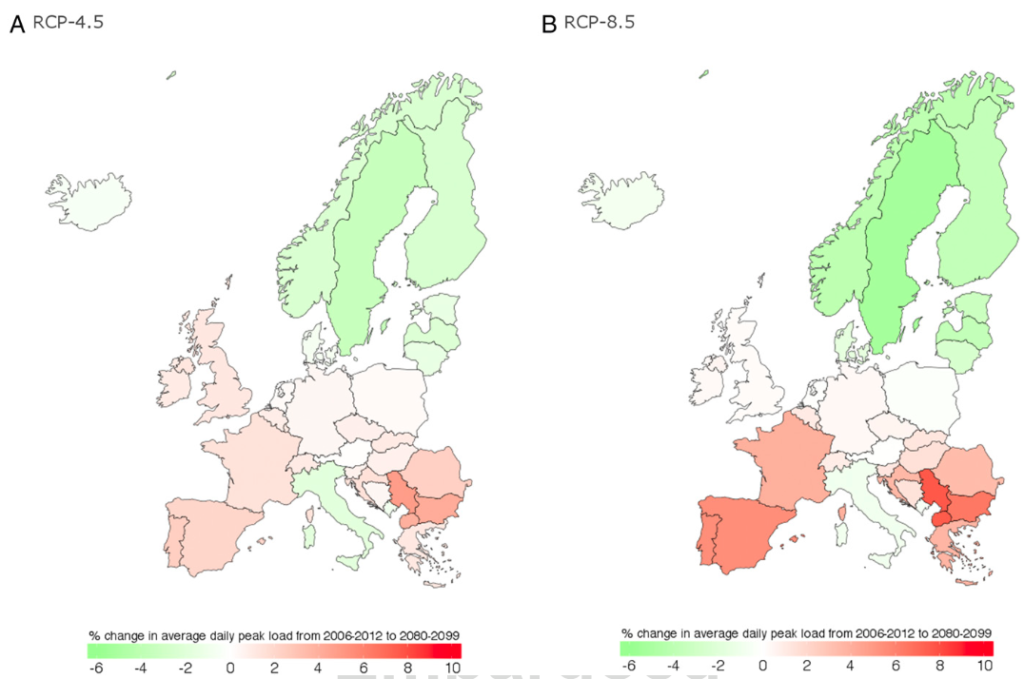
§ Climate ambition
The graphs below show the relative change in electricity demand to the end of the century under low climate ambition (RCP 8.5, top panel), intermediate emissions (RCP 4.5, middle) or high ambition roughly in line with Paris (RCP 2.6, lower panel).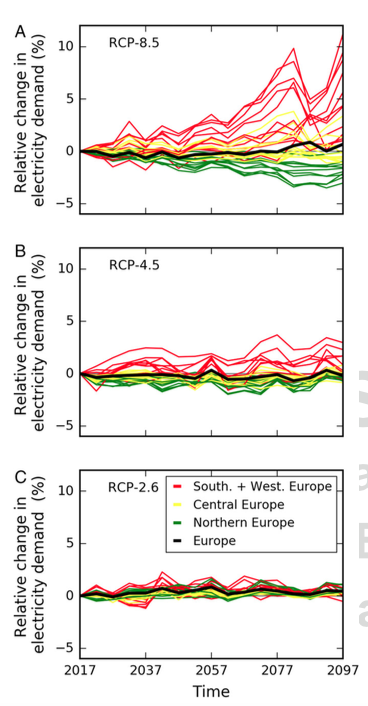
§ Extrapolation
It’s worth noting that, in order to isolate the climate effects on the electricity system, the authors keep all other factors constant in their study. Changes in population and economic structure over the next decades, as well as the electrification of heat and transport could also have large effects on electricity consumption.The authors set a common frame across countries of how electricity load will be affected by changing temperatures. This allowed them to look for changes due to the way countries use energy as temperatures rise, rather than just extrapolating current national data.For example, summers in Scandinavian countries are not currently warm enough to warrant air conditioning, however, this could change with hotter temperatures. The researchers used data from other European countries, which do already use air conditioning, as a guide to future changes elsewhere.On the other hand, differences between cultures may make this extrapolation too simplistic. The authors give an example of Swedes potentially having a much higher heat tolerance, resulting in lower use of air conditioning than in other countries.The authors also don’t account for the potential uptake of alternatives to air conditioning for dealing with warm weather, such as the use of natural ventilation or shading. The UK’s Committee on Climate Change (CCC) says reliance on air conditioning needs to be avoided as far as possible, since it adds to the urban heat island effect as well as increasing electricity bills and CO2 emissions. Passive cooling measures such as green roofs and passive ventilation systems are preferable, it says.Prof David Sailor, professor of geographical sciences at Arizona State University, who was not involved in the study, says there is a “good likelihood” that actual outcomes will differ due to factors not represented. This would be the case with any study that attempts to explore future scenarios, he says. He tells Carbon Brief:“[I]t may not capture current/future trends in energy-use intensity, proliferation of air conditioning, and country-specific trends in building construction, renovation, and management.”
Similarly, the extrapolation of the response functions across countries could lead to key differences in construction characteristics and human behaviour that would affect the projections being missed, says Sailor. He adds:“Also, while the focus of the paper is entirely on electrical consumption, the analysis of energy consumption sensitivities in winter and summer, would seem to require that such analysis should account for the varying energy mix in each country, particularly with respect to how heating loads are met, currently, and into the future.”
Article information
Wenz, L. et al. (2017) North–south polarization of European electricity consumption under future warming, Proceedings of the National Academy of Sciences, doi:10.1073/pnas.1704339114