World’s soils have lost 133bn tonnes of carbon since the dawn of agriculture
The world’s soils have lost a total of 133bn tonnes of carbon since humans first started farming the land around 12,000 years ago, new research suggests. And the rate of carbon loss has increased dramatically since the start of the industrial revolution.The study, which maps where soil carbon has been lost and gained since 10,000BC, shows that crop production and cattle grazing have contributed almost equally to global losses.Understanding how agriculture has altered soil carbon stocks is critical to finding ways to restore lost carbon to the ground, another scientist tells Carbon Brief, which could help to buffer the CO2 accumulating in the atmosphere.§ Soil as a carbon sink
three times as much carbonphotosynthesisglobal warmingProceedings of the National Academy of Sciences (pdf)transportedDr Jonathan SandermanWoods Hole Research Center“Considering humans have emitted about 450bn tonnes of carbon since the industrial revolution, soil carbon losses to the atmosphere may represent 10 to 20% of this number. But it has hard to calculate exactly how much of this has ended up in the atmosphere versus how much has been transported due to erosion.”
§ ‘Hotspots’ for carbon loss
“We used a dataset which defines 10,000BC as a world without a human footprint. What we did was develop a model that could explain the current distribution of soil carbon across the globe as a function of climate, topography [physical features], geology and land use. Then we replaced current land use with historic reconstructions including the ‘no land use’ case to get predictions of soil carbon levels back in time.”
“More carbon has been lost due to agriculture than has generally been recognised and a lot of this loss predated the industrial revolution. This loss isn’t equally distributed across agricultural land. Some regions stand out as having lost the most carbon.”
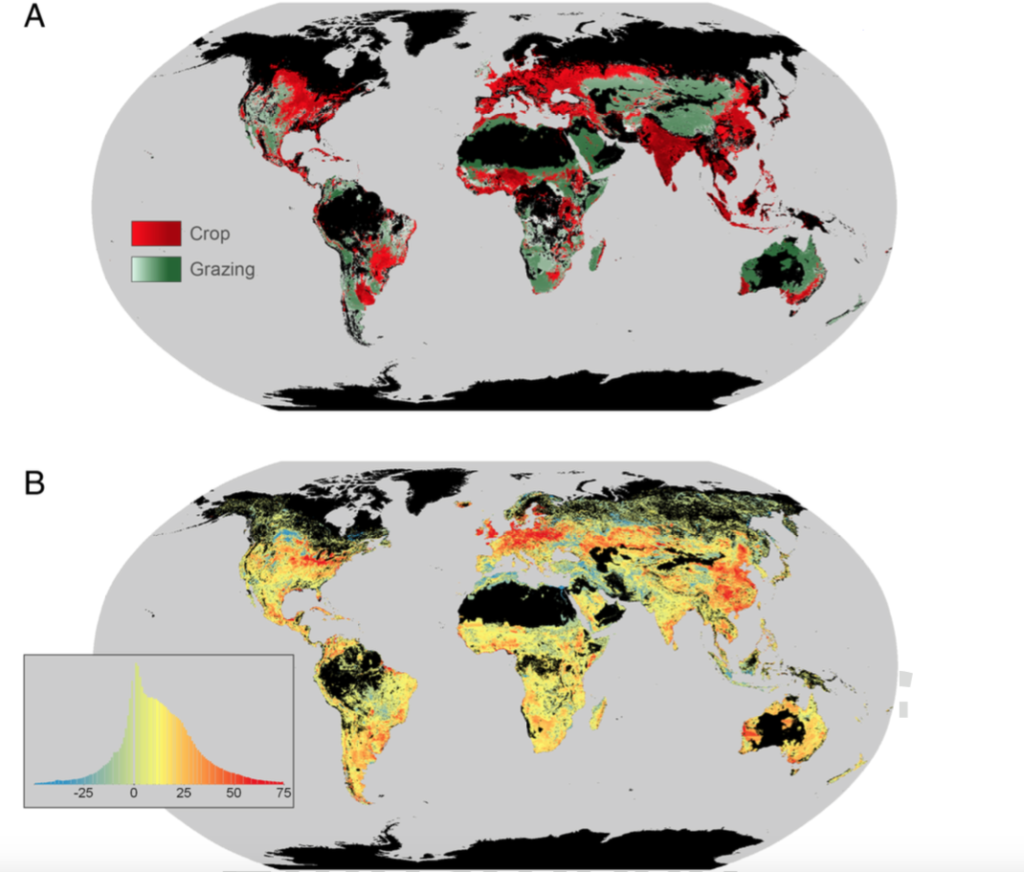
“Semi-arid and arid grasslands [the hotspots] are particularly vulnerable to potentially irreversible degradation if grazing intensity is too high. That’s because there isn’t a lot of soil carbon to start with and there can often be a complete shift in vegetation cover leading to lots of erosion.”
§ Repaying the debt
soilsnegative emissions technologiessuggestsParis Agreement“This figure [133bn tonnes of carbon] is likely a maximum potential if we were willing to give up agriculture and completely restore natural ecosystems. That is obviously not going to happen, so the real potential – giving the constraint of needing to feed 10 billion people by 2050 – is going to be a lot lower.”
Dr Thomas CrowtherYale Climate and Energy Institute“Modifying large-scale agricultural practices to restore some of these lost soil carbon stocks might be a valuable strategy in our efforts to dampen climate change. If regenerative agriculture can restore some of the carbon that we have lost, then it might be a really valuable tool in our fight against climate change.”
Prof Meine van NoordwijkWorld Agroforestry CentrePeat“Peat soils require and currently receive separate attention. Water management [of wetland soils] is a relevant part of agricultural use, leading to [carbon] losses, but also indicating opportunities for restoration.”
Article information
Sanderman, J. et al. (2017) Soil carbon debt of 12,000 years of human land use, Proceedings of the National Academy of Sciences, doi:10.1073/pnas.1706103114