Tropical forests are ‘no longer carbon sinks’ because of human activity
Tropical forests now emit more carbon than they are able to absorb from the atmosphere as a result of the dual effects of deforestation and land degradation, a new study says.The research challenges the long-held belief that forests act as “carbon sinks” by storing more carbon than they emit due to natural processes and human activity.Instead, the world’s tropical forests could have experienced a net loss of around 425m tonnes of carbon from 2003 to 2014, the lead author tells Carbon Brief. This figure is considerably higher than previous estimates of carbon loss from tropical forests.The findings suggest that curbing deforestation and protecting existing forests could be instrumental in removing greenhouse gases from the atmosphere and fighting future climate change, he adds.§ Canopy carbon
plant respirationdroughtswildfiresdeforestationconsensusDr Alessandro BacciniWoods Hole Research CentreScience“The main discovery is that forests in tropical regions are not a carbon sink, but a carbon source. That means that the amount of carbon emissions from tropical regions are actually bigger than the carbon removal that this region is able to achieve.”
§ Calculating carbon loss
“Degradation is a process where only a small portion of trees are removed from a forest. From a satellite image, the area will still look like an intact forest. But, when you lose even a small proportion trees, you lose a significant amount of carbon.”
carbon density“Carbon density is a measure of the weight of carbon that is held by forests. Even in the field we don’t really collect direct measurements of weight but we can collect direct measurements of the trees, such as their diameter and height, and then you use an equation to convert that into biomass.”
§ Understanding the loss
“We discovered that land degradation has a very significant effect on carbon loss. The carbon loss from land degradation is small but, because it happens a lot over a very large area, then it adds up to a lot of loss. We like to think that this is the first study where we can provide an estimate of the losses due to degradation over such a large area as the entire tropics.”
Prof Guido van der WerfVrije University“The current paradigm based on multiple lines of evidence is that terrestrial vegetation absorbs a substantial chunk of our emissions, but this research implies it is actually the other way around. If correct, the work certainly challenges the way we account for the global flows of carbon between various reservoirs and places on earth.
“You have to keep in mind though that it is much easier to detect the large decreases in forest biomass due to deforestation than the very gradual increases due to net forest growth, for example due to CO2 fertilisation. This is especially true for relatively short time series such as the 12 years of this study.”
Carbon Brief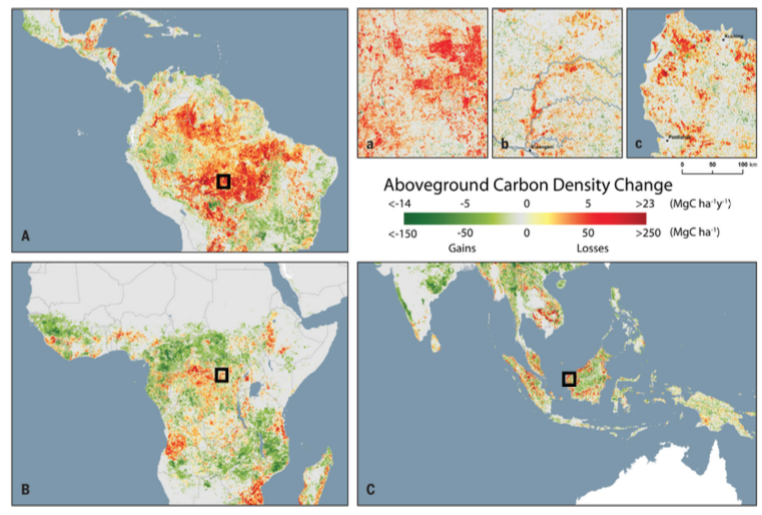
“What we see is Latin America, especially Brazil, is a region that is giving off the largest amount of emissions. That is in part because the size of its forests but there is also a lot of disturbance and deforestation for cattle rearing going on. What we find in Africa there is a much smaller amount of disturbance and this is mainly driven by mining and deforestation for palm oil. In Asia, we see a lot of deforestation for palm oil.”
§ From source to sink?
“There is a possibility that by restoring the forest, by reducing, decreasing or stopping deforestation, by reforestation projects, we could actually make it into a sink. And it would be a pretty big sink.”
Carbon Briefreforestationnegative emissions“Reforestation and afforestation could improve the quality of the planet through the conservation of biodiversity and an improvement in water quality and water resources, and all of this while we are reducing the concentration of CO2 in the atmosphere. It’s a win-win-win possibility.”
Article information
Baccini et al. (2017) Tropical forests are a net carbon source based on aboveground measurements of gain and loss, Science, http://science.sciencemag.org/content/early/2017/09/27/science.aam5962