World can meet growing food demands and limit warming to 1.5C, study says
Carbon emissions from agriculture can be significantly cut while still meeting the food demands of the world’s growing population, a new study says.Agriculture and food production is responsible for around 30% of global greenhouse gas emissions. Slashing the sector’s emissions is considered to be key to limiting global warming to 1.5C above pre-industrial levels, which is the aspirational target of the Paris Accord.However, adopting negative emissions strategies, such as soil carbon management, will be essential to help the farming industry reduce its carbon footprint without threatening the global food supply, the lead author tells Carbon Brief.The new study marks an important step in our understanding of how to tackle the “wicked problem” of food insecurity in a changing climate, another scientist tells Carbon Brief.§ Making a meal of the planet
nitrous oxidemethane10m hectares per year30% of all greenhouse gas emissions1.5CDr Stefan FrankInternational Institute for Applied Systems AnalysisEnvironmental Research Letters“Reducing global emissions may affect food availability as agricultural land could be diverted from food production to energy use for fossil fuel substitution, such as biofuels. Mitigation efforts may also limit land available for agricultural expansion due to the need for protection of high carbon landscapes, such as forests.”
§ Crunching the numbers
agriculture, forestry and other land usecarbon tax“For this study, we use an economic land use and mimic different climate change mitigation policies implementing emission reduction targets and bioenergy demands. The emission reduction targets are achieved by implementing a carbon price in the model, which incentivises the shift towards more greenhouse gas efficient production systems.”
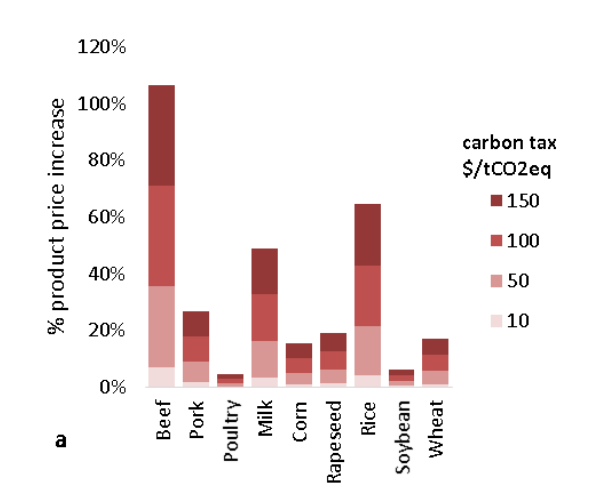
“[The analysis] tackles only a part of the whole issue. Globally, poor diets are driving ill-health through providing too many calories and not enough nutrition, so what we produce and how we produce it needs to change to provide healthier diets: calories are not a good proxy for food security.”
§ ‘Win-win’ strategies
soil carbon sequestration“There are of course uncertainties related to the mitigation potential from soil carbon sequestration, but if these potentials were to be achieved, the impacts on food security could be significantly eased.”
“There are several other “win-win” options such as reducing food waste and harvest losses, or societal dietary change that were not explicitly assessed in this study but if realised together, they could even enable us to achieve this goal [of limiting warming to 1.5C above pre-industrial levels] without compromising food security at all.”
“Rising food insecurity is painful to contemplate, but it is a wicked problem. Without mitigating climate change, its impacts on food security are also likely to increase the number of food insecure, either directly or indirectly (through promoting conflict).
“This is an important study which shows that carbon pricing can drive positive effects, but can also drive negative effects. It sets an agenda about how to avoid the negatives, whilst embracing the positives.”
Article information
Frank, S. et al. (2017) Reducing greenhouse gas emissions in agriculture without compromising food security? Environmental Research Letters, https://doi.org/10.1088/1748-9326/aa8c83