Shifting storms under climate change could bring wilder winters to the UK
The UK could face harsher and more frequent winter storms if global greenhouse gas emissions aren’t curbed, a new study says.The research uses modelling to investigate how rising global temperatures could change the movements of mid-latitude storms by the end of the century. These storms form outside of the tropics and are ferried across the Atlantic towards the UK along pathways known as “storm tracks”.In a warmer world, these storm tracks are expected to shift to be closer towards the poles, the author tells Carbon Brief.This means that mid-latitude storms could travel further before reaching their maximum intensity and, as a result, countries further from the equator, including the UK and the US, could face more frequent and more intense storms during winter months.§ Shifting storms
form in the mid-latitudes
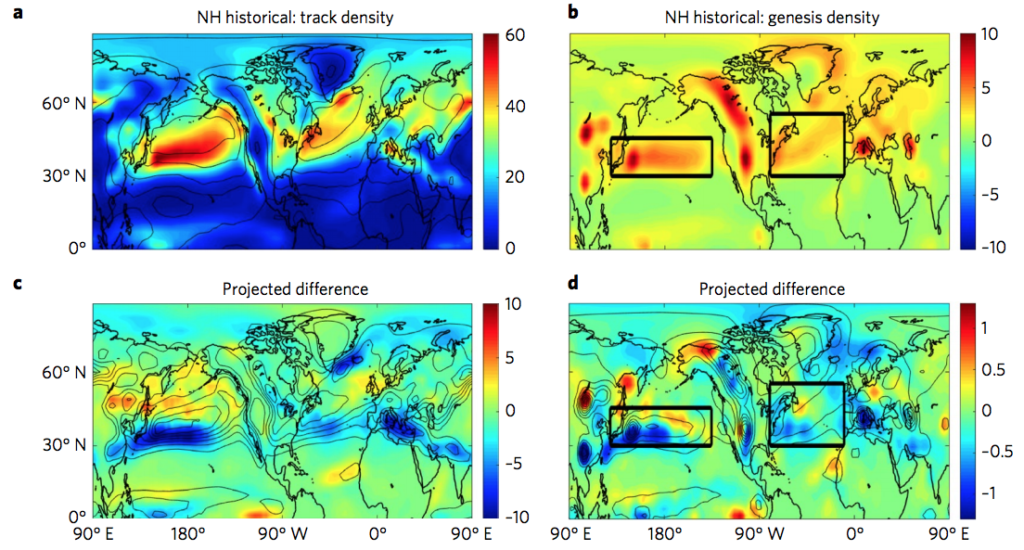
“Most previous studies indicated that the regions of maximum storm activity shift poleward under climate change. However, most of these arguments involved changes in the latitude of where these midlatitude storms are ‘born’.
“Our study highlighted another aspect of the shift – we showed that the storms are not only generated more poleward, but they actually also travel larger distances. This means that the storms reach their maximum intensity at higher latitudes in a warmer climate.”
§ Modelling the climate

“What these models show very robustly, as was shown by others in previous studies, is that the latitudinal position of the storm tracks shifts poleward. The ‘storm tracks’ are those regions in midlatitudes where storm mainly pass and are mainly active.”
§ Changing winds
“The second process is related to latent heat release. The hotter air in a warmer climate will contain more water vapour, and thus more heat will be released when the vapour condenses into drops.”
“The hottest, wettest air is circulating up the eastern flank of the storm – to the northern side – and releasing latent heat there. This process pushes the storm northward (or southward in the southern hemisphere), and this effect will also be stronger in a warmer climate.”
“In the Northern Hemisphere, midlatitude storms are usually generated over the oceans close to the east side of the continents, such as to the east of Japan and off the eastern coast of the United States, and generally travel eastward and somewhat poleward along similar paths.”
“[The models] showed that both the number and the wind speed of cyclones increase in the UK and the British Isles.”
Prof Dan ChavasPurdue University“The methodology is nice because they are actually tracking the storms themselves rather than looking at some broader proxy of the storm track. Their results may have implications the frequency of storm events hitting northeastern coastal boundaries, such as those in northeast US and eastern Canada, since storms tend to move poleward more quickly in a warmer climate.”
Article information
Tamarin-Brodsky, T. and Kaspi, Y. (2017) Enhanced poleward propagation of storms under climate change, Nature Geosciences, http://nature.com/articles/doi:10.1038/s41561-017-0001-8