Unregulated solar geoengineering could spark droughts and hurricanes, study warns
Artificially cooling the planet through solar geoengineering could have some dramatic side effects – including an increase in droughts and hurricanes in some regions – if it is carried out in an unregulated way, a new study warns.The study focuses on one proposed type of geoengineering, known as a “stratospheric aerosol injection”, which involves sending up substances to the stratosphere that are known to have a cooling effect on the climate.It finds that if only one country, region or hemisphere were to pursue this type of geoengineering, other parts of the world could face adverse consequences. For example, if only the northern hemisphere were to release aerosols, the Sahel in Africa and parts of India would have to cope with more droughts.The research highlights that “geoengineering is going to require more global cooperation than has ever been attempted before”, another scientist tells Carbon Brief.§ Mimicking volcanoes
making clouds brighterbubbles and spray behind shipsgiant mirrorsocean acidificationpublished in Nature Communicationsmajor volcanic eruptionssulphur dioxidesulfuric acid aerosols§ A geoengineered world
Dr Anthony JonesMet Office“If solar geoengineering were to be deployed solely in the northern hemisphere, then the resultant changes would reduce precipitation in the Sahel, and other regions such as India, and reduce the number of storms in the North Atlantic basin.
“To put it short, northern hemisphere solar geoengineering would be good for the southeast US, the Caribbean, and Mexico in terms of dissipating storms, but be very bad for the Sahel. In contrast, solar geoengineering in the south would enhance precipitation in the Sahel, but would also enhance the number of storms in the North Atlantic.”
§ Cyclone frequency
tropical cycloneshurricanestyphoonscyclones“North Atlantic storm activity is related to the position of the tropical jet stream. If the jet coincides with Atlantic hurricane main development region (MDR) then the enhanced vertical wind shear acts to weaken storms. Solar geoengineering in the north would shift the jet stream south so that it coincides with the MDR, while solar geoengineering in the south would shift the jet stream north providing optimal conditions for storm formation.”
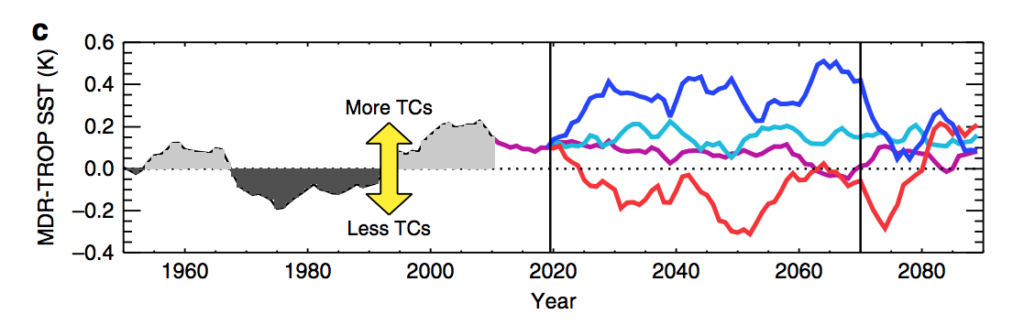
“Our results are less conclusive for a symmetrical scenario than for the hemispheric scenarios. In particular, we highlight a long-standing disparity between explicitly modelled storms and statistical-downscaling techniques.”
Global climate models“It is important that we identify the reasons why the two storm tracking methods differ before we can conclusively assess the storm changes under a symmetrical solar geoengineering scenario.”
Dr Ben KravitzPacific Northwest National Laboratory“One aspect of this is that the study goes beyond some of the usual things that we look at, like temperature and precipitation, and it’s aimed at extreme events, in this case hurricanes. These are the things that impact people’s lives directly and they need to be studied.”
“I would really like to see this study replicated by other models. One reason is that these results are from one model. The authors did a great job of understanding why the model behaves the way it does, and they tie those behaviours to physical mechanisms, so the results are definitely plausible. But we need to understand whether the results are different for a different model, and if they are, why.”
§ Controlling the future
geoengineering conferenceheld a meeting“My concern is that the positive impacts for one region may motivate an individual to deploy solar geoengineering in a single hemisphere at the expense of severe negative impacts to another region.
“Stratospheric aerosol injection would be relatively inexpensive and there is very limited if any existing governance that could deter individual actors or that could be used to hold actors accountable for any harmful consequences.”
Prof David KeithHarvard Universityone of the first outdoor SRM experiments“I don’t see it has any particular significance for the [geoengineering] debate. It was already obvious that doing solar geoengineering on just one side of the equator would not make sense.”
Janos PasztorC2G2“If one country decided to put its own interests first – say the leader of that country thought ‘our country needs cooling down, let’s do some regional solar geoengineering’ – that could have potentially catastrophic effects in other parts of the world.”
“Geoengineering is going to require more global cooperation than has ever been attempted before. What is clear is that a geoengineered world will have winners and losers, both geographically but also as we look towards future generations, because some generations will benefit more than others.”
Article information
Jones et al. (2017) Impacts of hemispheric solar geoengineering on tropical cyclone frequency, Nature Communications, http://nature.com/articles/doi:10.1038/s41467-017-01606-0