Guest post: Trees are the dominant source of methane emissions in Amazon wetlands
Prof Vincent Gauci is chair in global change ecology in the School of Environment, Earth and Ecosystem Sciences at the Open University. The world’s wetlands pack quite the climate punch. Not only can they store vast amounts of carbon in their saturated soils, they also release it as methane – a greenhouse gas that is 34 times more powerful than CO2 at trapping heat in the atmosphere.While wetlands are also frequently overlooked in favour of upland forests when considering the exchange of greenhouse gases between ecosystems and the atmosphere, there have been some truly stunning breakthroughs this year in these ecosystems.This year saw the discovery of huge reserves of carbon locked away as peat deep in the Congolese jungle – showing that even today, scientists are making the sorts of discoveries that might be expected from a Victorian explorer.In our new Nature study, my colleagues and I add to this new wetlands knowledge by revealing how trees in the seasonally flooded Amazon floodplain are the major regional emission source of methane.In doing so, we finally close the longstanding gap in the methane budget for the Amazon.§ Measurement mismatch
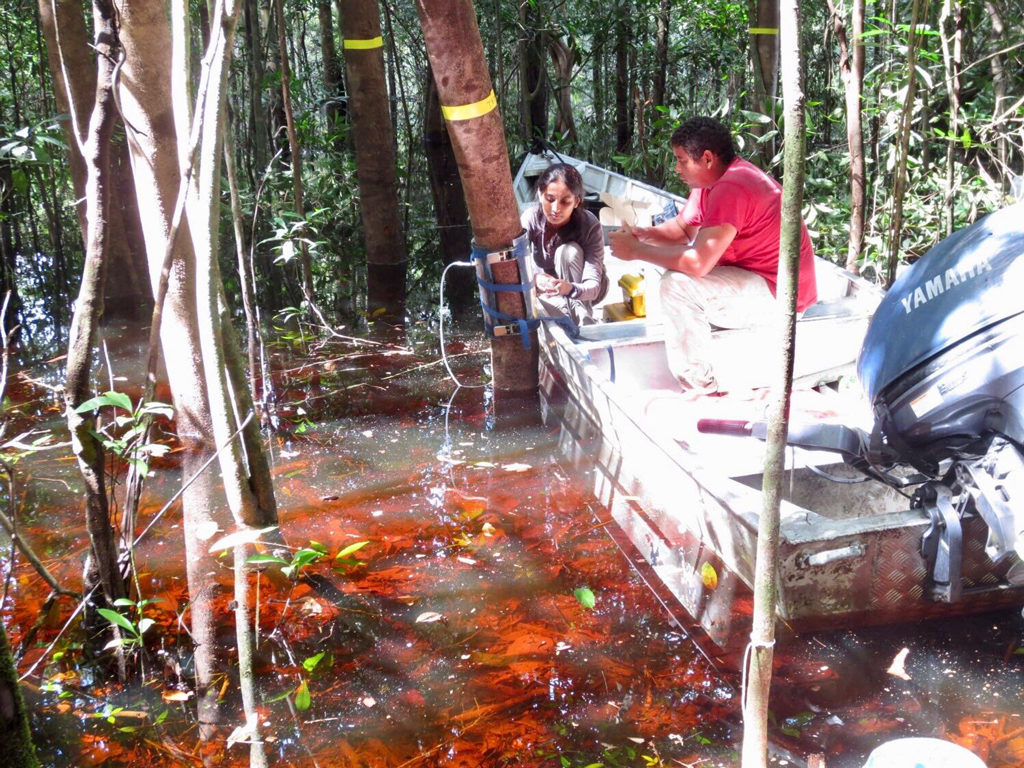
§ Trees as conduits of methane
§ Solving the mystery
massive dam building programmeArticle information
Pangala, S. R. et al. (2017) Large emissions from floodplain trees close the Amazon methane budget, Nature, doi:10.1038/nature24639