UK wind power potential could fall by 10% by 2100 because of climate change
Climate change could reduce the amount of wind available for power production in both the UK and the US, new research suggests.The arrival of weaker winds in the northern hemisphere as a result of global warming could cause average windfarm output to fall by around 10% in the UK and 14% in the US by 2100, the lead author tells Carbon Brief.Meanwhile, climate change could strengthen winds in parts of the southern hemisphere by the end of the century, the research finds, including in Australia, Brazil and South Africa.However, the study’s conclusions rely on models that have relatively low spatial resolution, other scientists tell Carbon Brief, which could affect the accuracy of the results.§ Wind ‘hot spots’
Paris Agreementjet streamEl Niño and La Niña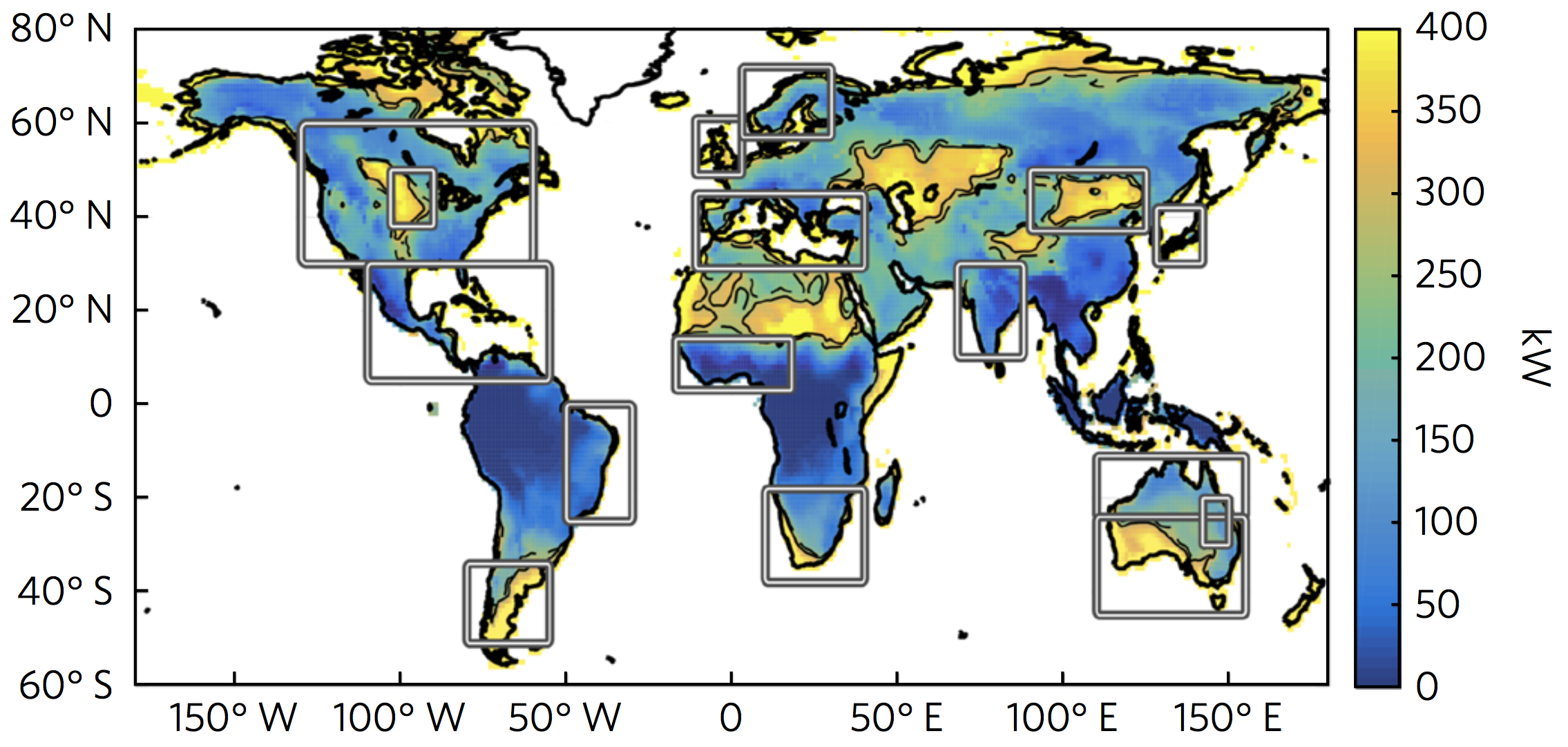
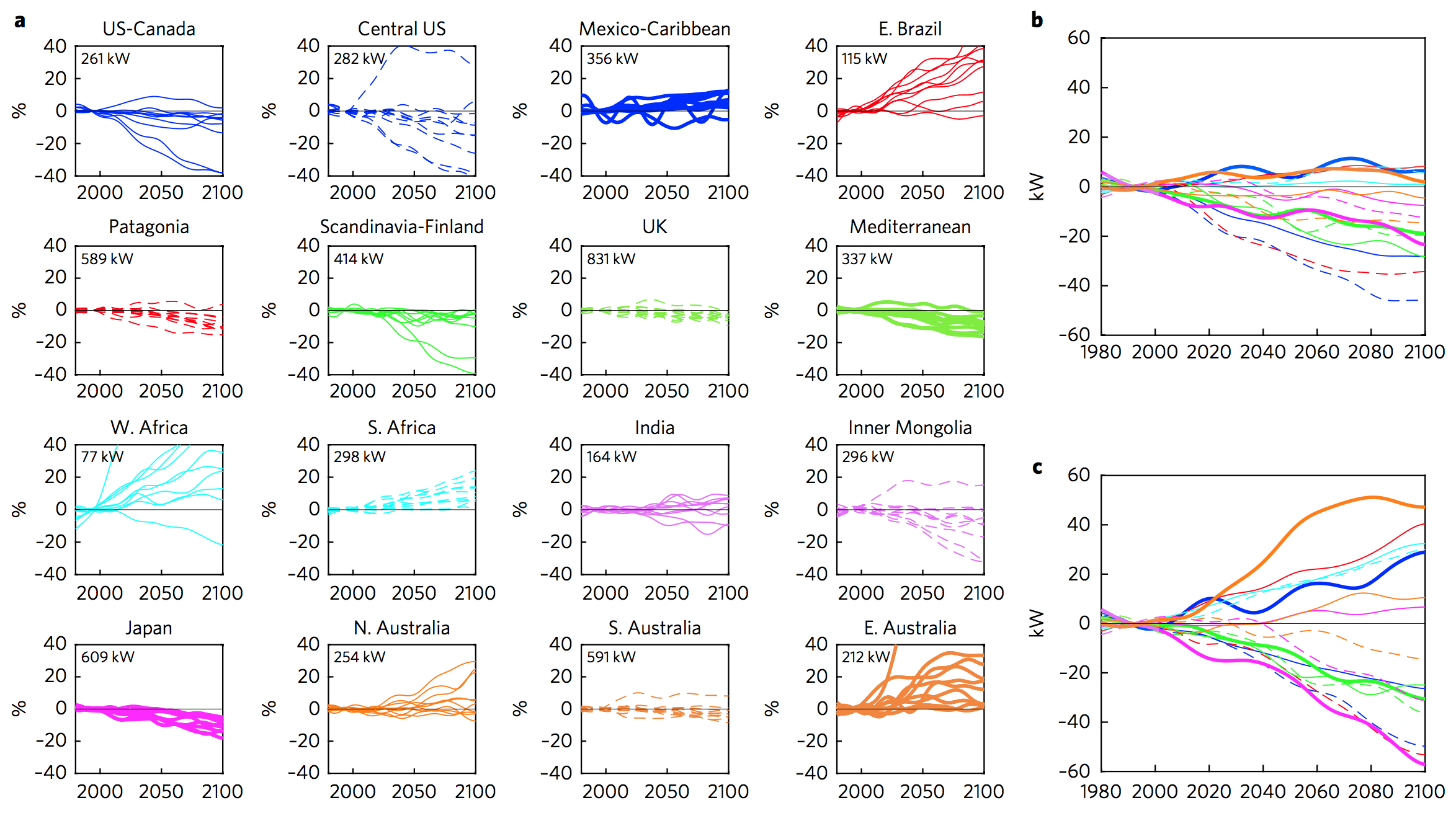
“What we found was that global warming will reduce the wind energy resource across much of the Northern Hemisphere, especially in the central US, the UK, all the way around the Mediterranean, Kazakhstan and western Russia, and large portions of Eurasia, as well as Japan.”
§ Changing winds
RCP8.5RCP4.5“Global climate models do not calculate wind power, per se, like they do for other general variables like temperature, humidity and simply wind itself. Wind power is not quite the same as just wind speed, so we took the variables that are calculated directly by the global climate models and used an industry wind turbine power curve as something of a translation device.
A power curve is simply a graph that tells you how much wind power will be generated for a given wind speed and it’s not one-to-one. Below 9 km/h, no power is generated. Between 9-43 km/h, there is an exponential ramp-up in power, and then it levels off at wind speeds between 43-92 km/h. Beyond 92 km/h, the wind turbine actually shuts down for safety and mechanical reasons.”
“That result is not sensitive to emissions scenarios, whether we continue to emit CO2 along a business-as-usual trajectory [RCP8.5] or begin to curb emissions [RCP4.5]. Those changes will be noticeable before mid-century and become stronger by the end of the century.”
“Wind usually derives its energy from instability in the atmosphere, and a major source of that instability in the northern hemisphere is the equator-to-pole temperature difference. We all know the tropics are warmer than the Arctic.
But because the Arctic is warming so much faster than the rest of the world, including the tropics, that temperature gradient is lessening. Hence, the energy source for those winds decreases with global warming.”
previous research“In the southern hemisphere, the increase in wind power depends on the land-sea thermal gradient, and apparently the stronger emissions scenario (RCP8.5) is needed to make the difference in temperature and thus pressure between land and sea strong enough to amplify the winds.”
§ Turbulent reception
Prof Joaquim PintoDr Christian GramsKarlsruhe Institute of Technology“These projections for Europe are partially in agreement with studies based on datasets with much higher spatial and temporal resolution. These studies reveal rather smaller changes of wind energy potentials for Europe on the continental scale.”
Dr Dave MacLeodUniversity of OxfordScience Media Centre“The resolution of the models is only around 100-200km – this is not very accurate. Also they use monthly average data from the models, which ignores day-to-day variations.
In addition, there is other research which directly contradicts this new research. One recent study used higher resolution atmospheric models and found that several regions over the US experienced an increase in wind energy of around 2%. Personally, I have serious doubts we can rule out future increases or decreases in wind energy over the UK.”
§ Blowing over?
“This information may also prove key in allocating resources and planning where and when to build new windfarms, service old ones, and fine-tuning the blend of renewables supporting the ever-growing regional energy consumption, since this shows how the baseline wind energy resource cannot be considered a constant.”
“These reductions are not trivial, but wind power should still be considered an important part of the portfolio of renewable investments as part of the broader strategy to reduce carbon emissions.”
Article information
Karnauskas, K. B. et al. (2017) Southward shift of the global wind energy resource under high carbon dioxide emissions, Nature Geoscience, http://nature.com/articles/doi:10.1038/s41561-017-0029-9