Climate change ‘tripled chances’ of Hurricane Harvey’s record rain
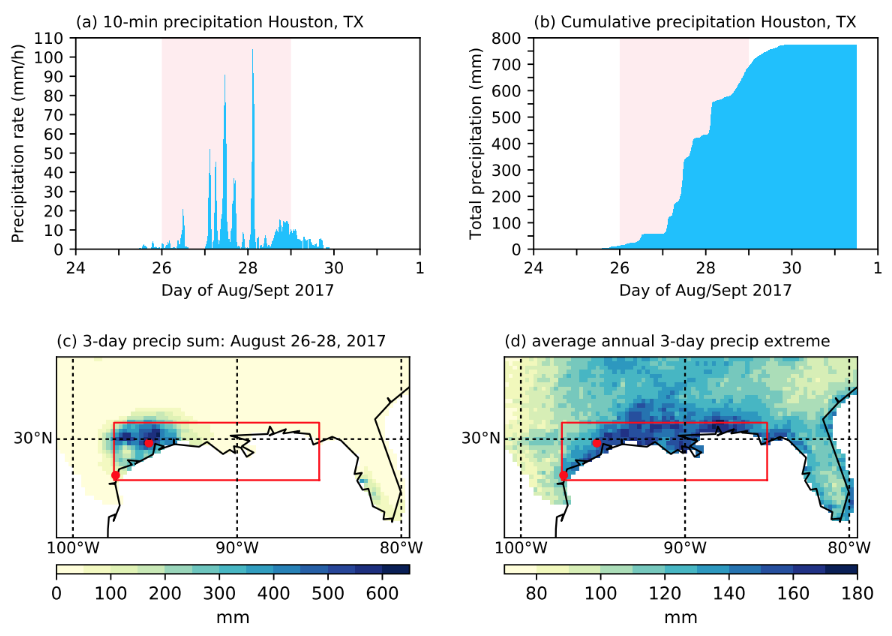
When Hurricane Harvey struck Texas on 25 August, the state was hit by catastrophic flooding caused by record rainfall. In just three days, up to 40 inches (100cm) of rain fell on Houston and its surrounding towns, leaving 80 dead and more than 100,000 homeless.Now, scientists have calculated that those record rains were made at least three times more likely by climate change.The analysis also shows that similarly extreme rainfall could become a further three times more likely to occur by the end of the century, even if global warming is limited to 2C.If no efforts are made to stop the release of greenhouse gases, rainfall events on the same scale as Hurricane Harvey’s downpour could become up to ten times more likely by 2100, the research finds.The research was conducted by scientists at the World Weather Attribution (WWA) project, which aims to assess the role of climate change in recent extreme events, such as droughts, heatwaves and floods.§ Human influence
category 4landfalltrackedmuch of the coverageEnvironmental Research Letterssingle event attributionnatural climate variabilityDr Geert Jan van OldenborghRoyal Netherlands Meteorological Institute“After an extreme weather event, we always get the question: ‘To what extent was this due to climate change?’ The almost identical question that an extreme event attribution study answers is ‘how much has the probability of an event changed due to climate change?’
“In this case, we looked at the probability in the current climate of getting as much rain as fell on Houston or more, and compared it with the probability a century ago, from observations and climate models.”
§ Eyeing the storm
“We explicitly do not attribute tropical storms in this study, only the precipitation from all causes, among them tropical storms.”
more difficult“The typical spatial extent of a heatwave is many hundreds of kilometers, so you can represent a heatwave with a climate model with a resolution of 200km or so. However, critical parts of tropical storms [hurricanes and typhoons] are much smaller, you only start getting realistic simulations with 25km resolution models. Only recently have the models and computer capacities increased enough, but even then the details of the dynamics of the storms are still not completely well-represented.”
§ Human fingerprint
Dr Karin van der Wiel2017 Fall Meeting“[This event] was really, really rare. Locally, the return period was one in 9,000 years. Any city in the world would have flooded with that amount of rain. Regionally, for an event like this occur anywhere on the Gulf Coast, it was a one in a 100 year event, even that is quite extreme.”
“There’s many factors that have occurred in the climate system that made this event more likely to occur. So the sea surface temperature in the Gulf was extremely high, that was related to climate change. Atmospheric moisture is higher when it’s warmer, so the atmosphere can hold more water so when it rains, it rains harder.”
§ Planning ahead
“The flood risks depend also on the other factors that we mention, such as water management and building practices. However, floods also depend on precipitation and we now know that the probability of extreme precipitation will increase as the world warms. By how much indeed strongly depends on how far we allow the earth to warm further.”
Dr Peter Stott“What I think is lacking in this study however is a specific analysis of hurricanes. The study does not examine hurricanes in the climate models, as to whether they have become either more intense or more frequent, and therefore the conclusions of this paper are rather general in scope regarding extreme rainfall, which can be caused by a variety of mechanisms in addition to hurricanes.
“Further work is therefore needed to look at hurricanes in more detail in order to determine how the risk of impacts specifically associated with hurricanes has changed.”
Article information
Van Oldenborgh, G. J. et al. (2017) Attribution of Extreme Rainfall from Hurricane Harvey, August 2017, Environmental Research Letters