Mass coral reef bleaching events have become five times more common worldwide over the past 40 years, new research finds, with climate change playing a significant role in the rise.The scale of bleaching has been rising steadily in the last four decades, a study author tells Carbon Brief, with the global proportion of coral being hit by bleaching per year rising from 8% in the 1980s to 31% in 2016.The findings indicate that “coral reefs as we know them may well vanish in the lifetime of the youngest of us” if no efforts are made to rapidly curb climate change, another scientist tells Carbon Brief.
“All coral reef regions of the world are now experiencing more frequent severe coral bleaching events. Critically, the time between bleaching events is now as short as six years, which is insufficient time for full recovery of coral cover on damaged reefs.”
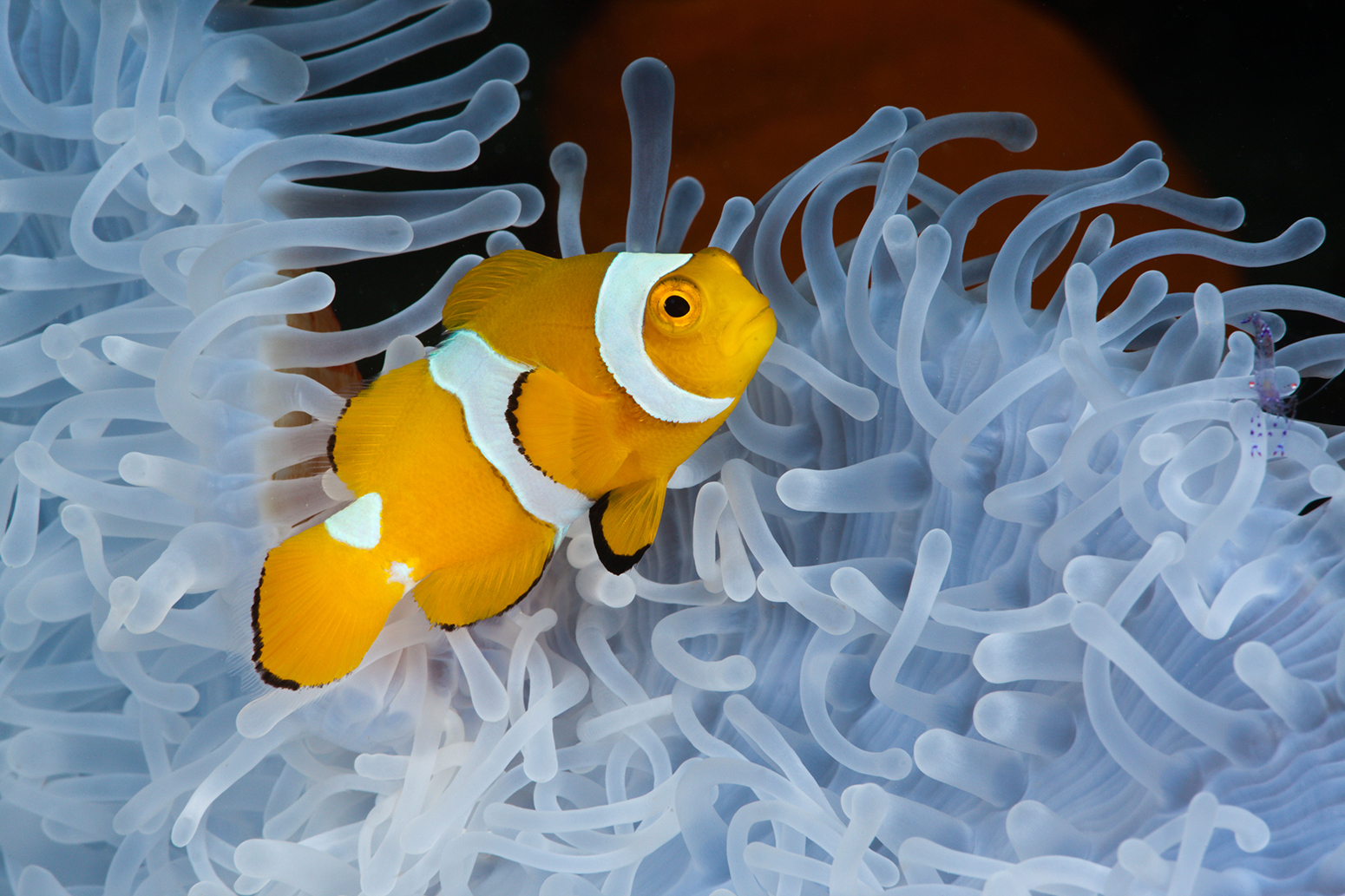
Image - Clownfish in a bleached Sea Anemone, Amphiprion ocellaris, Heteractis magnifica, West Papua, Indonesia, 2011. Credit: Reinhard Dirscherl / Alamy Stock Photo. - CBCMTR Clown Anemonefish in bleached Sea Anemone, Amphiprion ocellaris, Heteractis magnifica, West Papua, Indonesia. (note)Coral reefs are one of the most diverse habitats in the world. Despite covering just 0.1% of the ocean floor, reefs support around of the world’s fish biodiversity.With thanks to However, these colourful habitats are vulnerable to climate change. High sea temperatures are one of the main causes of coral bleaching, which occurs when stressed corals expel the tiny algae living in their tissues – known as – leaving behind a .The algae provide the corals with energy through photosynthesis. Without them, the corals . Although corals can recover from a bleaching event over time, persistent bleaching can kill off entire reefs.The new study, , is the first to make a global estimate of how both the frequency and severity of coral reef bleaching have changed over the last 40 years.It shows that bleaching events have become five times more frequent, with the average reef being affected once every 25 to 30 years in the 1980s and once every six years in 2016.The findings indicate that coral bleaching is a “modern phenomenon” driven by global warming, says study co-author , a Royal Society university research fellow and chair in marine ecology at . He tells Carbon Brief:
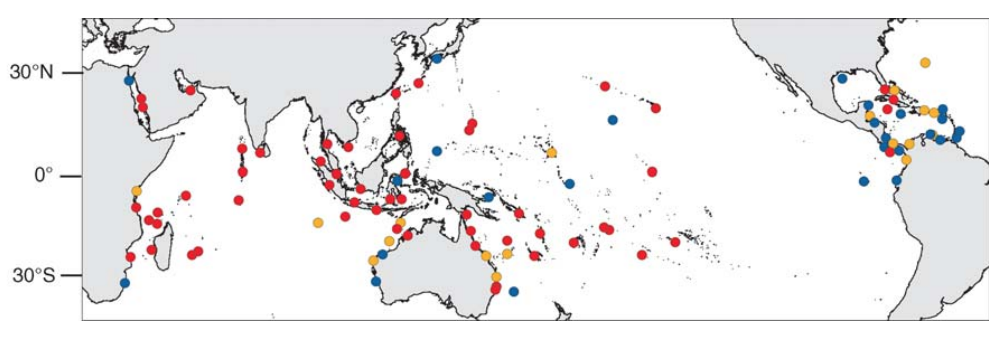
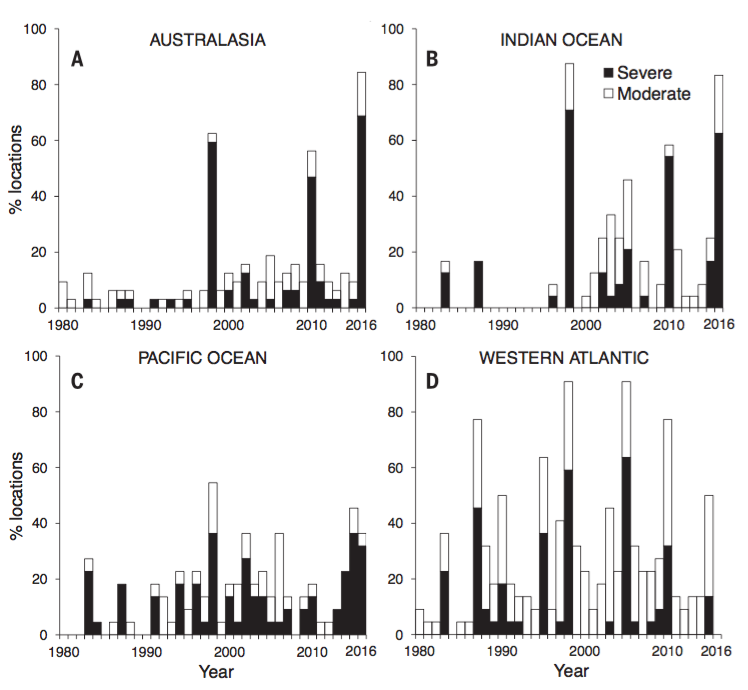
most recent mass bleaching eventImage - The global extent of coral bleaching from 2015-2016. Each circle represents one of 100 reefs, with red indicating severe bleaching, yellow indicating moderate bleaching and blue showing no bleaching. Source: Hughes et al. (2017) (note)sea levelImage - The percentage of coral reefs affected by moderate (white) and severe (black) bleaching from 1980 to 2016 in (A) Australasia, (B) Indian Ocean, ( C) Pacific Ocean, (D) western Atlantic. Source: Hughes et al. (2017) (note)For the study, researchers compiled data on coral bleaching from 1980 to 2016 for 100 coral reefs in 54 countries. The dataset drew from published research as well as direct observations.For each reef, the researchers recorded “severe bleaching” events – where more than 30% of corals were bleached at the scale of tens to hundreds of kilometres – and “moderate bleaching” episodes – where less than 30% of corals were affected over the same scale.They found that, across the globe, the risk of bleaching (both moderate and severe) has increased at a rate of 4% per year, with 8% of reefs being affected by bleaching per year in the 1980s and 31% being affected in 2016.The researchers also found that the , from 2015 to 2016, was the most severe on record, affecting 75% of the reefs examined in the study.The map below shows the global extent of coral bleaching in 2015 and 2016, with each circle representing one reef. Red indicates severe bleaching, yellow shows moderate bleaching and blue shows reefs where no substantial bleaching was recorded.Whether the impact of coral bleaching is moderate or severe determined by a range of factors, including local sea surface temperature and , as well as nearby human activity, such as pollution.From 1980 to 2016, the number of bleaching events was highest in the western Atlantic, including central America and the Caribbean, which experienced two to three times more events than other regions such as Australasia, the Indian Ocean and the Pacific Ocean.The charts below show the percentage of reefs that were affected by moderate (white) and severe (black) coral bleaching events in each of the four regions from 1980 to 2016.The research suggests that Australasia and the Middle East have experienced the largest increased risk of coral bleaching over the study period. However, the reason for this is still not clear, Graham says.
El Niño: Every five years or so, a change in the winds causes a shift to warmer than normal sea surface temperatures in the equatorial Pacific Ocean – known as El Niño. Together with its cooler counterpart, La Niña, this is known as the El Niño Southern Oscillation (ENSO) and is responsible for most of the fluctuations in temperature and rainfall patterns we see from one year to the next.
El Niño: Every five years or so, a change in the winds causes a shift to warmer than normal sea surface temperatures in the equatorial Pacific Ocean – known as El Niño. Together with… Read More
“Climate change is causing background sea surface temperatures to rise, such that a smaller and smaller temperature anomaly [rise] is causing corals to become stressed and bleached. El Niño events cause a big temperature anomaly and so, on top of the already warmed seas, the temperatures get far too hot and extensive bleaching occurs.”
“Importantly, other smaller anomalies are now sufficient to cause bleaching, so as climate change continues, coral bleaching events are occurring more and more frequently.”
The research shows that climate change is playing an increasingly large role in mass bleaching events, Graham says.Since 1980, 58% of severe bleaching events have been recorded during strong periods of .El Niño is a natural phenomenon occuring every five years or so that causes sea surface temperatures to rise in the equatorial Pacific Ocean. As the climate warms, the risk of bleaching during El Niño years is rapidly increasing, says Graham:The remaining 42% of events occured during hot summers in non-El Niño years. These kind of events are also increasing in frequency as the climate continues to warm, Graham says:
“Rapidly reducing carbon emissions is absolutely essential to save this iconic ecosystem that supports a third of all marine biodiversity, provides food security and livelihoods to hundreds of millions of people throughout the tropics and protects thousands of kilometres of coastlines from shoreline erosion.”
“The implications of this paper are dreadful: coral reefs as we know them may well vanish in the lifetime of the youngest of us. It is immensely important to make sure that the objectives of the Paris Agreement are met.
“Another implication is that the Paris Agreement will not be enough to save coral reefs. Other solutions must be identified but none, so far, seem to have the required effectiveness and scalability.”
“Even 1.5C warming will cause irreparable harm to coral reefs in many parts of the world. This is why we must redouble our efforts to limit climate change by reducing CO2 levels in the atmosphere, not just reducing emissions.”
The findings indicate that limiting global warming to 1.5C above pre-industrial levels, which is the aspirational goal of the , will be “essential” to give coral reefs a chance at survival, Graham says: has shown that limiting future global warming to 1.5C rather than 2C could greatly improve the Great Barrier Reef’s chances of survival.However, the research shows that even 1.5C of additional warming could spell disaster for much of the world’s coral, says , from the Institute for Sustainable Development and International Relations (), who was not involved in the research. He tells Carbon Brief:In recent months, there have been various plans and techniques proposed to help coral endure climate change, including the use of .One possible line of action to improve the survival chances of coral could be to remove CO2 from the atmosphere, says study co-author , coordinator of the US National Oceanic and Atmospheric Administration’s programme. This could in theory be achieved through the use of , Eakin tells Carbon Brief: