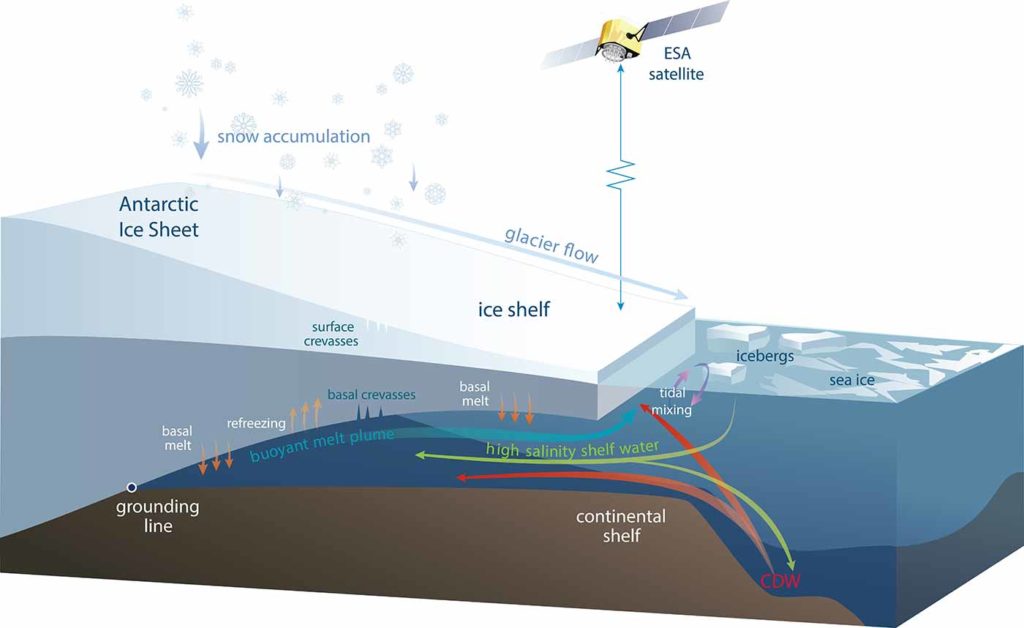
El Niño events are known for bringing floods to South America and contributing to wildfires in Indonesia, but new research reveals they also affect the height and mass of ice shelves in Antarctica.Ice shelves form where a glacier on land reaches the coast and the ice flows out onto the ocean to form a floating shelf.During an El Niño event, many of the ice shelves around West Antarctica receive more snow on their surface, but also lose more ice from underneath because of warm ocean water.Overall, the ice shelves actually lose mass during an El Niño, the research finds, making such events an important factor in the year-to-year fluctuations of ice shelf size.With more “extreme” El Niño events expected as global temperatures rise, West Antarctica’s ice shelves could see larger fluctuations in height and mass, the lead author tells Carbon Brief – on top of their accelerated thinning in response to climate change.
“In our previous work, we focused more on the trends. In this work, we actually remove the trends of the ice shelves and are more interested in this interannual variability of ice shelf height.
“During El Niño we have an increase in snowfall that means we have more mass being added on top of the ice shelf. The same wind patterns also control ocean circulation locally. In particular, it promotes the upwelling of warm Antarctic deep water onto the continental shelf and pushes it underneath the ice shelf. That water is warmer than the water the lies closer to the surface. Therefore, it promotes melting of the ice shelves at the base.”
“It turns out that the ocean removes more mass than the snowfall is able to add on top – just because these two mass changes have different densities.”
Around of Antarctica’s coast is fringed with ice shelves spilling out onto the water. They play an important role of “buttressing” the glaciers on land behind them, stopping ice flowing from the interior straight out into the ocean where it would contribute to sea level rise.The new study, published in , focuses on the ice shelves of the West Antarctic. These shelves hold back some of the fastest-melting glaciers on the continent.Using satellite data from four missions covering 1994 and 2017, the researchers identified a pattern in how the height and mass of the ice shelves fluctuate from one year to the next.Carbon Brief caught up with lead author at the of the last month. Paolo is a postdoctoral scholar at at the .Paolo starts out by explaining that their research concentrates only on the year-to-year variability of the ice shelves – not the general declining trend which has seen in response to human-caused warming. He tells Carbon Brief:The study finds a “very clear link” between the El Niño-Southern Oscillation (ENSO) and year-to-year fluctuations in the height and mass of the ice shelves, says Paolo.El Niño is a natural phenomenon that originates in the Pacific Ocean. Every five years or so, a change in the winds in the causes a shift to warmer than normal ocean temperatures, which has on weather conditions . ENSO also has a cold phase, known as “La Niña”, which brings cooler temperatures to the Pacific Ocean and also more widely.These impacts extend to affecting wind patterns in the West Antarctic. This stems from how ENSO influences a low-pressure weather system called the Amundsen Sea Low (), which tends to sit off the West Antarctic coast.The air pressure of the ASL tends to be higher during El Niño years and lower in La Niña years. Paolo explains what impact this has on the ice shelves in the region:(The continental shelf is the area of seabed immediately surrounding a land mass, where the sea is relatively shallow compared to the open ocean beyond it.)This means there are two opposite processes going on at once, says Paolo, so the next question to ask was: which one wins?The answer is two-fold. On the one hand, the height the ice shelf gains from the additional snowfall is greater than the ice that is lost from beneath. So the ice shelf gets thicker during an El Niño event.But, on the other hand, the fluffy snow that the ice shelf gains is not as dense as the solid ice it loses. This means that, overall, an El Niño causes the ice shelf to lose mass, explains Paolo:So, during an El Niño event, the ice shelves gain height, but lose mass.
“Since we saw the mass of the ice shelves fluctuate – and that can be affected by fluctuations in El Niño – then in the future we should expect a higher fluctuation.”
“These factors may influence ice shelf sensitivity to climate change in the future, so understanding controls on ice shelf surface mass balance is of imperative importance.”
Article information
Paolo, F. (2018) Response of Pacific-sector Antarctic ice shelves to the El Niño/Southern Oscillation, Nature Geoscience, doi:10.1038_s41561-017-0033-0
As global temperatures rise, that extreme El Niño events will become more frequent – even doubling under just 1.5C of warming above pre-industrial levels.This means the short-term variability in the height and mass of West Antarctica’s ice shelves may also increase in the future, says Paolo:This increase variability will need to be taken into account in how scientist project changes in the ice shelves as the world continues to warm, the study concludes. – a lecturer in physical geography at Royal Holloway, University of London, who was not involved in the research – stresses the importance of having a complete understanding of what affects the gains and losses of Antarctica’s ice shelves.The new study is “a thoughtful, original piece of work” and “very interesting indeed”, she tells Carbon Brief: