Timeline: The history of climate modelling
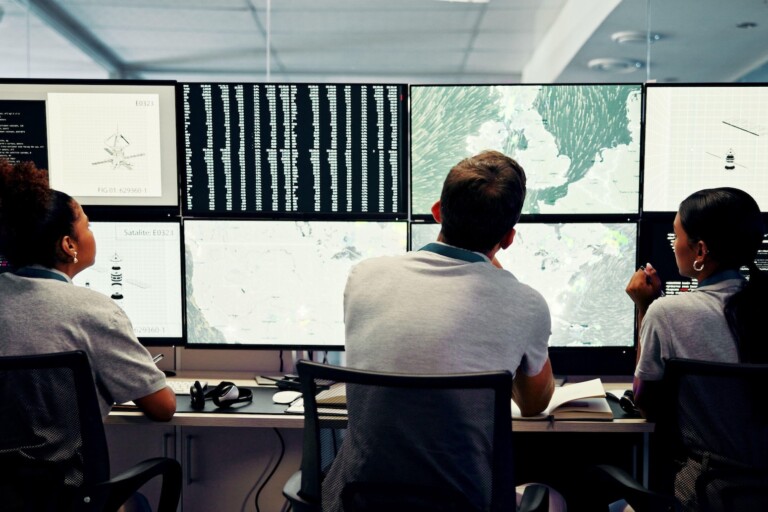
The climate models used by scientists today rely on some of the world’s most advanced supercomputers. It can take dozens of highly skilled people to build and then operate a modern-day climate model.
However, less than a century ago, climate models were little more than an idea; basic equations roughly sketched out on paper. After the second world war, though, the pace of development quickened dramatically, particularly in the US.
By the late 1960s, policymakers were being presented with the models’ findings, which strongly reinforced the theory that the continued rise in human-caused greenhouse gas emissions would alter the global climate in profound ways.
In the interactive timeline above, Carbon Brief charts more than 50 key moments in the history of climate modelling.
Such moments include…
- Guy Callendar’s seminal paper published in 1938.
- The first computerised, regional weather forecast in 1950.
- Norman Phillips’ first general circulation model in 1956.
- The establishment of a modelling group at the National Center for Atmospheric Research (NCAR) in Boulder, Colorado, in 1964.
- Syukuro Manabe and Richard Wetherald’s seminal climate modelling study in 1967.
- The Met Office’s first general circulation model in 1972.
- The Charney Report in 1979.
- James Hansen’s three scenarios published in 1988.
- The first Intergovernmental Panel on Climate Change (IPCC) report published in 1990.
- The Coupled Model Intercomparison Project (CMIP) launched in 1995.
- The IPCC’s fifth assessment report published in 2013.
Scroll through the various slides within the interactive timeline, above, by clicking on the arrows. Or you can use the calendar above each slide to jump to a particular moment within the history.
Article information
Carbon Brief would like to thank Prof Paul N Edwards, author of A Vast Machine: Computer Models, Climate Data, and the Politics of Global Warming, and Dr Gavin Schmidt, director of NASA Goddard Institute for Space Studies, for their suggestions and feedback during the timeline’s compilation.