Guest post: How ‘enhanced weathering’ could slow climate change and boost crop yields
Achieving the Paris Agreement goals of keeping global warming to “well below” 2C, or to 1.5C, above pre-industrial levels will require rapid decarbonisation of human society.But national commitments to rein in greenhouse gas emissions are currently insufficient to meet these agreed limits. It is increasingly likely that “negative emissions”, or “carbon dioxide removal”, technologies will be needed to take up the slack.These techniques involve extracting CO2 from the atmosphere and storing it indefinitely. Scientists have proposed a range of different approaches and we now need realistic assessment of these strategies, what they might be able to deliver, and what the challenges are.In a new paper for Nature Plants, we tackle an under-discussed technique of CO2 removal called “enhanced rock weathering”. Our research highlights the potential wider benefits for crop yields and soil health, and sets out a research agenda for the next steps.§ What is enhanced weathering?
Image - Graphic on 'Advanced weathering' (note)counteract ocean acidificationboost nutrient levels
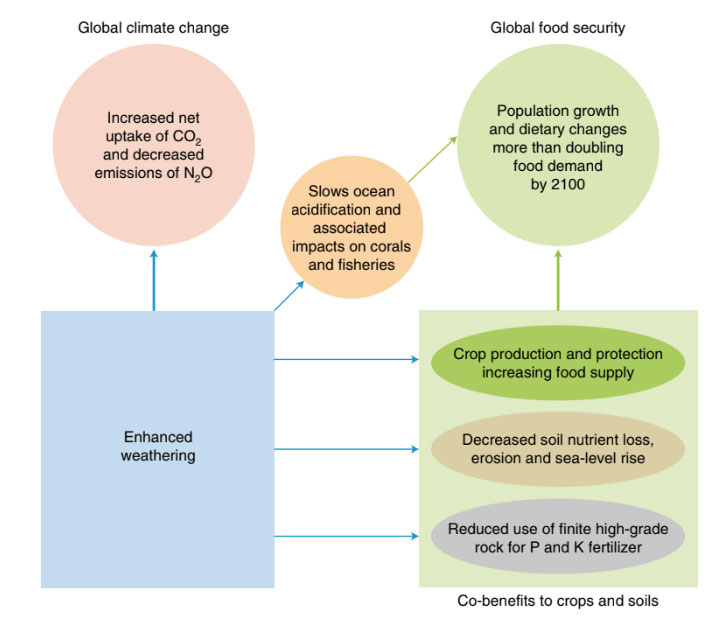
§ Food demand
11 billion by 2100growing contributor to climate change§ Estimates and challenges
12-year study most detailed analysis to date $39-100 per tonne of CO2 bioenergy with carbon capture and storage
§ Putting theory into practise
Article information
Beerling, D. J. et al. (2018) Farming with crops and rocks to address global climate, food and soil security, Nature Plants, doi:10.1038/s41477-018-0108-y
This article was updated on 21/02/2018 to amend the line “natural rock weathering absorbs around 3% of global fossil fuel emissions”. The correct figure is 0.3%.