The number of clashes between people and African lions could increase as temperatures rise, a new study suggests.The research shows that global warming could lead to changes in the geographical range of a disease carried by the tsetse fly – which can be deadly to cattle.It finds that, although the overall range of the disease is likely to increase, it could vanish from parts of eastern and southeastern Africa that support large numbers of lions. In turn, this could lead to cattle ranchers moving their animals into these areas.This could bring people and lions into close proximity, the lead author tells Carbon Brief, which may put herders in danger and trigger further declines in lion numbers.
“About one-third of lion areas, including key strongholds like Selous [game reserve in Tanzania] and Niassa [area in Mozambique] may see greater levels of cattle and therefore more conflict between lions and cattle if no mitigation measures are put into place ahead of time.”
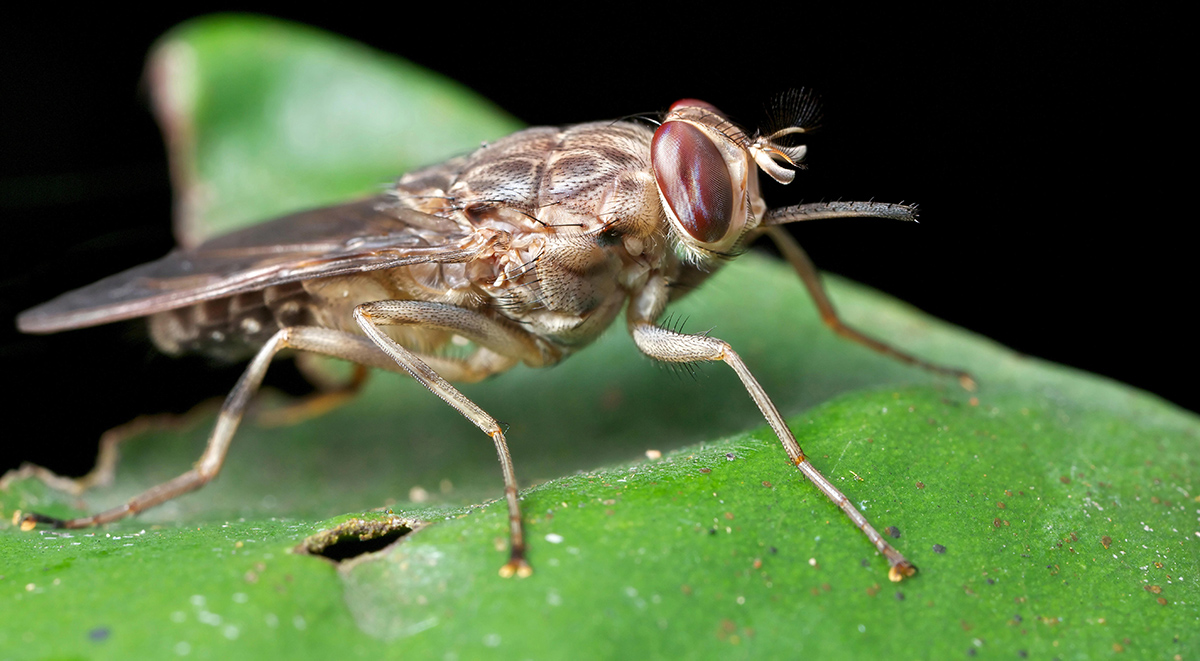
African lion numbers have dropped by over the last two decades, with violent clashes between humans and lions being one of the of this decline.Conflict commonly arises when lions prey on cattle, damage property or attack humans, which can lead to lions being . Other large threats to lions include habitat loss due to agricultural expansion and poaching for the animals’ pelts.In some parts of eastern Africa, the ranges of lions and humans do not overlap and conflict is kept to a minimum.Herders are less likely to rear cattle in these regions due to the prevalence of a disease called , which is caused by a microscopic parasite that is carried by the tsetse fly. The parasite also causes – or sleeping sickness – in humans.The disease is transmitted to cattle and other domesticated animals when tsetse flies feed on their blood and is responsible for every year in Africa, causing losses of around $1bn.The study, published in , finds that regional temperature rise is likely to cause shifts in the geographic range of the disease by 2050, with disease risk growing in parts of Zimbabwe, Rwanda and Uganda and falling in Kenya, Mozambique and Tanzania.This is because high temperatures can have an on the parasite that causes the disease while it is still developing.But the disappearance of the disease in some parts may encourage farmers to move further into the reserves and unprotected areas where wild lions live, says , a researcher in human-wildlife conflict from in the US. He tells Carbon Brief:
“Climate change will both expand and contract the geographic range of trypanosoma parasites in the next few decades. Although the areas in which the disease will expand is likely greater than those where it will contract, much of the area where it will shrink includes important lions areas.”
“We are primarily concerned with those areas where they may experience greater interactions, which happens to be quite a few places with important populations of lions.”
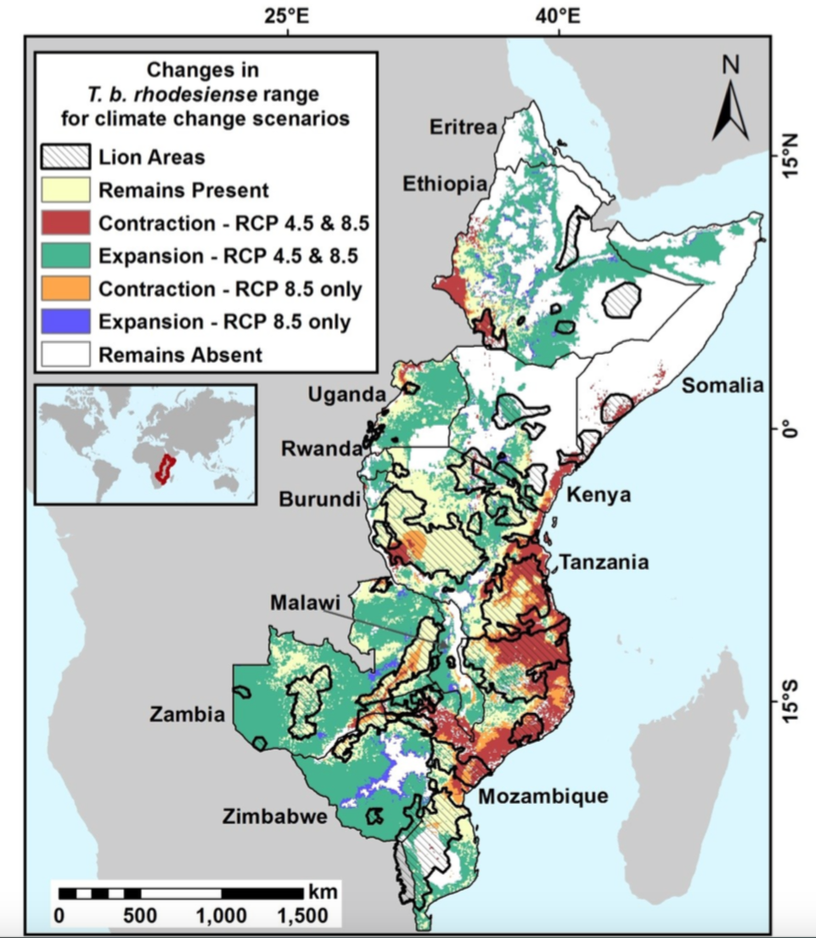
For the study, the researchers used models to simulate the future geographic range of the disease-causing parasite under an intermediate emissions scenario () and a “business as usual” or high emissions scenario ().The results are shown on the map below, where diagonal lines show areas with resident lion populations. The shading shows where parasite prevalence is likely to decrease (red and orange), increase (green and purple) and stay the same (yellow).The research finds that the overall area covered by the disease is likely to increase as the climate warms, including in parts of Eritrea, Ethiopia and Malawi. Carter says:The results find that the disease-causing parasite could disappear from 19-28% of the total area that is currently populated by lions in eastern Africa by 2050 and from 27-45% of “lion strongholds” – areas supporting more than 500 lions.Overall, changes to the parasite’s range could affect 3,900 lions under RCP4.5 and 6,500 under RCP8.5. These lions make up 11% to 19% of the total lion numbers in Africa, respectively.The results also show that many areas that do not currently support lion populations could experience an increase in disease prevalence by 2050. This may “push” farmers further into lion strongholds, increasing the risk of clashes, Carter says:He adds that is unlikely that lions will be able to colonise areas that are expected to experience an increase in disease risk. “New areas for lions to move to are likely very limited,” he says.
“It is impossible to provide a one-size-fits-all solution. On one hand, there are actions to reduce depredation to cattle by lions and therefore reduce retaliatory killing of lions by people. These actions are especially important in areas outside protected areas, where cattle numbers may increase near human settlements and pastures.”
“Human-wildlife conflict is a threat to big cat populations globally because people kill animals like lions, cheetahs and leopards to reduce real or perceived damage to their property. This is why it is crucial that we ensure that there are effective measures in place to reduce attacks on livestock whilst providing tangible incentives to local communities to tolerate wildlife.”
Article information
Carter, N. H. et al. (2018) Climate change, disease range shifts, and the future of the Africa lion, Conservation Biology, http://onlinelibrary.wiley.com/doi/10.1111/cobi.13102/full
The number of human-lion conflicts could be further increased by and ongoing efforts to eradicate the disease in eastern Africa, says Carter.To ease troubles for both lions and herders, new conservation practices could be needed as the climate warms, he adds:These could include the introduction of reinforced livestock enclosures and wildlife corridors to allow lions to travel around without coming into contact with herders, he says.The study provides “crucial new evidence” on how climate change could have a knock-on impact on the interaction between humans and lions, says , a carnivore conservationist from the Worldlife Wildlife Fund (), who was not involved in the study. She tells Carbon Brief: