Limiting warming to 1.5C could ‘substantially’ cut risk of ice-free Arctic summers
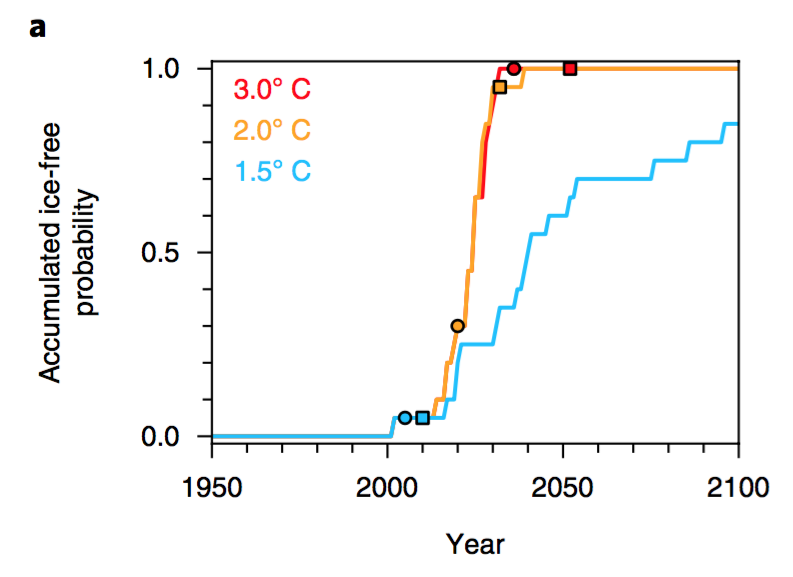
Meeting the Paris Agreement’s aspirational target of limiting global warming to 1.5C above pre-industrial levels could “substantially” reduce the risk of sea ice-free summers in the Arctic, research shows.Two new studies find that, under 1.5C of warming, Arctic waters could experience ice-free summers around 2.5% of the time, or one in every 40 years. Under 2C, ice-free conditions could occur 19-34% of the time – or once every three to five years.However, limiting warming to 1.5C will likely be not enough to prevent ice-free summers from occurring altogether, the researchers note.Such dramatic loss of sea ice could drive further increases in warming and result in habitat loss for a wide range of species, including polar bears, seals and walruses, one of the authors tells Carbon Brief.§ Out in the cold
annual peak extentyearly minimumsummer sea ice covera large role in the declineice freeProf Michael SigmondEnvironment Canadaone of the new studies“We found that under 1.5C, only one in every 40 summers is expected to be ice free in the Arctic, whereas under 2C, one in every five summers is expected to be ice free.”
Prof Alexandra JahnUniversity of Colorado Boulderthe second study“I was surprised that half a degree of warming would make such a big difference. The probability of seeing any month-long ice-free conditions are strongly reduced if warming is limited to 1.5C.”
§ Estimating ice loss
RCP8.5RCP4.5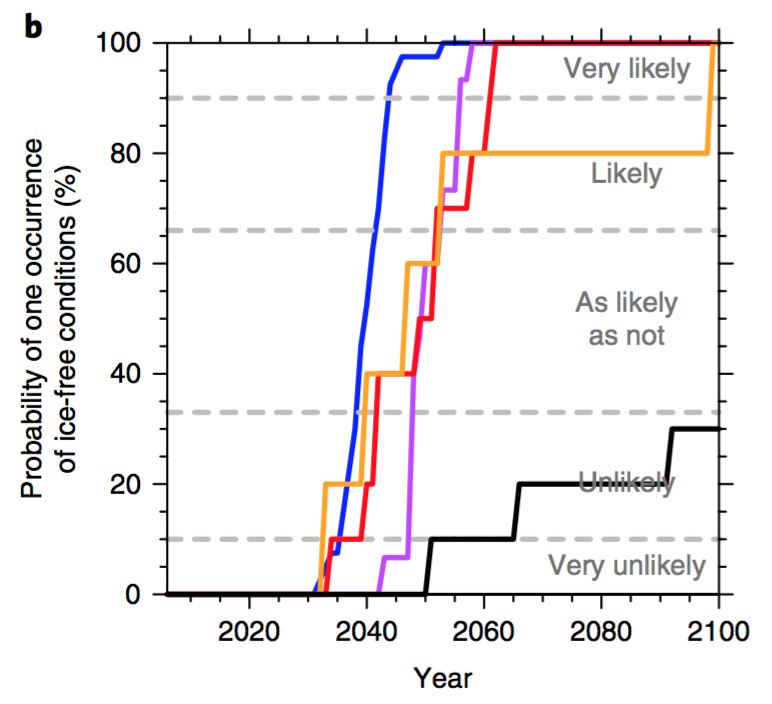
§ Measuring melting

“An important finding of our study is that the probability of ever reaching ice-free conditions continues to evolve after temperature stabilisation. Warming stabilization simulations are thus needed to properly assess the benefits of the Paris Agreement for Arctic sea ice.”
§ Growing loss
natural variabilityProf James ScreenUniversity of ExeterNews & Views articlenatural climate variability that leads to extremely low sea ice“Consider the analogy of the probability of rolling a six with a standard six-sided die. For each roll of the die, the chance of rolling a six is 1-in-6 (17%) and the chance of not rolling a six is 5-in-6 (83%).
“The more rolls of the die, the greater the chance of rolling a six at least once…There is a 30% chance of rolling a six at least once in two throws and a 60% chance in five throws. By twenty-five throws, the odds of rolling a six at least once are 99%.”
§ Paying the price
“Loss of habitat directly impacts polar bears, seals and walruses, which use the ice for foraging, reproduction and resting, and for also for people who use ice for hunting, travel and other activities.”
contribute to global warming“Ice loss also increases warming and can influence ocean circulation and weather – all of which can have impacts on people and ecosystems outside of the Arctic.”
“There is therefore agreement across climate models that the probability of an ice-free Arctic in September would be substantially reduced by achieving the 1.5C target of the Paris Agreement.”
Dr Amber LeesonUniversity of Lancaster“Each study uses a different climate model to come up with broadly the same conclusions – that if warming at 2C above pre-industrial temperatures is reached, and sustained, then we are locked in to an ice-free Arctic at least once before the end of the century.”
“Given the importance of these findings for climate change policy however, repeating this work in the context of a multi-model analysis – for example CMIP6 – is now a pressing concern.”
Article information
Jahn, A. (2018) Reduce probability of ice-free summers for 1.5C compared to 2C warming, Nature Climate Change, http://nature.com/articles/doi:10.1038/s41558-018-0127-8
Sigmond, M. et al. (2018) Ice-free Arctic projections under the Paris Agreement, Nature Climate Change, http://nature.com/articles/doi:10.1038/s41558-018-0124-y