Africa’s vegetation has lost 2.6bn tonnes of CO2 in just seven years
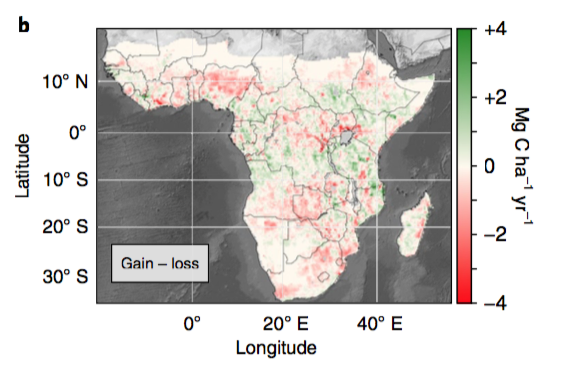
The rainforests, savannahs and woodlands of sub-Saharan Africa have lost around 2.6bn tonnes of CO2 over the past seven years, a new study finds.The large-scale loss of stored carbon – which on an annual basis is almost four times the CO2 emissions of Nigeria – was driven by a series of severe droughts across the continent, as well as deforestation, the research suggests.The results were gathered using a novel satellite technique, which allowed researchers to measure “deeper below the vegetation canopy” than ever before, the lead author tells Carbon Brief.§ Blank canvas
deforestationdroughtwildfiresone third50%scantNature Ecology and EvolutionDr Martin BrandtUniversity of Copenhagen“We find that severe droughts have caused huge carbon losses which are not restricted to rainforests but also happened in savannahs. Over the full period, losses in savannahs and woodlands were almost as high as in rainforests.”
§ Continental carbon
“[This method] is insensitive to clouds and almost insensitive to green vegetation, which allows the signal to sense deeper below the vegetation canopy and assess almost the entire vegetation layer including stems and branches.
“So the satellite is able to measure the water content of all vegetation, no matter how dense, and this can be used to estimate the biomass for both forests and savannahs.”
§ Damaging drought
El Niño“Natural factors clearly dominated over this period as much larger regions were affected – and the droughts in 2015 were extreme.”
“extreme” events more frequent“Human factors were observed more locally in rainforest areas but not clear in savannahs.”
“Climate plays a role, but the gains are much higher than one would expect. Migration to urban areas, land abandonment, conflicts and a decrease in wood gathering may play a role [in carbon density gains].”
§ Forest forecast
“If dry years become more frequent, large-scale carbon losses may exacerbate climate change, particularly in dry areas.”
“Our study therefore highlights the importance of timely monitoring of both tropical deforestation and the highly dynamic woody carbon stocks of savannah ecosystems for assessments of global carbon stocks.”
Article information
Brandt, M. et al. (2018) Satellite passive microwaves reveal recent climate-induced carbon losses in African drylands, http://nature.com/articles/doi:10.1038/s41559-018-0530-6