Marine heatwaves are now lasting longer and occuring more frequently across the world than in the early 20th century, a new study finds.The research, published in Nature Communications, compiles a global record of marine heatwaves going back as far as 1925 for the first time.The new dataset shows that marine heatwaves have become 34% more likely and 17% longer between the early 20th century and the early 21st century.As global temperatures rise further, “we can expect a continued global increase in marine heatwaves in future, with important implications for marine biodiversity”, the lead author tells Carbon Brief.
“In short, when daily ocean temperatures exceed a threshold for what is considered ‘very warm’ at that time of year – technically, the 90th percentile, meaning it is only exceeded with a 10% chance – for at least five days, we call it a marine heatwave.”
“We were able to borrow information across these three sources of data to piece together a single global record of marine heatwaves, going back to the early twentieth century.”
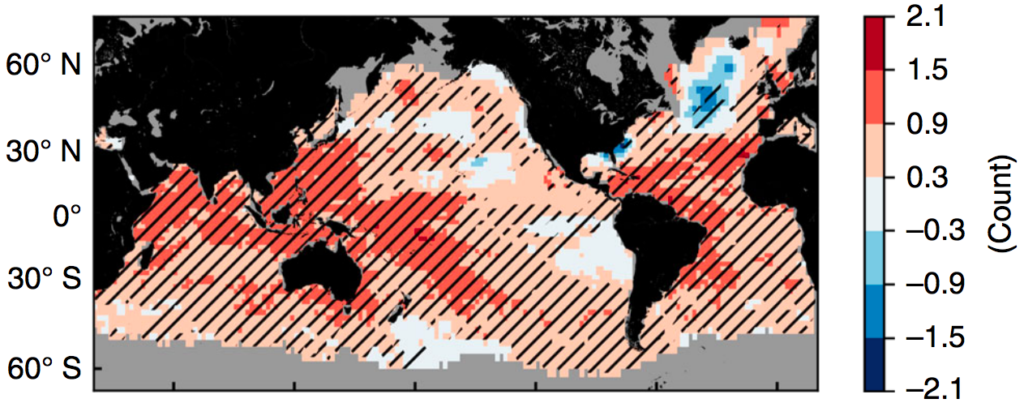
Image - Difference in marine heatwave frequency between 1925-54 and 1987-2016. Shading shows increases (red) and decreases (blue). Hatching indicates statistically significance results. Source: Oliver et al. (2018) - Graphic showing difference in marine heatwave frequency between 1925-54 and 1987-2016. Shading shows increases (red) and decreases (blue). Hatching indicates statistically significance results. (note)As with a heatwave on land, a marine heatwave is an extended period of unusually high temperatures. But while terrestrial heatwaves regularly around the world, their oceanic equivalents receive relatively little attention.Yet heatwaves in recent years have had considerable impacts on the marine environment.The Great Barrier Reef, for example, has seen in recent years caused by prolonged exposure to high sea surface temperatures (SSTs). A marine heatwave in 2010-11 caused the loss of 36% of the in Shark Bay – a “globally significant” store of carbon in Western Australia.Other impacts of these heatwaves include of marine species, of marine communities, and the need to .The new study quantifies, for the first time, the long-term changes in frequency and length of marine heatwaves as the climate warms.The researchers uses a definition of a marine heatwave that was recently agreed by an , explains lead author , an assistant professor in physical oceanography at in Canada. He tells Carbon Brief:The researchers pulled together SST data collected from coastlines, ships and satellites on daily and monthly timescales to create one record, says Oliver:The results show that, globally, marine heatwaves have become 34% more likely and 17% longer between the periods 1925-54 and 1987-2016. The result is that the number of days each year with a marine heatwave has increased by 54% since the early 20th century.As the map below shows, heatwave frequency has increased for 97% of the global ocean surface, with the North Atlantic the only exception. Most areas are seeing 0.3-1.5 more heatwaves per year (red shading) in 1987-2016 compared to 1925-54.Much of the recorded change has occurred over the past several decades, the study finds, which suggests that the warming trend has accelerated over the 1925–2016 period.
“Ocean currents move water around in the ocean and, as we know, some of these currents – including the Gulf Stream and the East Australia Current – carry warm water into otherwise cooler regions. If these currents get stronger than usual they can build up warm water in a particular region and trigger a marine heatwave.”
“Similarly, if the atmosphere is very warm and – in particular – if there are clear skies and weak winds then the upper layers of the ocean can warm up very quickly, also triggering a marine heatwave.”
“The ocean has taken up more than 90% of the extra heat that has been accumulated in the Earth system as a result of greenhouse gas emissions over the last several decades. The warming of the ocean increases the likelihood that extreme temperature in the ocean occur and, therefore, that marine heat waves will become longer and more frequent.”
“Given the likelihood of continued ocean surface warming throughout the 21st century and the accelerating trend observed in recent decades, we can expect a continued global increase in marine heatwaves in future, with important implications for marine biodiversity.”
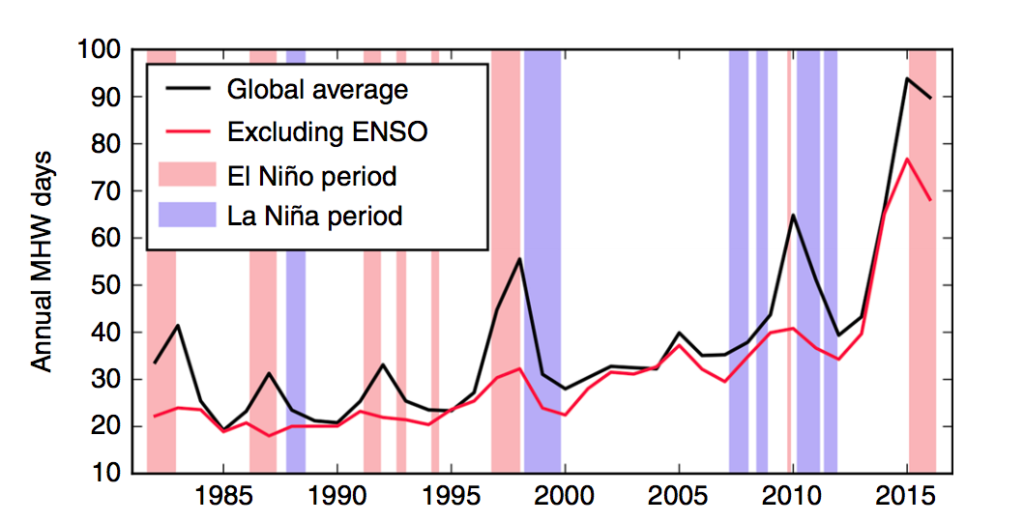
There are numerous ways that a marine heatwaves can develop, says Oliver. The two main mechanisms are via ocean currents or the atmosphere, he explains:(The Gulf Stream carries warm water from the Gulf of Mexico into the North Atlantic, while the East Australia Current (EAC) moves warm water down the east coast of Australia. The EAC made an unlikely Hollywood appearance in the 2003 Pixar film, , when Marlin – the father of the eponymous clownfish – on the current from the Great Barrier Reef towards Sydney.)Heatwaves in the ocean can also be caused by conditions in the air above it, explains Oliver:The observed increase in marine heatwaves can mostly be explained by increases in global temperature, the study says. For example, warming SSTs are behind the increasing frequency of heatwaves for more than 80% of the ocean surface area. from the ocean modelling group at the in Switzerland, who was not involved in the study, explains:The study also calculated the separate contribution from different sources of natural variability in the oceans – such as the (ENSO), and the . And while they found that these natural phenomena played a role in heatwave likelihood at the regional scale, they did not affect the long-term increasing trends.The chart below shows the global number of marine heatwave days per year from 1982 to 2016 with (black line) and without (red) the influence of ENSO included. While removing the impact of ENSO dampens some of the peaks in marine heatwave days, the increasing trend remains.With the role of human-caused climate change identified, it follows that marine heatwaves will continue to increase as global temperatures rise further, concludes Oliver:
“This is a very important and timely study as a growing number of studies have reported that recent marine heatwaves strongly impact corals and other marine ecosystems, which further impacts economies and societies.”
“It will be interesting to see how these marine heatwaves will change under future global warming and where the possible increase will be most pronounced.”
Article information
Oliver, E. C. J. et al. (2018) Longer and more frequent marine heatwaves over the past century, Nature Communications, doi:10.1038/s41467-018-03732-9
By identifying how the frequency of marine heatwaves has changed in recent decades, the study closes an important knowledge gap, says Frölicher. He tells Carbon Brief:While the body of research for land-based heatwaves is considerable, there is still much to establish about the wider impacts of marine heatwaves in a warming world, Frölicher adds: