CO2 emissions from wildfires have fallen over past 80 years, study finds
The annual amount of CO2 emitted as a result of wildfires has fallen over the past 80 years, a new study finds.The research finds that, over the past few decades, large areas of forest and savannah have been converted to cropland, meaning that the overall area that could be burned by wildfires has decreased.However, this drop in wildfire emissions has not led to a large net drop in CO2 emissions from land use, the lead author tells Carbon Brief. This is because a rise in emissions from deforestation for cropland largely counteracted the decline in wildfire emissions over the past century.The new research is “innovative”, but may overlook some factors, such as how wildfire severity has changed over time, other scientists tell Carbon Brief.§ Feeling the burn
90% in the USNature Communicationslarge releasesDr Vivek AroraCanadian Centre for Climate Modelling and Analysis“Our paper shows that, since the 1930s, increasing population densities and cropland area have led to a decrease in area burned by wildfires and an associated decrease in wildfires CO2 emissions.”
§ Looking back in time
“Models are mathematical representations of how nature works, but they are only as good as our understanding. However, they do allow us to go back in time – and into the future – and ask questions which we are not able to ask using observations alone.
“In this case, we asked how individual factors like increases in crop area and population densities over time have affected the global wildfire behaviour and what is the resulting effect on carbon uptake by land. These kind of model simulations allow us to tease out the effect of individual drivers.”
§ Inferring infernos
Global Fire Emissions Database.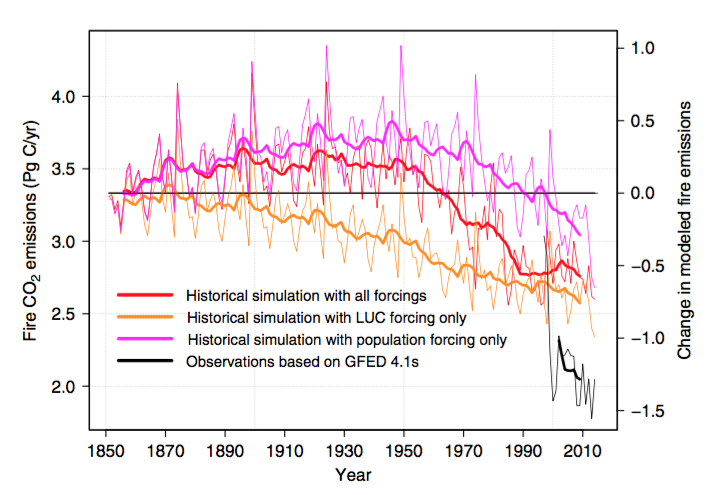
§ Changing landscape
“We show that the decrease in wildfires CO2 emissions associated with increasing population densities has led to an enhanced carbon uptake by land.”
Mexico§ Fanning the flames
Prof Guido van der WerfVrije UniversityGlobal Fire Emissions Database“For me, one interesting aspect is that the carbon sink due to decreased fire is not so much in areas where the decline is largest but originates mostly from places with active fire suppression.”
Prof David BowmanUniversity of Tasmania“The entire argument hinges on area burned. Severity is the most important factor in understanding wildfire impacts – high severity forest fires are stand replacing [meaning that almost or all of the trees are killed] so a lot of carbon is lost.”
Previous researchwildfire severityresearchProf António FerreiraResearch Center for Natural Resources, Environment and Society“In the Mediterranean area, despite urbanisation and land use change to agriculture, the number of fires and burned area has increased immensely over the last few decades.
“We need a more elaborated model, with more variables. But the approach is innovative and is a step forward in linking fires to climate change.”
Article information
Arora, V. K. & Melton, J. R. (2018) Reduction in global area burned and wildfire emissions since 1930s enhances carbon uptake by land, doi:10.1038/s41467-018-03838-0