Analysis: The gender, nationality and institution of IPCC AR6 scientists
Since being founded in 1988, the Intergovernmental Panel on Climate Change (IPCC) has published five sets of “assessment reports” on the state of climate science, involving hundreds of scientists from across the world.A sixth set (“AR6”) is slated for completion in 2022, with the IPCC issuing a call for nominations for authors in September last year. The final lists of authors for all three “working groups” have now been confirmed.For AR6, the IPCC has selected 721 authors, representing 90 different nationalities. This is a slight reduction on the 829 authors for the fifth assessment report (AR5) published in 2013-14. Using the information provided by the IPCC, Carbon Brief reveals the mix of nationalities and genders across the authors, as well as the institutions they represent.§ Nationality
The IPCC lists authors under its three working groups: Working Group I (WG1), “The Physical Science Basis”; Working Group II (WG2), “Impacts, Adaptation, and Vulnerability”; and Working Group III (WG3), “Mitigation of Climate Change”.§ Gender balance
The IPCC provides binary male/female data for all the AR6 authors. Across all 721 authors of AR6, 67% are male and 33% female. This compares with 79% vs. 21% for AR5.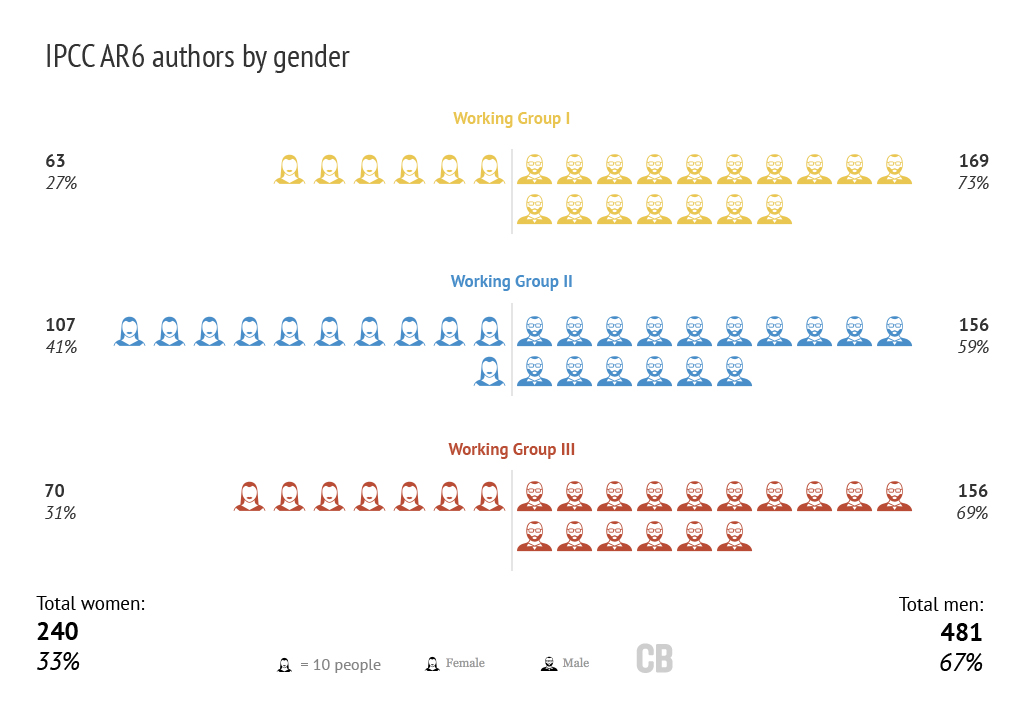
§ Institutions
International Institute for Applied Systems AnalysisUniversity of TokyoNational Center for Scientific ResearchNational Oceanic and Atmospheric AdministrationUniversity of Cape TownUniversity of ReadingCommonwealth Scientific and Industrial Research OrganisationFederal University of Rio de Janeiro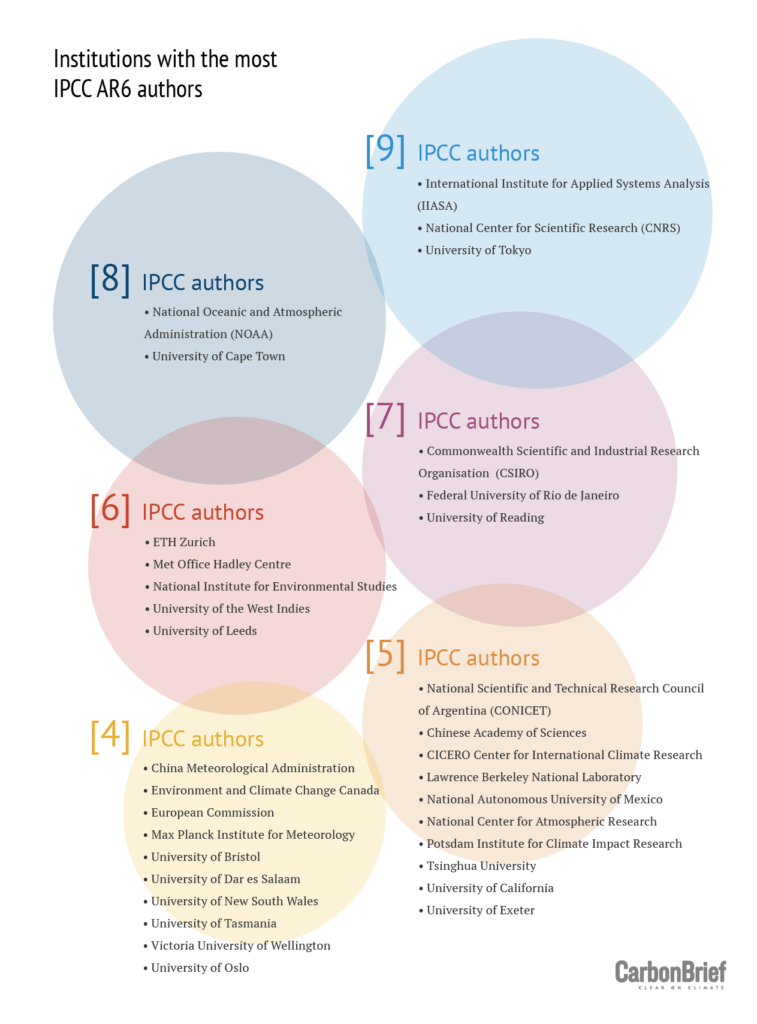
Article information
Update: This article was updated on 07/02/2019 to reinstate some weblinks that had broken when the IPCC launched their new website.