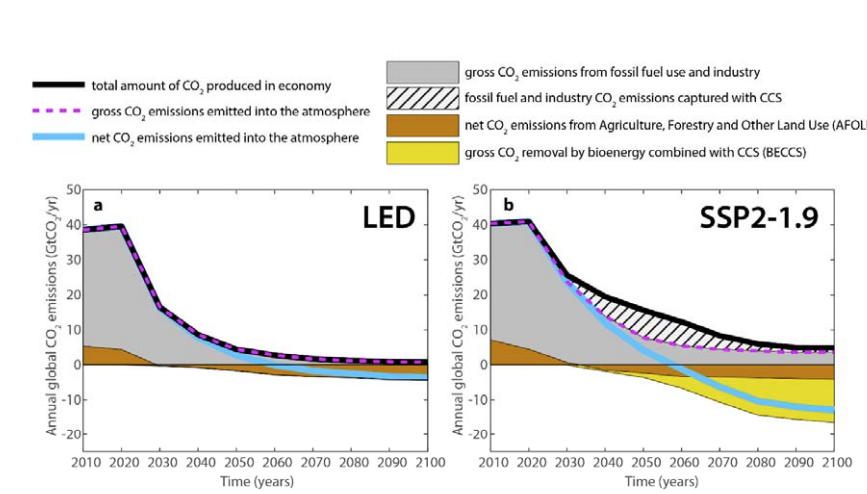
It is possible to limit global warming to 1.5C and achieve many of the sustainable development goals without “negative emissions technologies”, a new study finds.The research suggests that improving energy efficiency – chiefly by saving on everyday energy use – could play a major role in restricting warming to 1.5C above pre-industrial levels, which is the aspirational target of the Paris Agreement.Emerging technologies, such as multipurpose smartphones and electric autonomous cars, could be key to improving energy efficiency both in the developed world and the global south, the lead author tells Carbon Brief.The “landmark” study provides policymakers with tools to implement strategies to rapidly increase energy efficiency, another scientist tells Carbon Brief.
“We develop a coherent big-picture storyline of how the world may change from today to 2050, identifying key drivers of change including: rising quality of life, urbanisation, digitalisation, and decentralisation of the energy system.
“We find that global warming can be limited to 1.5C without relying on negative emission technologies by reducing the energy required to provide for rising living standards – particularly in the global South.”
Under the Paris Agreement, countries agreed that warming should be limited to “well below” 2C above pre-industrial levels, with efforts to keep it below 1.5C. Since then, researchers have developed a range of scenarios to explore how this could be achieved.Until recently, scenarios limiting warming to 1.5C have on the rapid and widespread deployment of negative emissions technologies (NETs). are a group of methods – many still in development – that would limit global warming by removing CO2 from the air and storing it on land, underground or in the oceans.In particular, most 1.5C scenarios assume that the world will develop large-scale bioenergy with carbon capture and storage (). Put simply, BECCS involves burning biomass – such as trees and crops – to generate energy and then capturing the resulting CO2 emissions.The assumption that BECCS will be needed to reach 1.5C has proved among some groups. This is because BECCS has yet to be demonstrated at a commercial scale and that deployment would take up large amounts of land, which could threaten food production and wildlife.In March, covered research showing, for the first time, how the world could limit warming to 1.5C with “minimal to no” BECCS. The study looked at several pathways for tackling climate change without BECCS, including by adopting low-meat diets, limiting population growth and by increasing crop yields.However, the new study, published in , describes an alternative scenario where warming is limited to 1.5C by improving energy efficiency, with no use of negative emissions technologies.Increasing efficiency would also come with significant co-benefits for the developing world, says study lead author , a scientist from the . He tells Carbon Brief:
Integrated Assessment Models: IAMs are computer models that analyse a broad range of data – e.g. physical, economic and social – to produce information that can be used to help decision-making. For climate research, specifically, IAMs are typically used to project future greenhouse gas emissions and climate impacts, and the benefits and costs of policy options that could be implemented to tackle them.
Integrated Assessment Models: IAMs are computer models that analyse a broad range of data – e.g. physical, economic and social – to produce information that can be used to help decision-making. For climate research, specifically,… Read More
“We don’t focus on behavioural change as a result of conscious or ‘mindful’ awareness of energy consumption – rather we focus on consumer-facing innovations which may prove attractive because they’re cheaper, cleaner, quicker, more sociable, easier, more convenient or otherwise ‘better’.”
“We sensitised our results by increasing energy demand by up to 50% (relative to the main LED scenario) and we found we could still limit warming to 1.5C without BECCS. So the basic insight of the scenario is robust to rebound of up to 50%, which is above the typical range of direct rebound effects found in the literature.”
“The integration of multiple service functions in single devices (particularly smartphones) yields up to a 100-fold potential power savings while in use. Devices increasingly become ‘smart’ and interconnected, which opens up potential for controllability.”
“Real-time information via mobile devices support shared vehicle fleets (including autonomous vehicles) and flexible transit systems. By 2050, the total vehicle numbers halve to around 850m light-duty vehicles.”
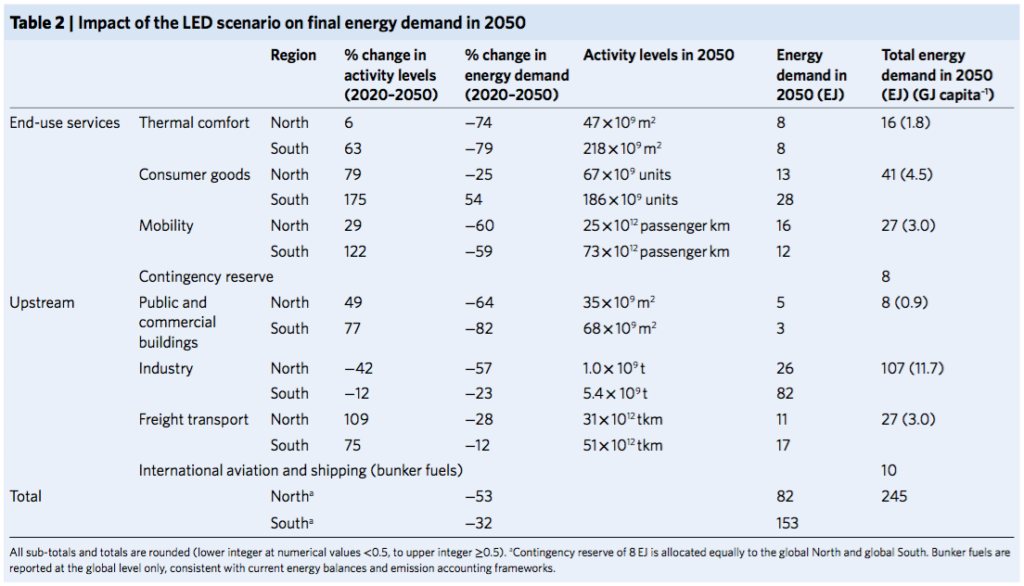
In the scenario, improvements in energy efficiency are largely driven by technological and social innovations, such as the spread of digital services in the global south and the rise of vehicle-sharing in the global north, says Wilson:The study does not directly address the – which occurs when technological innovation increases efficiency – but also demand for the resource – leading to a rise in overall consumption. However, indirectly, the results are robust to the Jevons effect, Wilson says:These changes are made at both the consumer (end-use services) and industrial (upstream) level. The table below summarises the expected changes to energy demand from different sectors in the global north and south.The table shows how, in most sectors, energy demand is expected to decrease despite rises in activity levels. This reflects steep increases in energy efficiency across each sector, Wilson says.For example, the scenario expects the ownership of “consumer goods” – household appliances used for cooking, entertainment and communication – to increase by 80% in the north and by a factor of three in the south.However, the scenario expects that “energy efficiency improves significantly per device”, the paper notes:The scenario also considers that mobility-related activity (such as owning a car and using public transport) is expected to double in the global south as populations, incomes and leisure opportunities rise.However, the scenario expects that “the rapid market diffusion of electric cars” will allow for large power savings despite surges in demand.In the north, the scenario expects that further savings will be made as ride-sharing rises in popularity. The paper notes:
“In all regions, consumer awareness mixed with climate policy incentives also influence the composition of diets at the product level, with less rice and red meat consumption.”
“Afforestation may be a net sink and so ‘negative emissions’, but we do not consider it to be a ‘technology’.”
While the scenario focuses on changes in energy use, it also includes some other assumptions.For example, the scenario expects the global food supply to expand by one-third globally to feed growing populations and to eradicate hunger in the developing world.In the scenario, this is achieved by agricultural intensification and by a switch to “”, which include less red meat and more fruit and vegetables. The table below shows expected changes to calorie and meat consumption from 2020-2100.The scenario expects that, in the north, calorie consumption will remain relatively constant over time. This is because further rises in income and choice may lead to more calorie consumption, but the rise may be roughly offset by advances in health awareness and quality of life, Wilson says.In comparison to today, red meat consumption is expected to fall “very slightly” in both the north and south by 2050, Wilson says. In the research paper’s supplementary information, the authors note:The scenario also expects forest cover to increase by 300m hectares by 2100. These additional trees are expected to absorb 168bn tonnes of CO2.This is largely achieved by creating new forests (), Wilson says. The research team do not consider afforestation to be a negative emissions technology, he adds:
“Focusing on energy services and the energy required to provide those services is the single most important way of addressing climate change while raising living standards.”
“It is unlikely we can get to 2C or 1.5C without negatieve emissions, but given the risks involved in a large scale use of negative emissions, it is really important to explore pathways that could tell us how to minimise their use. As such, it is a landmark study that could help policymakers to focus more on implementing strategies to rapidly increase energy efficiency.”
“Hitting 2C – let alone the 1.5C climate target – is probably unobtainable without radical and disruptive change in all elements of society, the impacts of which will be unequally distributed.”
Article information
Grubler, A. et al. (2018) A low energy demand scenario for meeting the 1.5C target and sustainable development goals without negative emission technologies, Nature Energy, https://www.nature.com/articles/s41560-018-0172-6
The findings show that policymakers should focus on implementing strategies to improve energy efficiency, Wilson says:The study shows how improving energy efficiency could have co-benefits for the environment and society, says , senior researcher in the department of climate, air and energy at the , who was not involved in the study. In March, van Vuuren published looking at 1.5C scenarios without BECCS. He tells Carbon Brief:The research highlights how a societal shift will be necessary to limit global warming to 1.5C without NETs, says from Imperial College London’s , who was not involved in the research. He tells Carbon Brief: