Global warming could be causing tropical storms to ‘slow down and last longer’
Rising global temperatures could be causing tropical storms to slow down, allowing them more time to unleash heavy rainfall once making landfall, a new study suggests.
The research, published in Nature, finds the speed at which they travel across the Earth has slowed by an average of 10% over the past 70 years, with the speed of storms originating in the Western North Pacific falling by 30%.
A “notable example” of this effect was seen during Hurricane Harvey, which “stalled” over Houston, releasing 100cm of rain in just three days, the study author tells Carbon Brief.
Although the new study finds a link between temperature rise and storm slowdown, it is possible that natural climate variability has also played a role in the downturn, the author adds.
However, the new analysis does not consider a range of factors affecting the forward speed of tropical storms, including the time of year and local weather conditions, another scientist tells Carbon Brief.
§ Slowing storms
Climate change can worsen the intensity of tropical storms (such as hurricanes, typhoons and cyclones) in several ways, including by making record rainfall more likely and by causing sea levels to rise, which can raise the risk of storm surges.
The new research looks at how warming could influence the “translation speed” of tropical storms – the speed at which they move across the Earth.
Storms travel as they are carried along global atmospheric circulation patterns – a worldwide system of winds which transport heat from the equator towards the poles.
Climate change is expected to weaken the world’s circulatory winds, which could, in turn, lead to a slowing of the speed at which tropical storms move forwards, says study author Prof James Kossin, an atmospheric scientist at the National Oceanic and Atmospheric Administration’s (NOAA) Center for Weather and Climate. He tells Carbon Brief:
“Tropical cyclones are moving more slowly over the past 70 years or so. The slowing is seen in every ocean basin, except the Northern Indian Ocean. This is having impacts on local rainfall amounts. It could also be impacting coastal storm surge and wind damage.”
As storms slow, they can last for longer over one area, releasing large amounts of intense rainfall. This could pose a threat if storms stall above areas vulnerable to flooding, such as large urban areas, says Kossin. A “notable example” of this effect occurred during Hurricane Harvey, he says in his research paper:
“The unprecedented rainfall totals associated with the ‘stall’ of Hurricane Harvey over Texas in 2017 provide a notable example of the relationship between regional rainfall amounts and tropical-cyclone translation speed.”
§ Data deluge
For the study, Kossin analysed tropical storm data taken from NOAA’s International Best Track Archive for Climate Stewardship (IBTrACS). “Best-track data” includes information of tropical storm intensity, position and wind structure. The findings suggest that the forward speed of hurricanes fell by an average of 10% between 1949 and 2016.
However, the change in storm-forward speed varied widely from region to region.
The charts below show changes in storm-forward speed in (from top left to bottom right) the North Atlantic, Western North Pacific, Eastern North Pacific, Northern Indian, Southern Hemisphere (less than 100 degrees longitude) and Southern Hemisphere (more than 100 degrees longitude) over the 70-year period. Changes in speed are shown over land (black line) and sea (dotted line).
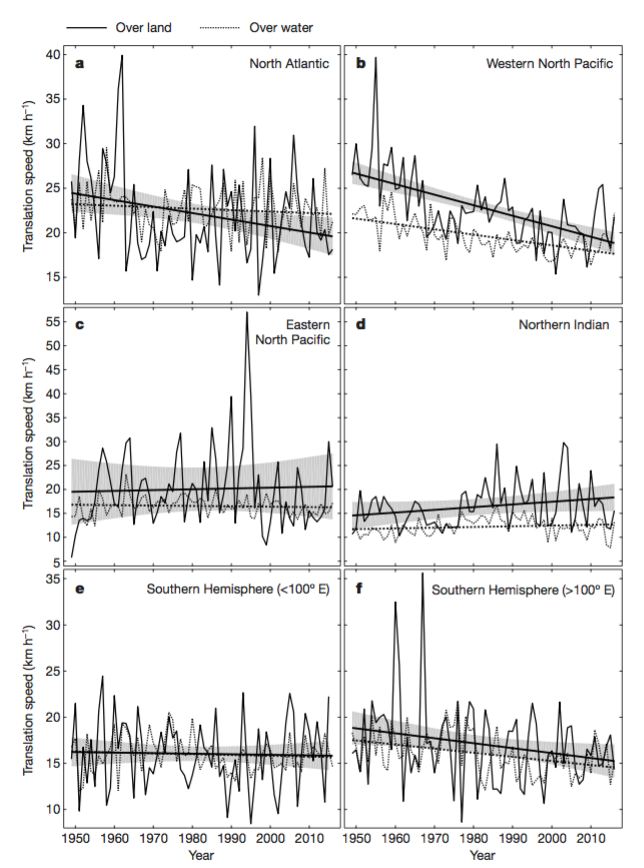
The charts show how the largest reductions in speed have occured in the Western North Pacific – where the speed of tropical storms fell by 30% – and the North Atlantic, where speeds fell by 20%. In the Australian region, the speed of tropical storms slowed by 19% – although the statistical significance of this result is “marginal”, Kossin says.
However, storms originating in Eastern North Pacific and Northern India do not appear to have slowed over the study period. This could be down to natural climate factors, such as changing ocean currents, Kossin says.
§ Human fingerprint?
Although the analysis finds a link between falling storm speed and temperature rise, it does not constitute a “single attribution study”, Kossin notes in his research paper.
Attribution studies attempt to work out to what extent climate change could have influenced the likelihood of an extreme weather event, when other factors, such as natural climate variability, are also considered.
However, this analysis does not attempt to tease apart the impacts of human-caused climate change and natural variability, says Kossin:
“The human-caused factors would be things such as anthropogenic global warming, changes in air pollution, land-use change, ozone depletion, but mostly anthropogenic global warming. The natural factors would be just the internal variability of the planet, for example, naturally varying ocean currents.”
Due to this, it is “far from clear that global climate change has anything to do with the changes being identified” in the study, says Prof Kevin Trenberth, a senior scientist at the National Center for Atmospheric Research (NCAR) in Colorado, who was not involved with the research. He tells Carbon Brief:
“There are some major decadal variations in play. In the Pacific, there is the Pacific Decadal Oscillation.”
The Pacific Decadal Oscillation (PDO) is a recurring climatic event that affects vast areas of the Pacific Ocean. It has “positive” and “negative” phases, which can each last 20-30 years.
§ Storms on the horizon
The findings provide a “significant scientific advance” in the world’s understanding of how climate change could influence tropical storms, says Dr Shuai Wang, an atmospheric physicist from Imperial College London, who was not involved in the study. He tells Carbon Brief:
“Tropical cyclones are one of Mother Nature’s most devastating hazards. Based on the findings in this article, it is likely – or very likely – that the motion of tropical cyclones has slowed down.”
However, the analysis has not taken into consideration several factors that may have influenced changes to storm-forward speed over the past 70 years, says Trenberth:
“The month of the storm matters. The translation speed is expected to be different in July, September and November. This should have been taken into account. The track and speed of a storm is heavily dependent on the weather patterns in play: the distribution of anticyclones, and cyclones, cold fronts, jet streams, troughs of low pressure and so forth. There is no evidence that these are changing, on the contrary, the expectation even 50 years from now is that the changes will be imperceptible.”
Article information
Kossin, J. P. (2018) A global slowdown of tropical-cyclone translation speed, Nature, https://www.nature.com/articles/s41586-018-0158-3