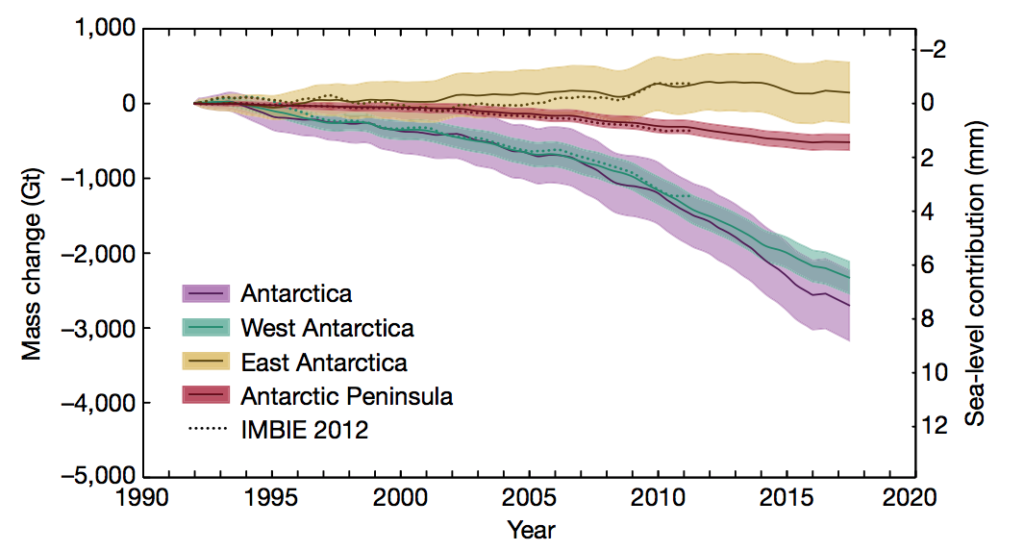
The rate of sea level rise resulting from the melting of the Antarctic ice sheet has tripled over the past five years, according to new research from a global team of scientists.The study, published in Nature, finds that ice loss from Antarctica has caused sea levels to rise by 7.6mm from 1992-2017, with two fifths of this increase occurring since 2012.At a press conference held in London, scientists said the results suggest that Antarctica has become “one of the largest contributors to sea level rise”.A glaciologist not involved in the paper tells Carbon Brief that the findings show “there now should be no doubt that Antarctica is losing ice due to regional climate change, likely linked to global warming”.
IMBIElast assessment report3.2mmProf Andrew ShepherdNERCUniversity of LeedsEmbedded component (note)The new research was carried out by a team of scientists from the Ice Sheet Mass Balance Inter-comparison Exercise (). The international group was established in 2011 with the aim of creating a comprehensive view of how melting in world’s polar regions could be contributing to sea level rise.In its , released in 2012, it found that ice melt in Antarctica was causing global sea levels to rise by 0.2mm a year. (Over the past two decades, global sea levels have risen around a year in total.)However, the new analysis finds that Antarctic ice melt is now driving sea level rise of 0.6mm a year – suggesting that the rate of melting has increased three-fold in just five years.The results show that Antarctic ice melt has become “one of the largest contributors to sea level rise”, says , co-leader of IMBIE and director of the Natural Environment Research Council () Centre for Polar Observation and Modelling based at the .Speaking on the sidelines of a press conference held in London, he explains the significance of the new findings to Carbon Brief.
“We now have a signal that is large enough that those adjustments we have to make are smaller than the signal that we’re seeing. So we’re very confident in the net result – which is Antarctica seems to be losing ice mass, enough to cause about 0.6mm of sea level rise per year.”
For the new study, the researchers combined data on ice cover and weight taken from a range of satellites, including NASA’s Gravity Recovery and Climate Experiment () mission and the European Space Agency’s mission.The team then used models to adjust the data to take into account physical processes that might have influenced sea level changes – such as how the ground beneath ice sheets responds to shrinking ice cover.The resulting data reveals a “clear signal” showing an acceleration in the rate of Antarctic ice sheet melt, says, co-leader of IMBIE and a senior research scientist at the . He tells Carbon Brief:
“The three-fold increase puts Antarctica now in the frame as one of the largest contributors to sea level rise. The recent acceleration makes us have concerns about the future.”
“There now should be no doubt that Antarctica is losing ice due to regional climate change, likely linked to global warming. If these rates of sea level rise continue, they will put low-lying cities like London and New York at severe risk of increased flooding.”
Though the study did not seek to make future predictions about how Antarctic melting could influence sea level rise, it does cause “concerns for the future”, Shepherd says:In the video below, Ivins explains that Antarctic melting could become a far larger driver of sea level rise than melting from Greenland – which was to be the biggest driver of global sea level rise.The findings are “significant” because they encompass “new satellite missions and advances in geophysical techniques and corrections”, says , a glaciologist at the National Snow and Ice Data Center Group () at the , who was not involved in the research. She tells Carbon Brief:The research is part of a special issue in Nature, which includes five papers exploring Antarctica’s , and .