Guest post: How global warming is causing ocean oxygen levels to fall
Prof Andreas Oschlies is head of the marine biogeochemical modelling group and speaker of the Collaborative Research Centre SFB 754 at the Helmholtz Centre for Ocean Research Kiel (GEOMAR) and Kiel University, Prof Peter Brandt is professor of physical oceanography at GEOMAR and Kiel University, and Dr Lothar Stramma and Dr Sunke Schmidtko are senior scientists in the physical oceanography group at GEOMAR.Direct measurements show the amount of oxygen in the global oceans has decreased by around 2% over the past 50 years.Climate change is thought to be a principal cause of this “deoxygenation”, affecting how much oxygen seawater can hold and the circulation patterns that carry oxygen-rich water to the deeper ocean.In a new review paper, published in Nature Geoscience, we assess the scientific literature on the direct and indirect impacts of rising global temperatures on ocean oxygen levels, and the threat this poses to marine life.Our findings show that climate models underestimate deoxygenation to date, but project that it will continue and accelerate. Improving understanding on the processes involved and expanding data collection will help reduce the uncertainties in models and, hence, produce more robust projections.§ Dangers of deoxygenation
can also release nitrous oxideResearch suggestsat all oxygen concentrations in all ocean basinsgrowing number of coastal regions§ Role of global warming
most recent and comprehensive analysis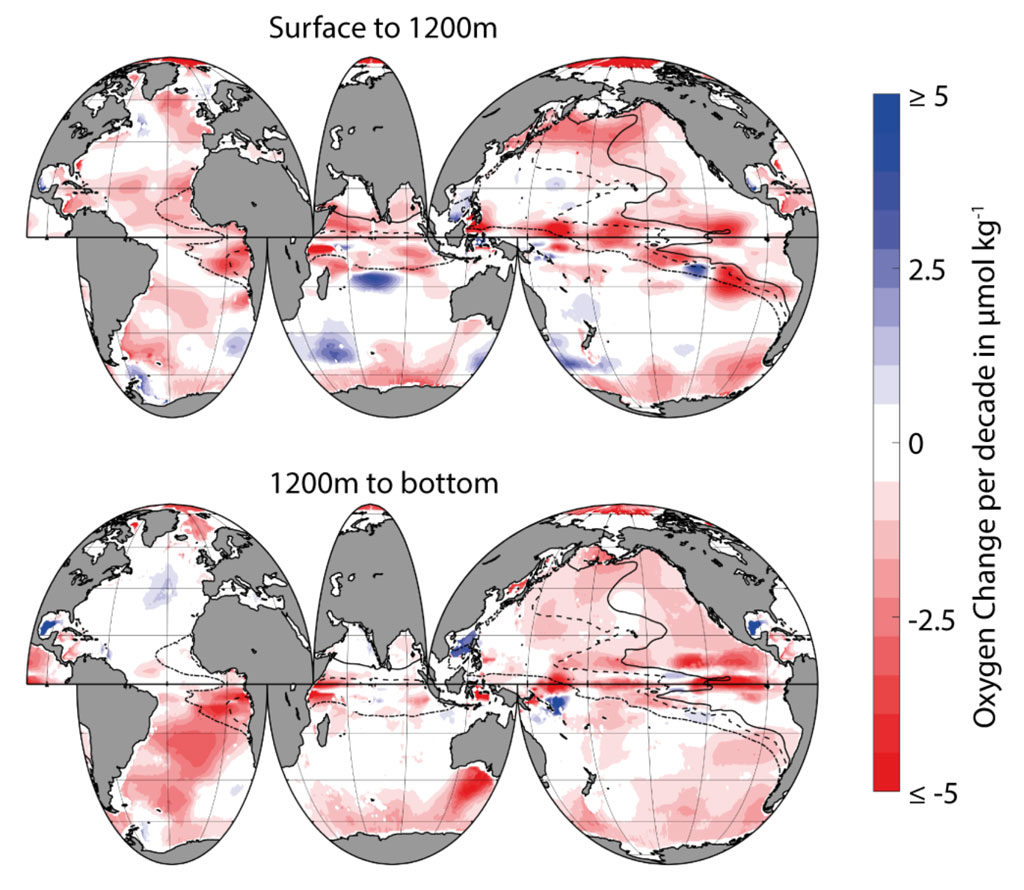
§ Models
climate modelfifth assessment reportIPCC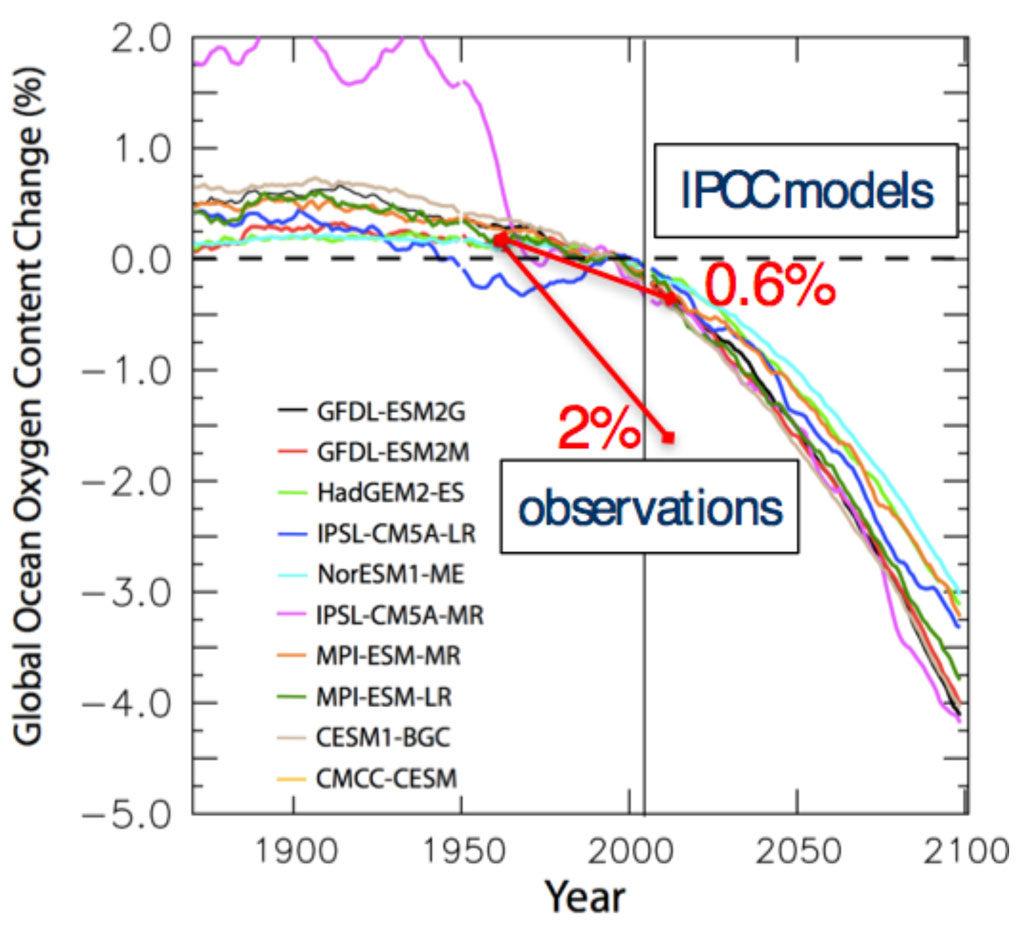
§ Ocean observation
SFB 754 Climate-Biogeochemistry Interactions in the Tropical OceanGlobal Ocean Oxygen NetworkArticle information
Oschlies, A. et al. (2018) Drivers and mechanisms of ocean deoxygenation, Nature Geoscience, doi:10.1038/s41561-018-0152-2
Up-to-date information about research on ocean deoxygenation can be found at http://www.ocean-oxygen.org/.