The Carbon Brief Interview: Chris Stark
Chris Stark has been the chief executive of the Committee on Climate Change (CCC) since April 2018. The CCC is the UK government’s official climate change advisor. He was previously the director of energy and climate change for the Scottish government and before that worked across Whitehall, including in the Treasury.- Stark on the UK government’s Clean Growth Strategy: “[It] had all the right elements in it, but [it’s] a real challenge for government to turn that into delivery. That was last October…And since then very little…there’s not much to write home about.”
- On the CCC’s advice to government: “What we’re trying to do is give ammunition to the people in government who are trying to create climate policies.”
- On his “daft list” of cost-effective action not being pursued: “Top of my list would be onshore wind. Finding a route to market for the cheapest renewable electricity technology, it would seem to me, to be the most important step that government could take in the short term and I do believe it is daft that that is not happening at the moment.”
- On onshore wind: “I think it’s a totemic issue, actually, that you can’t see a way to produce the route to market for a technology like onshore wind.”
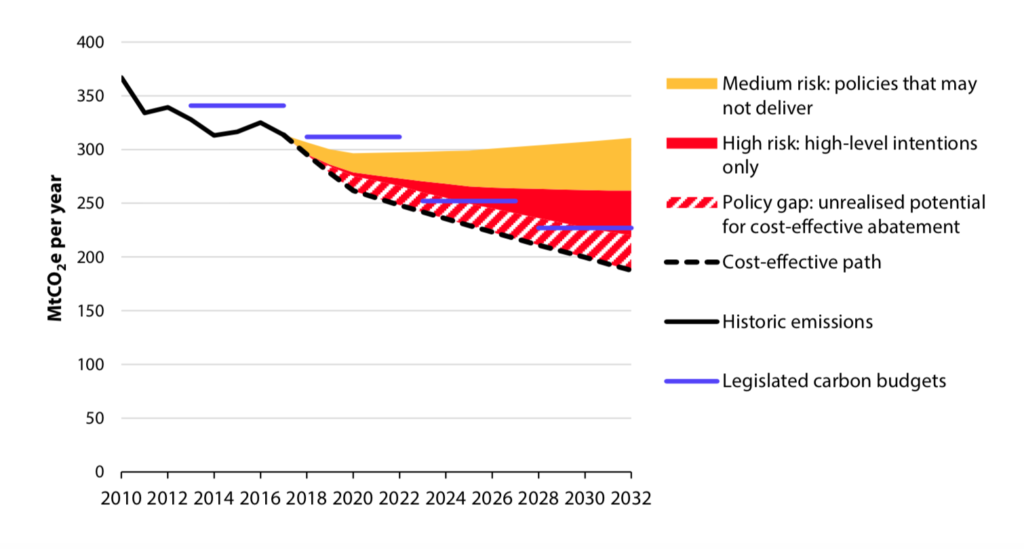
- On the government saying it is currently on track to achieve 93% or 95% of its carbon budgets: “I would really be concerned if government thought that somehow adding up the low and the medium and the high risk [policies] and getting to some sort of figure at the end of that was an appropriate way to consider the overall delivery of the strategy, because the risk attendant to that is really quite substantial…I don’t think [the strategy] should be described as 93% of the way.”
- On enforcing the UK’s carbon budgets: “There is plenty of scope through the parliamentary route for the Climate Change Act and the carbon budgets to be enforced properly. There is also scope to bring government to court…In every case, the ultimate sanction is that government needs to make a new plan, which is exactly what we need.”
- On 10 years of the Climate Change Act: “It’s really impressive, if you look at it, what’s been achieved with UK policymaking – especially in the power sector…If we could bring the same kind of level of strategic focus and ambition to the transport sector, to the agriculture sector, and to buildings, then I think we can be more optimistic…about where we’re headed with all this.”
- On raising the UK’s climate goals in light of the Paris Agreement: “Regardless of the long-term target and how ambitious it is, it may, in the end, be a question of how quickly we introduce these things, actually, rather than dreaming up some new things to add to the list…There are a whole obvious and clear set of things that we aren’t doing at the moment that would really help with that.”
- On the CCC’s forthcoming advice on aligning with the Paris Agreement: “We are a technical analytical body and I don’t think we are in the business of offering unevidenced optimism, so I think it’s really important. I’m sure that will be the way we approach the work on Paris, too.”
- On how ambitious the UK should be: “I definitely think that the history of the UK’s development and the contribution that the UK has made globally to that emission story should factor in the decision about how far we go and how fast we go. It is partly a moral issue…but it’s an economic issue, too.”
- On the economic case for decarbonisation: “So, this is a kind of curious situation, that we know the world will have to decarbonise. It’s not often in life you get a dead cert like that…Surely, we can build a set of economic advantages from that in the UK.”
- On the current voluntary approach to farming emissions: “Policies, particularly in agriculture, have relied on a voluntary response, and that hasn’t happened. So I think we need to accept that and move on to something that looks like a tighter policy framework.”
- On climate risks and benefits: “I believe – quite passionate, actually – that one of the issues in climate change is that we often understate some of the risks to the climate and risks to the economy that come from climate change…I think we also understate…the benefits of what comes when you address climate change.”
- On the UK government’s “Road to Zero” transport strategy: “I don’t regard the 2040 phase-out of petrol and diesel vehicles as being that ambitious. I mean, that’s 22 years away.”
- On being optimistic about the future: “I think the world is divided into two camps. Those who’ve driven a Tesla and those who haven’t. And when you drive a Tesla it’s nothing to do with climate change, you think, my goodness, this thing goes fast. So there is an optimism that comes from the experience of actually seeing something better. And I think the CCC should be part of spelling that out.”
- On climate policy after Trump: “The reaction to Trump has been really positive, it seems to me, in the sense that everyone’s thought more about the climate issues, and especially China.”
Article information
The interview was conducted by Simon Evans at the Committee of Climate Changes office in central London on 6 July 2018.