Scientists studying the troposphere – the lowest level of the atmosphere – have found “powerful evidence” that climate change is altering seasonal temperatures.A study published in Science finds that climate change has caused an increase in the difference between summer and winter temperatures across North America and Eurasia over the past four decades.This could be the result of summer temperatures warming at a faster rate than winter temperatures in these parts of the world, the lead author tells Carbon Brief.The findings show the “substantial human influence on Earth’s climate, affecting not only global averages, but also local and seasonal changes”, another scientist says.Most of the world’s weather originates in the troposphere, a second scientist tells Carbon Brief, meaning that changes to seasonal temperatures could be affecting the likelihood of extreme weather events, such as flooding and drought.
“Our results suggest that attribution studies with the changing seasonal cycle provide powerful evidence for a significant human effect on Earth’s climate.”
Evidence shows that the seasons are changing. In Europe, for example, of the first-emergence dates of more than 500 plant species shows that the first day of spring has advanced by six to eight days in the past three decades.However, working out to what extent seasonal changes can be explained by climate change – rather than natural climate variability, caused by phenomena such as – presents more of a challenge.To quantify the influence of climate change versus natural variability, scientists often carry out “” studies.The new study is the first to assess how climate change could be influencing seasonal temperature changes in the troposphere – a layer that covers roughly the first 17km of the atmosphere above the Earth.Writing in their research paper, the team, led by , a scientist at the , says:
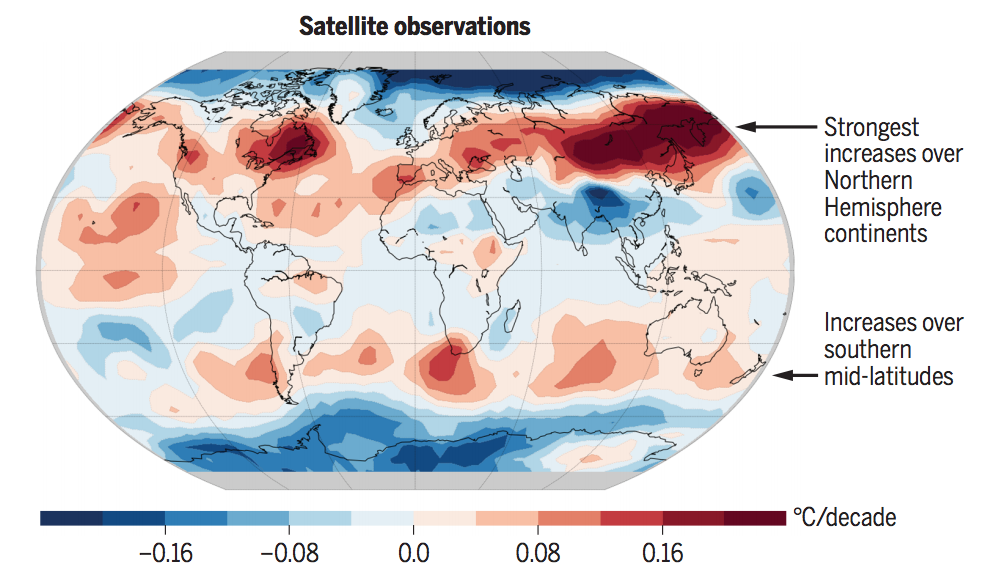
“Countries with the largest observed changes include Mongolia and eastern Russia. Parts of the northeast and western US and eastern Europe have also seen substantial increases in the tropospheric seasonal cycle. Changes tend to be small over the UK.”
diminishing presenceprevious researchFor the study, the researchers analysed atmospheric temperature data recorded by throughout the summer and winter months from 1979-2016. ( has published an explainer on how satellite temperature records compare with measurements at the Earth’s surface.)The map below shows how the difference between summer and winter temperatures, expressed as an average per decade, has changed across the world.On the map, dark red indicates where the difference between summer and winter temperatures have grown larger, while dark blue shows where the difference has grown smaller.The map shows that the difference between summer and winter temperatures has increased the most in mid-latitude regions, particularly in the northern hemisphere.This is because, in these regions, atmospheric summer temperatures are increasing at a faster rate than winter temperatures – causing the disparity between the two seasons to grow larger and larger, the researchers say.The northern hemisphere has experienced more summertime warming than the southern hemisphere because it contains more land, the researchers say. The presence of land means that less heat can be absorbed by the ocean – leading to amplified atmospheric warming, says Santer and co-author , a fellow at Lawrence Livermore National Laboratory. In a joint statement, the researchers tell Carbon Brief:The map also indicates that the eastern edges of both North America and Eurasia have experienced the greatest amounts of warming. This could be because, during the winter in these regions, warm air masses are carried from east to west – leading to milder winters along western continental margins, the researchers say.Changes in temperatures are not as pronounced around the tropics because this region is not highly seasonal, the researchers say. Instead, the seasons in tropical regions are typically defined by rainfall (“wet” and “dry”, for example), rather than by temperature.In contrast, the difference between summer and winter temperatures around the poles has shrunk over the past four decades, the map shows. In these regions, winter temperatures are rising faster than summer temperatures, the research finds.In the Arctic, this winter warming is partly influenced by the of sea ice during summer months, the researchers say. With less sea ice present, the ocean absorbs more heat – which is later released during the winter, the researchers say.The reason that winter atmospheric warming may have accelerated above Antarctica is less clear. However, suggests that the presence of polar clouds in the stratosphere (which sits above the troposphere) could be playing a role.
RCP8.5: The RCPs (Representative Concentration Pathways) are scenarios of future concentrations of greenhouse gases and other forcings. RCP8.5 is a scenario of “comparatively high greenhouse gas emissions“ brought about by rapid population growth, high energy demand, fossil fuel dominance and an absence of climate change policies. This “business as usual” scenario is the highest of the four RCPs and sees atmospheric CO2 rise to around 935ppm by 2100, equivalent to 1,370ppm once other forcings are included (in CO2e). The likely range of global temperatures by 2100 for RCP8.5 is 4.0-6.1C above pre-industrial levels.
RCP8.5: The RCPs (Representative Concentration Pathways) are scenarios of future concentrations of greenhouse gases and other forcings. RCP8.5 is a scenario of “comparatively high greenhouse gas emissions“ brought about by rapid population growth,… Read More
“The real-world observations are much closer to model simulations that include increases in greenhouse gas concentrations, allowing us to attribute the observational record to human influence using formal climate detection and attribution techniques.”
“[The] findings provide further markers of a substantial human influence on Earth’s climate, affecting not only global averages, but also local and seasonal changes.”
To understand to what extent the observed seasonal changes were influenced by human-caused climate change, the researchers compared the satellite results to .The model simulations, which ran from 1979-2016, included a range of natural factors that can influence tropospheric temperature, including the cooling effect of and . To include the impact of human-caused climate change, the researchers used a “business-as-usual” emissions scenario known as .The results show that only simulations that include the impact of human-caused climate change could correctly predict the patterns of seasonal temperature change recorded by the satellites. The researchers say:The results indicate that humans are having a “substantial influence” on the temperatures in the troposphere, says , a senior scientist at the , who was not involved in the research. In an accompanying perspectives article, he writes:
“The paper significantly increases confidence that the observed changes in the troposphere – where all our weather is – are consistent with models and that they are of human origin. This gives more confidence in the existing findings of an increase frequency of extreme weather, such as more intense rainfall and more extreme summer hot spells.”
Article information
Santer, B. D. et al. (2018) Human influence on the seasonal cycle of tropospheric temperature, Science, doi/10.1126/science.aas8806
Updated on 20 July to add comments from Dr Ben Santer and Dr Stephen Po-Chedley
However, it is not clear how temperature changes in the troposphere could affect conditions at the land surface, he adds:One possible effect could be changes to the timing and likelihood of extreme weather events, says , from the Centre for Environment and Agricultural Informatics at , who was not involved in the research. He tells Carbon Brief: