Methane uptake from forest soils has ‘fallen by 77% in three decades’
The amount of methane absorbed by forest soils has fallen by an average of 77% in the northern hemisphere over the past 27 years, a new study finds.The research, which analysed soil data taken from more than 300 studies, suggests that the world is currently “overestimating the role that forest soils play in trapping gas”, the lead author tells Carbon Brief.This reduced uptake of methane by soils is likely being driven by increases in soil moisture as a result of enhanced rainfall, the author adds. In wetter soils, the bacteria that break down and store methane are less able to function, he explains.The discovery “means that methane will accumulate much faster in the atmosphere”, another scientist tells Carbon Brief.§ Methane matters
greenhouse gas34 times more potent than CO2 over a 100-year periodlivestockrice productionescapewetlandsmelting permafrostfreshwater lakestropospherehydroxyl radicalsDr Peter GroffmanProceedings of the National Academy of Scientists§ Determining the decline
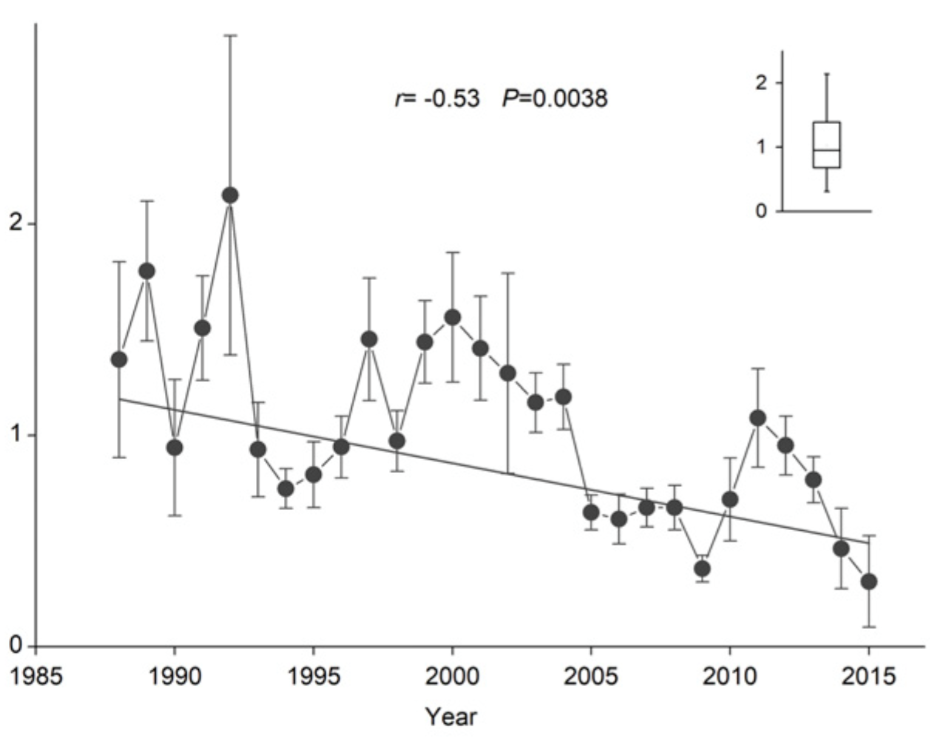
§ Saturated soils
climate change“Increased soil moisture inhibits diffusion of methane from the atmosphere into the soil, which reduces the ability of bacteria to access and consume the methane.”
Carbon BriefDr Patrick MegonigalSmithsonian Environmental Research Center“The discovery that soils are consuming less methane over time is important because it means that methane will accumulate much faster in the atmosphere – all things being equal.
“The fact that the same patterns appeared in the global dataset is particularly impressive because it confirms the assertion that methane consumption by soils has declined dramatically; a more subtle decrease in rates would have been obscured by variations in study designs, locations and methods.”
§ Beleaguering budget
“These findings suggest that global budgets for atmospheric methane – which are used to inform policy around methane-producing activities – are overestimating the role that forest soils play in trapping gas. Declining methane uptake by forest soils should be factored into these models to avoid exacerbating climate warming, as methane in the atmosphere may rise more quickly and reach higher levels than current models predict.”
“We can’t rely on natural processes to solve our greenhouse gas problems. Just as trees and oceans may not always be able to absorb CO2, forest soils may not always be able to take up methane and keep it out of the atmosphere.
“If we are going to stabilise the atmospheric concentration of methane, we are going to have to work harder to control anthropogenic sources such as leaks from natural gas extraction.”
Prof Mari PihlatieUniversity of Helsinki“We have a trend in increasing methane uptake, which coincides with increasing soil temperatures. Soil moisture does not seem to be critical in our site – which is really dry and, hence, greater precipitation would not decrease the soil methane uptake.”
Article information
Ni, X. & Groffman, P. M. (2018) Declines in methane uptake in forest soils, Proceedings of the National Academy of Sciences, doi/10.1073/pnas.1807377115
Updated on 8 and 9 August to amend definition of the global methane budget and potency of methane.