Solar geoengineering could ‘fail to prevent damage to crop yields’
Releasing aerosols into the atmosphere in order to limit the rise in global temperature would not stave off damage to crop yields, a new study suggests.Scientists have suggested that intentionally releasing aerosols into the atmosphere – a type of “solar geoengineering” – could help to limit global warming by reflecting away incoming sunlight in a similar way to a volcanic eruption.The new research uses historical data to investigate how past major volcanic eruptions have impacted global crop yields. It finds that, following past eruptions, global crop yields have been negatively impacted by a reduction in direct sunlight – which impairs the ability of plants to photosynthesise.The findings suggest that, if ever used, solar geoengineering could benefit crops by cooling temperatures and reducing the risk of heat stress. However, this positive effect could be largely offset by the negative impacts associated with a reduction in sunlight, the authors say.However, the new research is “limited” and does not take into account the differences that are likely to exist between volcanic eruptions and solar geoengineering, other scientists tell Carbon Brief. Therefore, they say, it should not be used to draw “solid conclusions”.§ Artificial volcanoes
Solar geoengineeringstratospheric aerosol injectionprevious researchheat stress and droughtpostulatedNaturesulfuric acid aerosolsaverage global temperatures to dip by 0.5C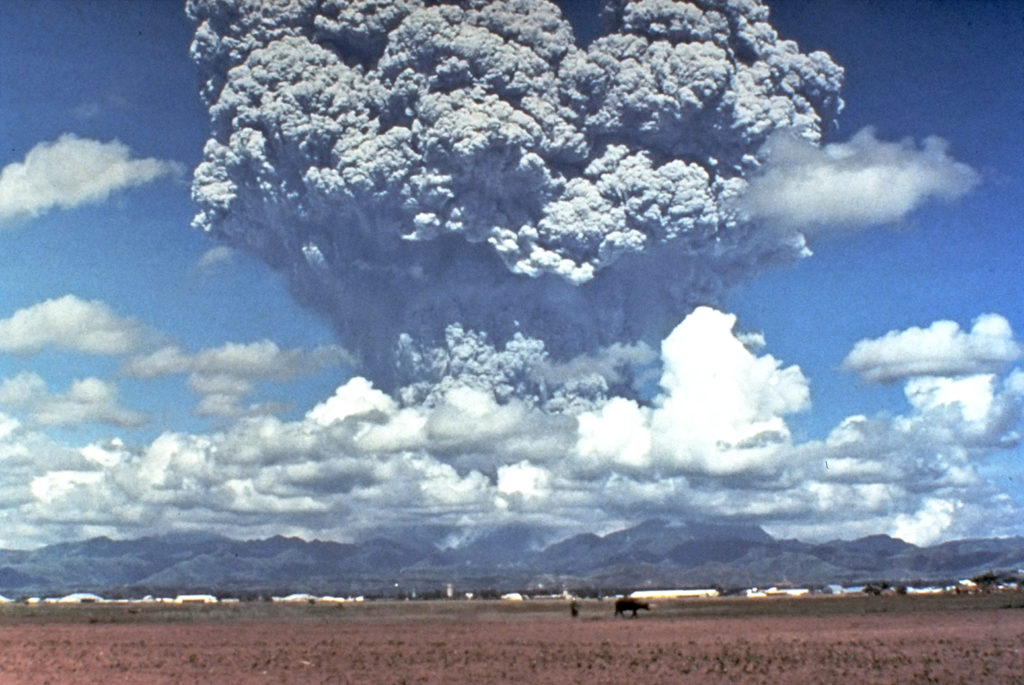
“The implications of this are that solar geoengineering, using sulphate-based aerosols like we saw emitted from these volcanic eruptions, may be an ineffective way to mitigate the damages that climate change poses to global agricultural production.”
§ Yielding results
FAO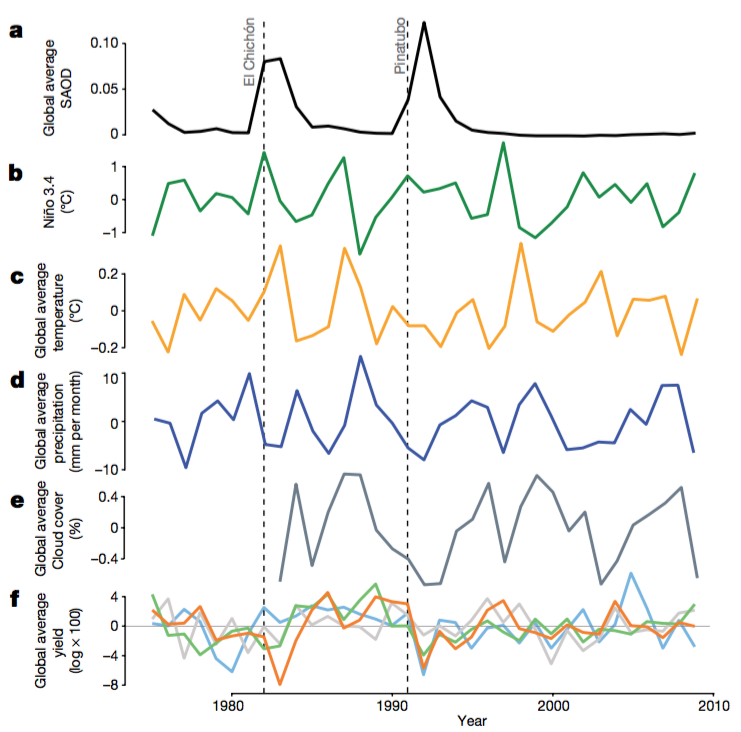
§ Geoengineered world
climate model
§ Food for thought
Prof Solomon Hsiang“A key innovation of this study was to find a way to study the potential side-effects of geoengineering without actually deploying it.”
Prof David KeithSolar Geoengineering Research ProgramUniversity of Harvard“Solar geoengineering would likely differ from volcanoes in two crucial respects. First, and most important, solar geoengineering would be a relatively continuous application of aerosols rather than a single pulse that lasts less than a year. The climate response to continuous and pulsed radiative forcing – science speak for dimming the sun – would be very different.
“Second, most serious proposals for solar geoengineering assume that it would be designed to have roughly even pole-to-pole radiative forcing. A volcano, in contrast, tends to produce a quite asymmetric radiative forcing. That asymmetry again produces a climate response quite different from what would likely happen under solar geoengineering.”
Dr Anthony JonesUniversity of Exeter“I suspect that the crop yields are sensitive to changes to extremes – for instance, droughts and heatwaves – that may be ameliorated by SRM and which are not accounted for in this model.”
Prof Alan Robockdepartment of environmental sciencesRutgers University“But they are based on agricultural practices from 30 years ago. More study of whether modern and future farming, including new equipment, seeds, and fertilisers, would react the same way is needed.”
Prof Govindasamy BalaDivecha Centre for Climate ChangeIndian Institute of Science“However, I do not think this is the last word on this subject. More similar studies would be needed to narrow down the uncertainty in process modeling.”
Prof Douglas MacMartinCornell Universitycontributed“The study is important for looking at a possible impact of solar geoengineering that no one has yet explored. But because the data that goes into the study is so limited and so noisy, one shouldn’t read too much into it, at least not yet. Instead, this should be taken simply as motivation for doing more research and only reaching conclusions after more studies have looked at this question.”
Article information
Procto, J. et al. (2018) Estimating global agricultural effects of geoengineering using volcanic eruptions, Nature, https://www.nature.com/articles/s41586-018-0417-3