Guest post: Why BECCS might not produce ‘negative’ emissions after all
Dr Anna Harper is a research fellow and lecturer in climate science in the College of Engineering, Mathematics and Physical Sciences at the University of Exeter.With the long-term goal of restricting global temperature rise to “well below 2C” or 1.5C above pre-industrial levels now enshrined in the Paris Agreement, attention has increasingly turned to how these limits could be met.Model scenarios that limit warming to 1.5C or 2C typically rely on large amounts of “negative emissions” to extract CO2 from the atmosphere and store it on land, underground or in the oceans.Bioenergy crops with carbon capture and storage (BECCS) is, perhaps, the most prominent of the various negative emissions techniques. There are many attractive features, since this technology would provide energy – thus reducing our need for fossil fuels – and remove CO2 from the atmosphere at the same time.However, the full carbon-cycle impacts of large-scale deployment of BECCS are not well studied. And, before now, no studies have looked at these impacts specifically for a scenario that could meet the 1.5C target.In our new study, published in Nature Communications, my colleagues and I find that expansion of bioenergy in order to meet the 1.5C limit could cause net losses in carbon from the land surface. Instead, we find that protecting and expanding forests could be more effective options for meeting the Paris Agreement.§ Forests compared to BECCS
Tree-planting programmes1-2bn tonnes of carbonincreased biodiversitysoil carbonmiscanthusIntergovernmental Panel on Climate Change3.3bn tonnes of carbo§ Land for food
our need to grow foodscenariosIMAGE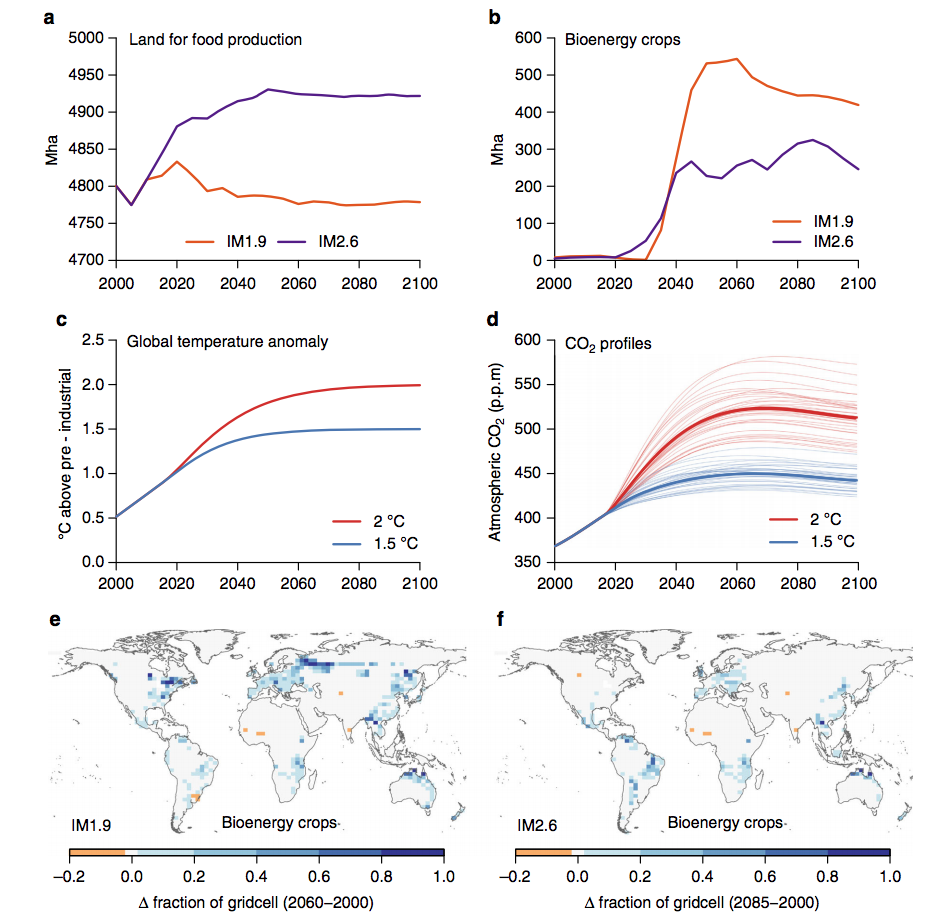
Image (note)
meat
Glossary
Integrated Assessment Models: IAMs are computer models that analyse a broad range of data – e.g. physical, economic and social – to produce information that can be used to help decision-making. For climate research, specifically, IAMs are typically used to project future greenhouse gas emissions and climate impacts, and the benefits and costs of policy options that could be implemented to tackle them.
Integrated Assessment Models: IAMs are computer models that analyse a broad range of data – e.g. physical, economic and social – to produce information that can be used to help decision-making. For climate research, specifically,… Read More
§ The importance of land-use change emissions
land-surface computer model
§ Ambition
diet less reliant on meat and dairyby three or four timesArticle information
Harper, A. B. et al. (2018) Land-use emissions play a critical role in land-based mitigation for Paris climate targets, Nature Communications, doi:10.1038/s41467-018-05340-z