Guest post: India’s emissions will double at most by 2030
Navroz K Dubash is a professor and Ankit Bhardwaj is a senior research associate at the Centre for Policy Research (CPR)’s Initiative on Climate, Energy and Environment in New Delhi.In a global climate regime built around national climate pledges – known as “nationally determined contributions” (NDCs) – it becomes essential to understand the likelihood of meeting these pledges.However, understanding how national conditions will affect these pledges can be difficult, especially in rapidly changing developing countries, such as India.India is undertaking multiple transitions driven by demography, urbanisation and energy access, amid rapidly changing policies and technologies. All these factors will shape its emissions future, which has considerable importance to the future of global emissions.This means assessing how its emissions will be affected by national development goals, such as access to energy, becomes important for projecting future emissions.§ Understanding India’s trajectory
paperEnvironmental Research Letterswide![Image - Projected annual CO2 emissions in India from energy projections in several recent studies. The figure plots carbon dioxide emissions from energy in 2030 against average annual GDP growth rates used by each scenario, named after its respective study. The secondary y-axis on the right indicates percent change from the 2012 level. The red dotted lines represent the CO2 emissions from energy in 2030 at different average annual GDP growth rates from 2005, corresponding to India’s INDC target of a 33-35% reduction from the GHG intensity level in 2005. The proportion of CO2 emissions from energy in the total mix is assumed to remain the same in 2030 as in 2012. Scenario acronyms are clustered and coloured as per their policy assumptions. Scenarios are labelled as either reference [R] or aspiration policy scenarios [P]. When more than one scenario is included from the same study, the scenario acronym is annotated with a number, eg. [R-1],[R-2],[P-1],[P-2]. Source: Dubash et al. (2018)](https://www.carbonbrief.org/wp-content/uploads/2018/08/Projected-annual-CO2-emissions-in-India-from-energy-projections-in-several-recent-studies-1024x528.jpg)
§ National energy models
very low per capita baseclimate targetChina’s emissions in 2015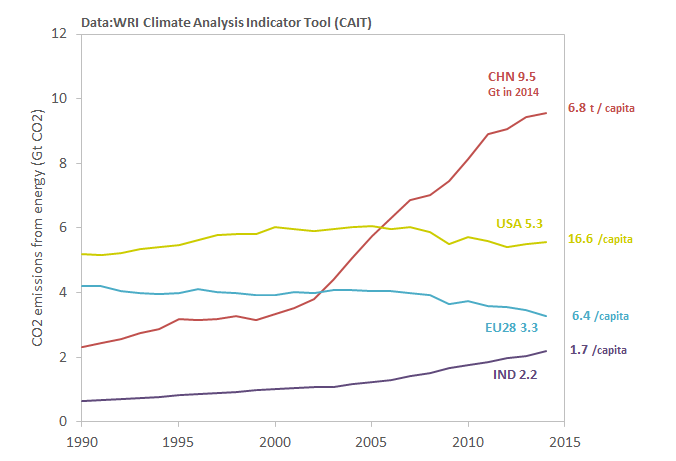
§ Interpreting recent trends
recent shiftsCoalsignificantrenewable electricity
Article information
Dubash N. K. et al (2018) India’s energy and emissions future: an interpretive analysis of model scenarios, Environmental Research Letters, doi/10.1088/1748-9326/aacc74