Guest post: 13 ‘ocean-based solutions’ for tackling climate change
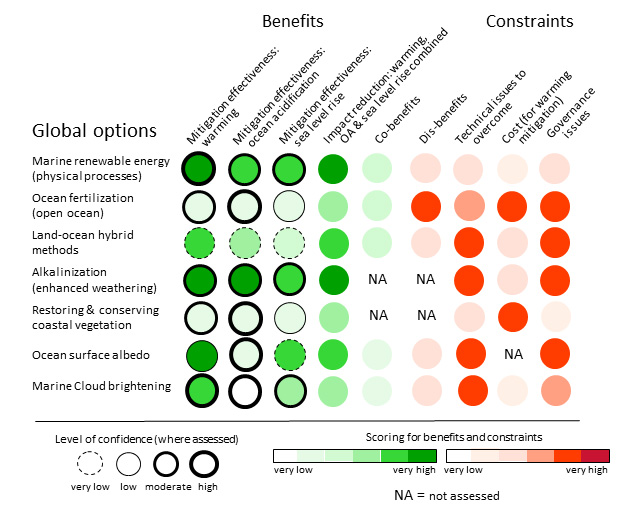
Dr Phillip Williamson is an honorary reader at the University of East Anglia and science coordinator of the UK Greenhouse Gas Removal from the Atmosphere research programme, which is coordinated by the government-funded National Environment Research Council (NERC).There will be at least one inescapable conclusion in the upcoming publication of the Intergovernmental Panel on Climate Change’s special report on 1.5C: unconventional interventions will be needed to avoid dangerous climate change.That was already a between-the-lines message of Article 4 of the Paris Agreement, which recognised the need for “net-zero emissions” – and, hence, pro-active greenhouse gas removal from the atmosphere – to effectively tackle climate change.All the options, therefore, need to be on the table – not just the land-based approaches, such as planting new forests and bioenergy with carbon capture and storage (BECCS) – which have dominated conversations to date.This week, myself and colleagues attempt to address this gap by publishing an analysis of 13 ocean-based actions to address climate change and its impacts. The study considers the effectiveness and feasibility of both global-scale and local ocean-based solutions using information from more than 450 other publications.Each potential action was assessed for a range of environmental, technological, social and economic criteria, with additional consideration given to each action’s impacts on important marine habitats and ecosystem services.§ Global ocean solutions
Image (note)
RCP8.5RCP2.6ocean acidification
Glossary
RCP8.5: The RCPs (Representative Concentration Pathways) are scenarios of future concentrations of greenhouse gases and other forcings. RCP8.5 is a scenario of “comparatively high greenhouse gas emissions“ brought about by rapid population growth, high energy demand, fossil fuel dominance and an absence of climate change policies. This “business as usual” scenario is the highest of the four RCPs and sees atmospheric CO2 rise to around 935ppm by 2100, equivalent to 1,370ppm once other forcings are included (in CO2e). The likely range of global temperatures by 2100 for RCP8.5 is 4.0-6.1C above pre-industrial levels. The release of the Shared Socioeconomic Pathways (SSPs) has introduced a number of additional “no-new-policy” scenarios, meaning RCP8.5 is no longer the sole option available to researchers as a high-end no-mitigation pathway.
RCP8.5: The RCPs (Representative Concentration Pathways) are scenarios of future concentrations of greenhouse gases and other forcings. RCP8.5 is a scenario of “comparatively high greenhouse gas emissions“ brought about by rapid population growth,… Read More
Image (note)
Glossary
RCP2.6: The RCPs (Representative Concentration Pathways) are scenarios of future concentrations of greenhouse gases and other forcings. RCP2.6 (also sometimes referred to as “RCP3-PD”) is a “peak and decline” scenario where stringent mitigation and carbon dioxide removal technologies mean atmospheric CO2 concentration peaks and then falls during this century. By 2100, CO2 levels increase to around 420ppm – around 20ppm above current levels – equivalent to 475ppm once other forcings are included (in CO2e). By 2100, global temperatures are likely to rise by 1.3-1.9C above pre-industrial levels.
RCP2.6: The RCPs (Representative Concentration Pathways) are scenarios of future concentrations of greenhouse gases and other forcings. RCP2.6 (also sometimes referred to as “RCP3-PD”) is a “peak and decline” scenario where stringent mitigation… Read More
§ Local ocean solutions
assisted evolutionexamplemass bleaching event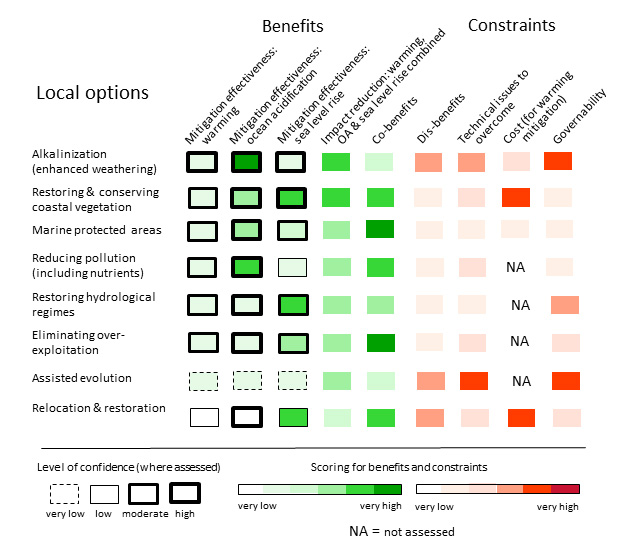
§ Turning tides
Article information
Gattuso, J.-P. et al. (2018) Ocean solutions to address climate change and its effects on marine ecosystems, Frontiers in Marine Science, doi:10.3389/fmars.2018.00337