Spraying aerosols high in the stratosphere could dampen global warming over land, but may not prevent the oceans from heating up, new research says.The findings suggest that this type of “solar geoengineering” – a set of techniques that aim to tackle global warming by reflecting sunlight back into space – may not necessarily stem sea level rise or prevent damage to the world’s marine ecosystems.The research indicates that solar geoengineering could carry “major uncertainties and risks”, the lead author tells Carbon Brief.The study also raises the issue of whether global average temperature “is the best metric to control” when addressing the impacts of climate change, another scientist tells Carbon Brief.
“The explanation involves two key stages. In the first, the aerosols reduce the amount of rainfall that occurs globally. This change in rainfall is not uniform, rather, reductions are larger in some key regions – namely, the northern Atlantic Ocean – and this increases the salinity of those ocean areas, making the water more dense.”
“The North Atlantic is a key region of deep-water formation and higher density therefore leads to an acceleration of this circulation. The speed up in deep-water formation buries more heat in the deep ocean that would have otherwise occurred.”
Scientists have suggested that releasing aerosols into the atmosphere – a technique known as “” – could cool the planet in a similar way to a .When a volcano erupts, it sends an ash cloud high into the atmosphere. The released in the plume combines with water to form , which reflect away incoming sunlight, temporarily cooling the Earth.Artificially introducing aerosols into the atmosphere – via a plane or a high-altitude balloon – could have a similar cooling effect, researchers say.The idea has never been tested, but using computer simulations suggests that releasing aerosols could help limit global temperature rise to 1.5C – the aspirational target of the – and keep rainfall from .However, an aerosol sunshade would not protect the planet from rising CO2 emissions – which is causing and , among other problems.The new study, published in , identifies, for the first time, another potential downfall of the proposed technique: it may not be able to limit warming in the deep ocean.This is because aerosol release could cause rainfall to decrease in some regions, which could influence ocean circulation patterns, says lead author , a project scientist at the National Center for Atmospheric Research (), Boulder. He tells Carbon Brief:This increase in water density could cause the “Atlantic Meridional Overturning Circulation” () to speed up, he says. The AMOC is a perpetual conveyor belt that transports heat from the equator up to the North Atlantic. It is part of a wider network of that transports heat all around the world. Fasullo says:
RCP8.5: The RCPs (Representative Concentration Pathways) are scenarios of future concentrations of greenhouse gases and other forcings. RCP8.5 is a scenario of “comparatively high greenhouse gas emissions“ brought about by rapid population growth, high energy demand, fossil fuel dominance and an absence of climate change policies. This “business as usual” scenario is the highest of the four RCPs and sees atmospheric CO2 rise to around 935ppm by 2100, equivalent to 1,370ppm once other forcings are included (in CO2e). The likely range of global temperatures by 2100 for RCP8.5 is 4.0-6.1C above pre-industrial levels. The release of the Shared Socioeconomic Pathways (SSPs) has introduced a number of additional “no-new-policy” scenarios, meaning RCP8.5 is no longer the sole option available to researchers as a high-end no-mitigation pathway.
RCP8.5: The RCPs (Representative Concentration Pathways) are scenarios of future concentrations of greenhouse gases and other forcings. RCP8.5 is a scenario of “comparatively high greenhouse gas emissions“ brought about by rapid population growth,… Read More
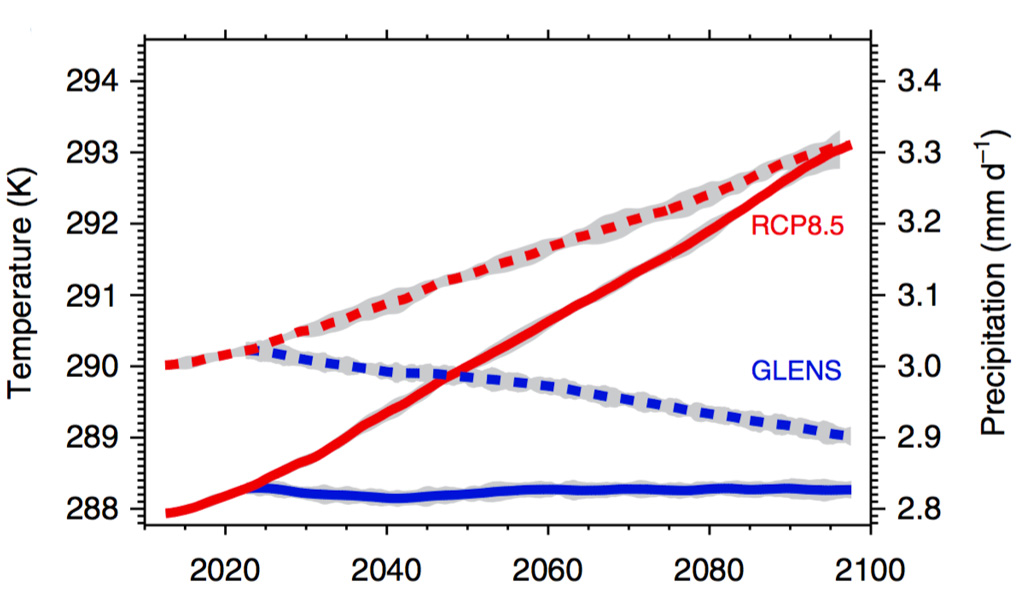
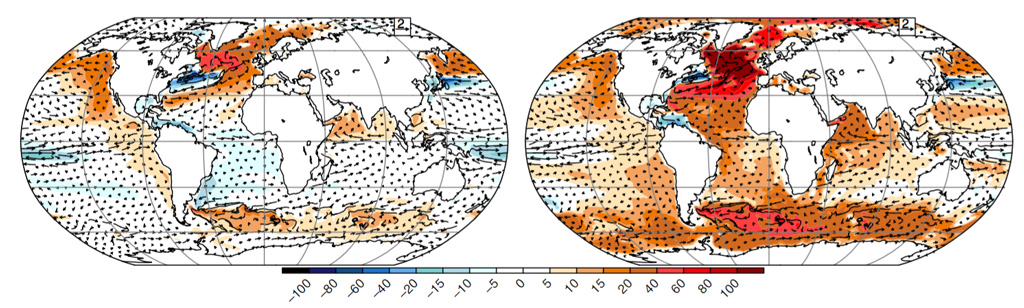
Previous researchRCP8.5Image - Changes to global mean temperature (full lines, left-hand y-axis) and global rainfall levels (dashed lines, right-hand y-axis) under a scenario with solar geoengineering (GLENS; blue) and a scenario with no geoengineering and high greenhouse gas emissions (RCP8.5; red). Source: Fasullo et al. (2018) (note)OHCImage - Expected changes to ocean heat content (OHC) between 2010-30 and 2075-95 in the upper ocean (0-300m; left) and in the full-depth of the ocean (right) under a solar geoengineering scenario. Red shows increases in OCH, while blue shows decreases. Source: Fasullo et al. (2018) (note)To explore the impact of aerosol release on oceans, the researchers used a set of 20 computer simulations looking at what would happen if aerosols were released between 2020 and 2099. This set of simulations is known as the “geoengineering large ensemble” ().The simulations assume that aerosols are released at uniform points across the globe. ( shows doing this would prevent large regional changes in temperature and weather.)The researchers compared their geoengineering simulations to another set of simulations where no geoengineering takes place and little action is taken to tackle climate change, leading to high emissions in the coming decades (a scenario known as “”).The chart below shows how global average temperature (full lines, left-hand y-axis) and global rainfall levels (dashed lines, right-hand y-axis) are expected to differ between the high-emissions scenario (RCP8.5) simulations and GLENS.The chart shows how, in the geoengineered world, the global average temperature is kept constant while global rainfall levels fall. In comparison, temperatures and rainfall levels continue to rise under the high-emissions scenario.The maps below show expected changes to ocean heat content () between 2010-30 and 2075-95 in the upper ocean (0-300m; left) and in the full-depth of the ocean (right) under the geoengineering scenario. On the maps, red shows increases in OHC, while blue shows decreases.The charts show how, in the geoengineering scenario, some shallower parts of the ocean are expected to heat up. This includes the Arctic Sea and waters off the western coast of North America.When the full depth of the ocean is considered, however, many more regions are expected to see OHC increases – with warming likely to be most severe in the Arctic Sea and in the Southern Ocean.It is worth noting, however, that increases in heat content in the full depth of the ocean were found to be considerably higher under the scenario with high greenhouse gas emissions and no solar geoengineering.
“Relative to present day, it is extremely likely that sea level will continue to rise under our geoengineering approach, but it is also likely that the rate of this rise will be less than under a business-as-usual climate trajectory [RCP8.5].
“We cannot say with confidence what that rate of rise might be as we don’t have models of the ice sheets fully coupled to our climate simulations, nor have we sufficiently vetted such models to have confidence in their projections at this point.”
“However, as this is a single modelling study, it is not clear to me if the results of this paper are robust. A multi-model based approach would be needed to verify the robustness.”
“There have been various high-profile policymakers in the US that have framed climate change as an engineering challenge. I think the key takeaway from our work is that geoengineering itself carries major uncertainties and risks.”
The headline of this article was updated on 30/10/2018
The findings suggest that – contrary to – solar geoengineering could fail to prevent sea level rise. is chiefly driven by the expansion of seawater as a result of warming and by the melting of land ice at the world’s poles. In some parts, including in , melting occurs where land ice comes into contact with warm ocean water. Fasullo says:The results could also mean that solar geoengineering would fail to prevent , which pose a major threat to undersea wildlife, and the in hurricane intensity. (Although no research has looked at these issues, specifically, so it is still too soon to draw conclusions, Fasullo says.)The study raises the issue of whether global average temperature “is the best metric to control” when addressing the impacts of climate change, says , a physical scientist from the at the , who was not involved in the study. He tells Carbon Brief:The findings imply that solar geoengineering could have “large potential downsides”, says Fasullo: