Melting Antarctic ice could slow global temperature rise, study says
Cold meltwater running off Antarctica’s ice sheets and into the ocean could dampen the pace of global temperature rise, a new study suggests.The research, published in Nature, finds that the rate of ice-sheet melt in a high-emissions scenario could see the oceans cooled by the influx of frigid water. This could knock as much as 0.4C off global temperature rise, the researchers say, potentially delaying exceeding the 1.5C and 2C Paris temperature limits by around a decade.However, the study adds that the meltwater could have wider impacts on the Earth’s climate, increasing the formation of Antarctic sea ice, reducing rainfall in the southern hemisphere and increasing rainfall in the northern hemisphere. It could also cause warming of the ocean beneath the surface layer around the Antarctic coast, the researchers add, leading to further ice-sheet melt and additional sea level rise.Scientists not involved in the research tell Carbon Brief that while the results are intriguing, some caution is warranted given that the study relies on a single climate model. It also uses a speculative ice-melt scenario and focuses on a region – the Southern Ocean and Antarctica – which climate models can struggle to simulate accurately.Additional work, including running similar simulations using other climate models and including the impact of meltwater from Greenland, may provide a more complete picture of the climate impacts of melting ice sheets, the scientists note.§ Adding Antarctic meltwater to climate models
climate modelsdo not includeice shelvesCMIP5CMIP6hosing experimentsprior studies
§ Slower temperature rise
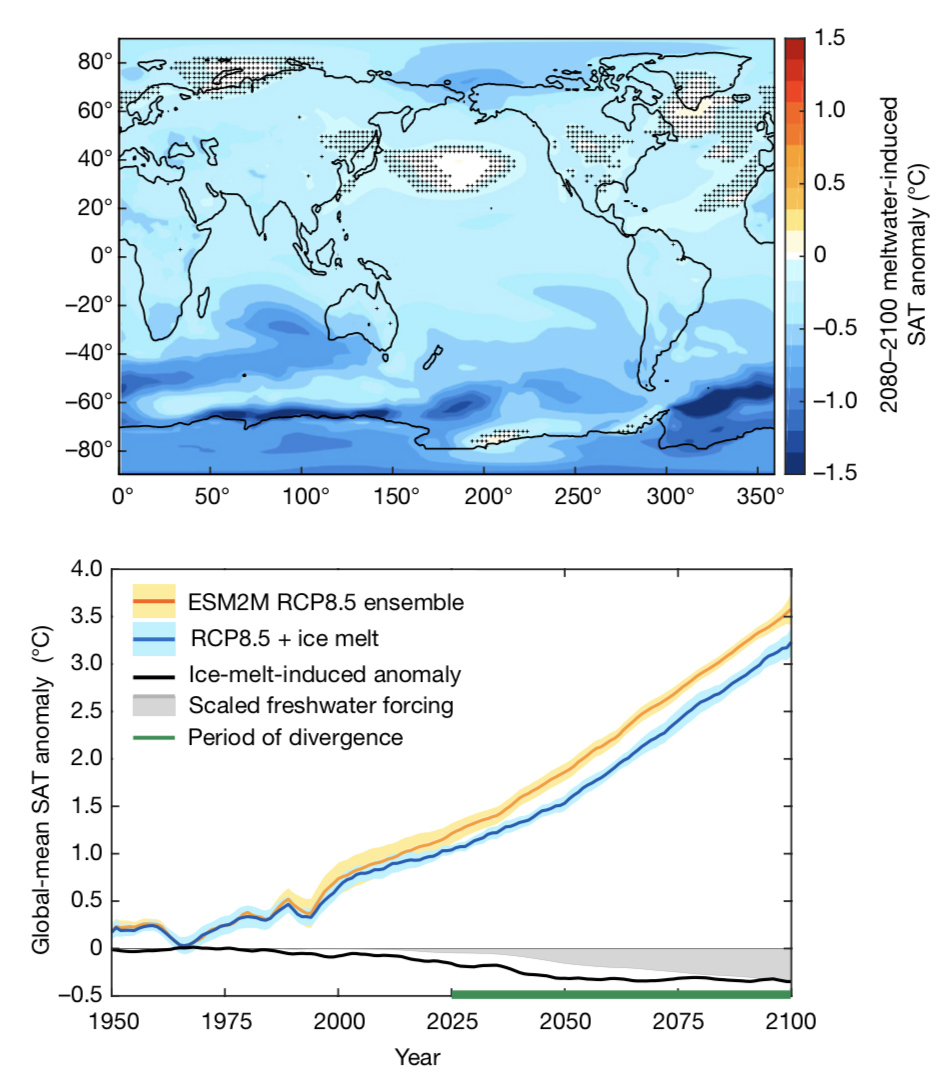
§ Rainfall patterns
Inter-Tropical Convergence Zone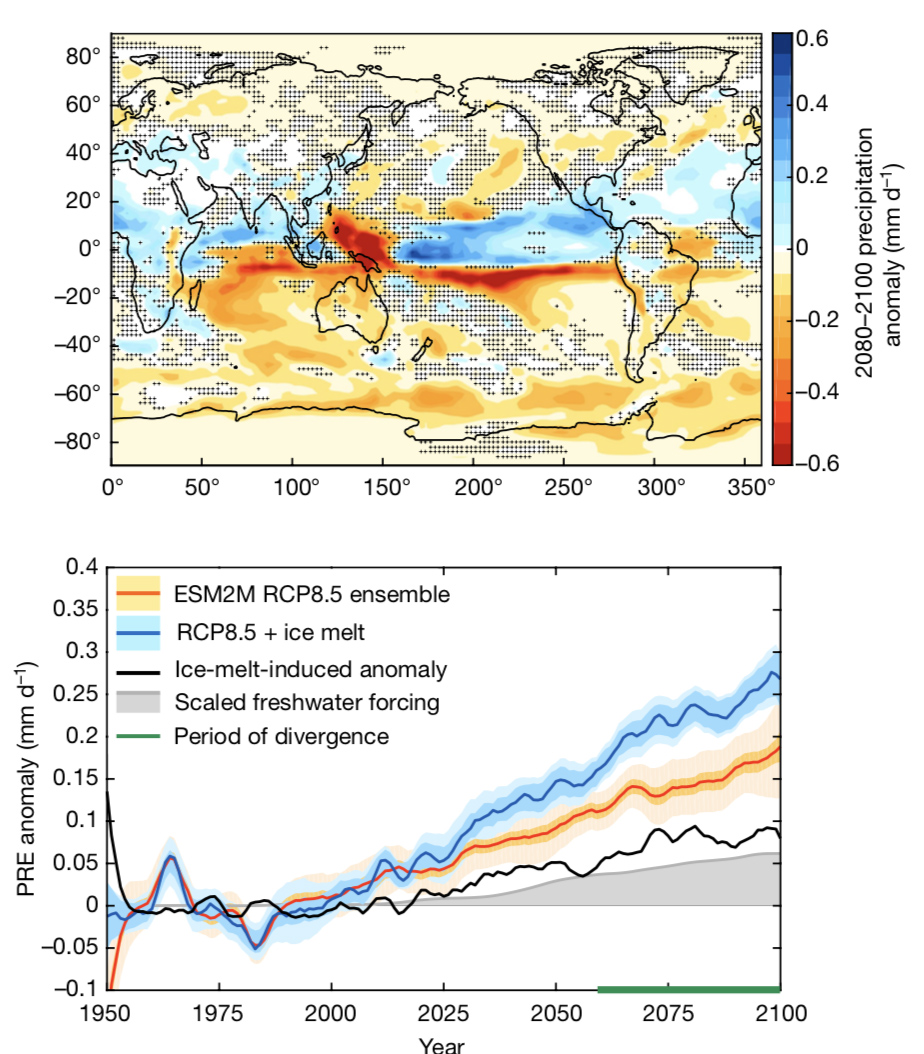
§ Faster melting ice sheets, but more sea ice
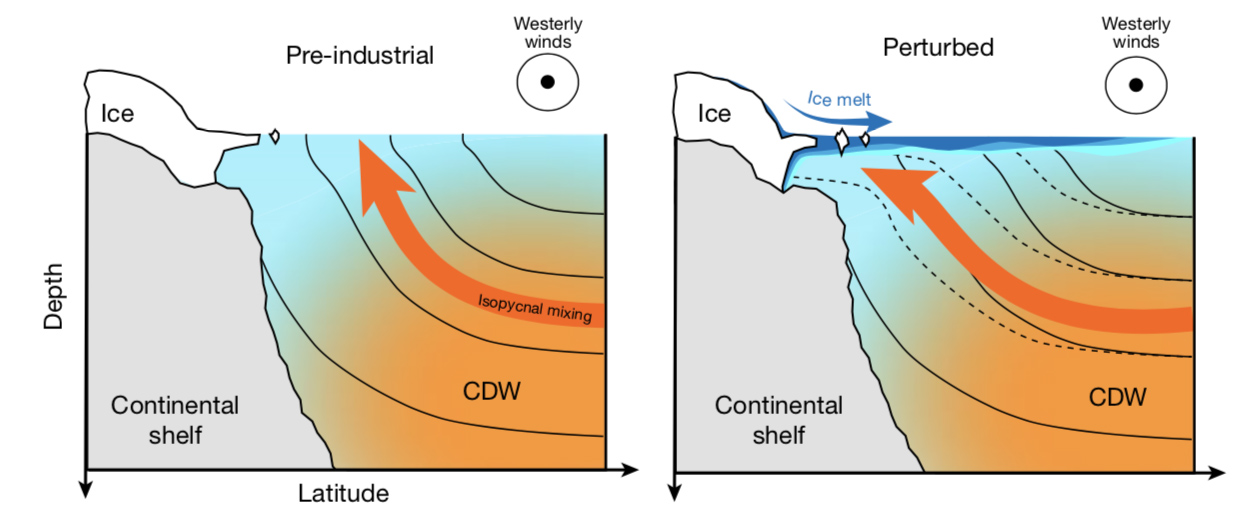
“The Southern Ocean is a complex system and many ice-sheet-related feedbacks need to be accounted for…Global coupled models such as ESM2M are useful tools for identifying and quantifying the potential of this feedback by modelling the temperature response of the Southern Ocean to meltwater discharge…however, they lack high-resolution continental-shelf and ice-shelf-cavity dynamics. Consequently, global coupled model simulations need to be complemented with regional ice-sheet studies to fully constrain the magnitude of the ice-loss feedback.”
§ Urge for caution
Prof Joellen RussellDr Kate MarvelNASA GISS“It would, however, surprise me if a large influx of Antarctic meltwater had no climate impact and I think this study is useful in noting that this could potentially be an important factor in future climate. I do worry about [the media] acting as if melting Antarctica is going to mitigate climate change because the paper notes it could delay exceeding 1.5C or 2C targets by a decade. We don’t get this extra time for free!
This could have massive implications for rainfall patterns globally – the paper suggests it drags the tropical rain band into the northern hemisphere, which is really unfortunate if you live in one of the regions left behind and rely on that rainfall. Moreover, it will probably make southern hemisphere droughts even worse. These effects seem plausible, but more than that, it’s important to note that climate change is about so much more than global average temperature.”
Dr Kevin TrenberthNCARheat budgetwesterliesscenarios withsignificant uncertaintyProf Michael MannPenn State UniversitySOMIPArticle information
Bronselaer, B. et al. (2018) Change in future climate due to Antarctic meltwater, Nature, doi:s41586-018-0712-z