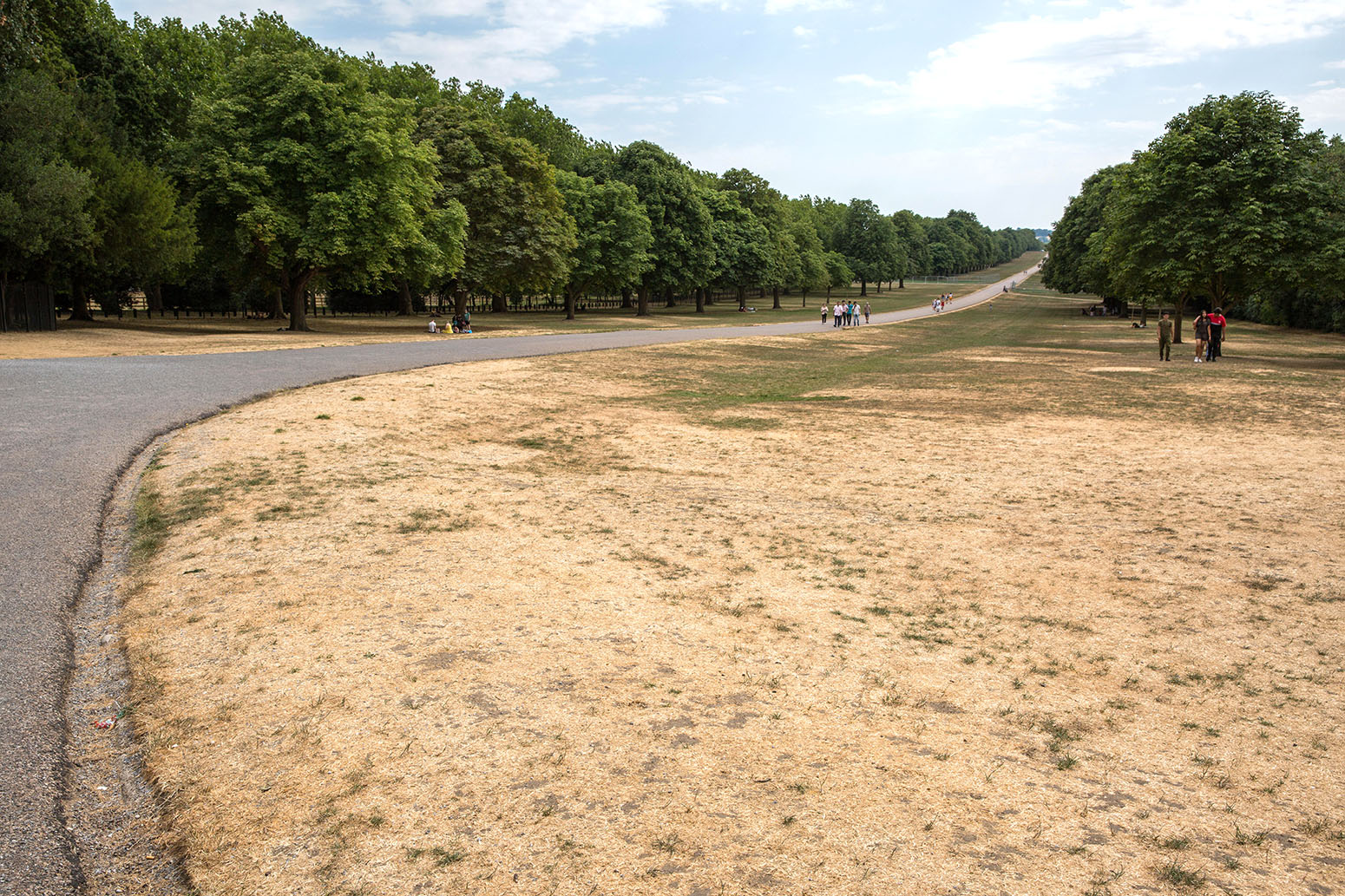
This year’s summer heatwave, which saw temperature records broken across the UK, was made up to 30 times more likely by climate change, a new assessment says.A preliminary study by scientists at the Met Office Hadley Centre finds that the extreme heat experienced by the UK this year had around a 12% chance of occuring. In a world without climate change, it would have had a 0.5% chance, according to the results.The influence of climate change on the odds of the 2018 summer heatwave is the highest recorded for a study of this kind looking at extreme events in the UK, the study scientist tells Carbon Brief at the UN’s 24th Conference of the Parties (COP24) in Katowice, Poland.And, by 2050, the chances of such a heatwave occuring could reach 50%, the scientist adds. “With continued emissions, we’ll eventually make it impossible to adapt.”
“This is a piece of scientific evidence showing that this is not just chance; we’re not just unlucky. We’re reaping the results of our emissions.
“If you look right back at global temperatures, it’s effectively impossible to have the temperatures that we’re having now without human-induced climate change. Zooming in to a region like the UK, this is probably the highest I’ve seen in that context.”
“This is largely dominated by rising temperatures. It really is as simple as that. Where we are now, you need relatively unusual circulation patterns to get to such elevated temperatures – but, as we go on, weather patterns which bring warmer temperatures will be less rare.”
This year’s summer heatwave in the UK – with all-time temperature records broken in, among other places, Belfast (), Glasgow () and Porthmadog, Wales ().The new analysis suggests that such extreme heat was made around 30 times more likely by human-caused climate change.The results are “surprising”, says study author , who leads on climate monitoring and attribution at the Met Office Hadley Centre. Speaking to Carbon Brief at COP24, he says:Climate change chiefly heightens the risk of heatwaves by raising global temperatures, but the 2018 heat could have also been influenced by “unusual” patterns of weather in the atmosphere, he adds:
“There are now many models which have, in their simulations, all the forcings on climate – so, increasing greenhouse gas concentrations and other human factors, as well as natural factors, such as volcanic eruptions and solar variability.
“We can basically look into those models and then zoom in over the UK and look at the odds of that extreme weather happening in the UK – and then compare that with the same models, but when they only include natural forcings.”
“If you’re looking at high summer temperatures in the UK, then 2003, 2006 and 2018 were all actually neck and neck. That’s three times in the last 20 years. If you look back at pre-1850s – an estimate of pre-industrial temperatures – it happened once, in 1826. So, once in 200 years versus three times in 20 years – that’s roughly 30 times [more].”
“What we’re already experiencing is a forecast of what could happen – but in spades. With continued emissions, we’ll eventually make it impossible to adapt.”
The results suggest that the 2018 summer heatwave had a 12% of occuring. In other words, in today’s climate, this sort of heatwave is likely to happen every eight years.However, in a world without human-caused climate change, the heatwave had around a 0.5% likelihood of occuring – meaning this kind of event would only occur once in every 245 years.The findings of the study seem to correspond to historical records of heatwaves in the UK, Stott says:The research follows in the footsteps of published earlier this year. That analysis by scientists at the found that, across northern Europe, the 2018 summer heatwave was made up to five times more likely by climate change.The difference in results likely arises for differences in methods and scope, Stott says. The previous analysis focused on six countries in northern Europe, but did not include the UK.In addition, the previous study focused on how climate change could have influenced a three-day spike in temperatures, whereas the new analysis looks at temperatures across the summer season, Stott says.Last week, the Met Office published its . Among its findings, it reported that summers as hot as in 2018 could be expected every other year by the middle of the century. Stott says: