The Carbon Brief Interview: Prof Jonathan Bamber
Prof Jonathan Bamber is a professor of glaciology at the University of Bristol and the current president of the European Geosciences Union (EGU). He was the director of the Bristol Glaciology Centre from 2010-14 and is the founder and former editor-in-chief of The Cryosphere, a scientific journal.- Prof Jonathan Bamber on climate change’s impact on the cryosphere: “We’ve seen changes that are unprecedented, certainly in the satellite record.”
- On Arctic sea ice loss: “We could potentially have an ice-free Arctic Ocean in summer by 2035-2040, which is potentially in my lifetime, not so far away. That really is incredible.”
- On unknowns in glaciology: “I think one of the biggest questions…is what might the potential contribution of Antarctica and Greenland be to sea level rise over the next 50 to 100 years.”
- On how melting glaciers could contribute to sea level rise: “We might just nudge them a little bit – and we might see quite a large response over decades to centuries.”
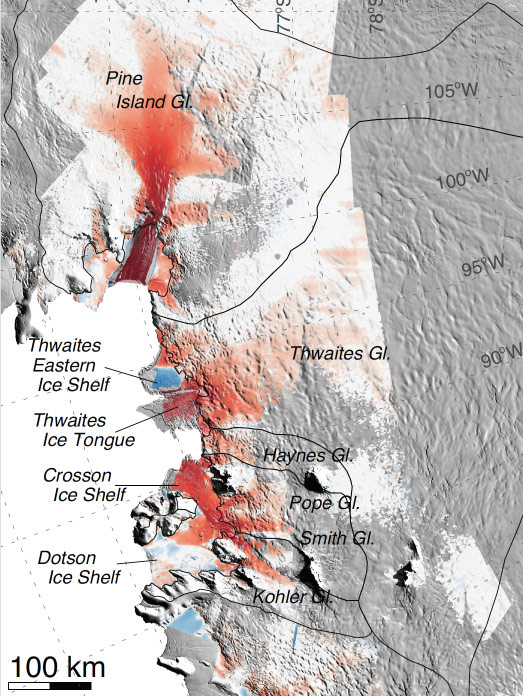
- On Antarctica’s Thwaites Glacier: “That area has been described by colleagues, and this is going back to the 1970s, as the ‘weak underbelly’ of west Antarctica.”
- On the Himalayas and Hindu Kush region: “It’s sensitive to small changes in temperature. You only have to turn up the thermometer a little bit and you’re going to melt a lot of these glaciers.”
- On 1.5C: “I think I’m relatively optimistic in the sense that I think it’s still possible. It’s not beyond our capability as a species to tackle this, but we have to take action.”
- On the Greenland ice sheet: “Once that [the surface mass balance] becomes negative, the ice sheet is on its way out. That’s one of the thresholds.”
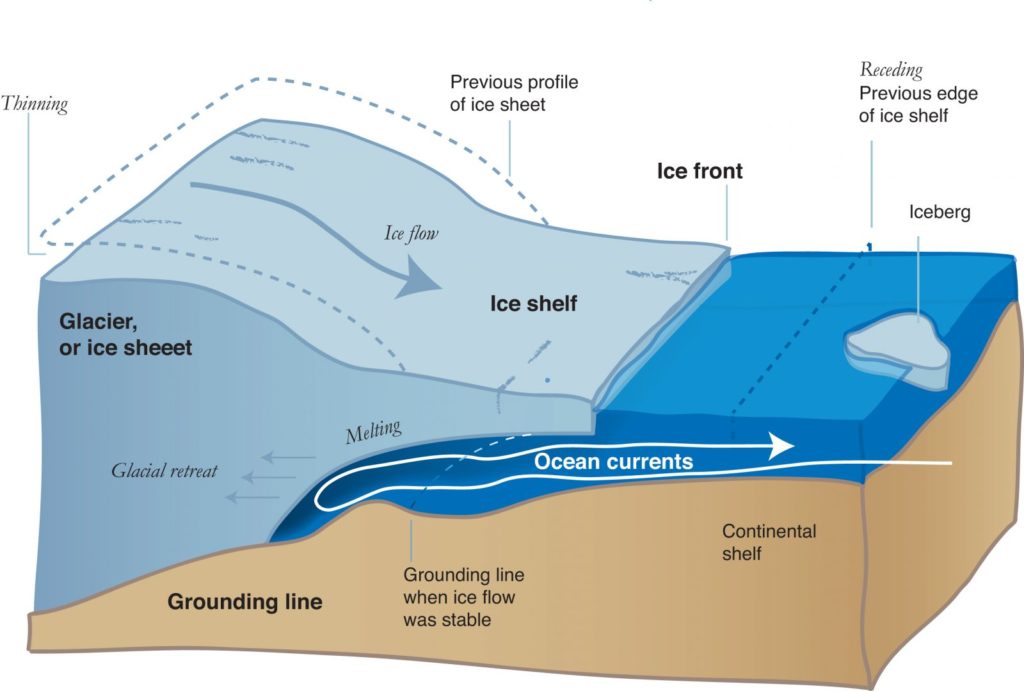
- On the west Antarctic ice sheet: “There were some papers…that suggest that we may even have passed that marine ice sheet instability threshold already for parts of west Antarctica.”
- On negative emissions technologies: “If we want to stick to 1.5C, some form of negative emissions technology is going to be needed…we can’t wean ourselves off fossil fuels tomorrow.”
- On solar geoengineering: “I think we shouldn’t just dismiss it out of hand, for sure.”
- On the IPCC special report on 1.5C: “[It] has really added momentum to a sense of urgency and the need to take action, deep action, and to do it soon.”
- On Arctic permafrost: “When it melts, we believe most of that carbon will be emitted as methane, which is a much stronger greenhouse gas than CO2.”
- On being EGU’s president: “It’s been a rewarding and challenging exercise in moving the organisation forward.”
- On his EGU legacy: “I’m very proud of the fact that, when we surveyed our attendees at the general assembly, over half declare themselves as early-career scientists.”
- On reducing the carbon footprint of the EGU General Assembly: “Last year, we had 15,500 participants. It’s pretty much impossible to hold a meeting with that number of people [virtually].”
- On Brexit: “[it] is going to be bad for us, bad for scientists in the UK and bad for European scientists as well. I think it’s really a tragedy, actually.”
- On science communication: “it doesn’t suit every scientist. Some are good and some aren’t. Some are brilliant verbal communicators and can get messages across in incredibly effective ways and others, not so well.”
Article information
This interview was conducted by Daisy Dunne on 7 February 2019 at the University of Bristol.