Guest post: Land management ‘blind spots’ make 1.5C goal highly unlikely

thomas harrisson

Dr Calum Brown is a scientist at the Institute of Meteorology and Climate Research – Atmospheric Environmental Research (IMK-IFU), part of the Karlsruhe Institute of Technology in Germany.The Paris Agreement represents a rare high point in international climate negotiations, with 195 signatories pledging to limit global average temperatures to 1.5C or 2C above pre-industrial levels.However, despite initial optimism, progress towards meeting this ambition has been lacking. Of the “Nationally Determined Contributions” (NDCs) that describe each country’s plans for cutting greenhouse gas (GHG) emissions, most are vague, underwhelming documents that are almost certainly insufficient and unlikely to be implemented in full.This is particularly obvious in plans for cutting emissions from the way the land is used, managed and farmed.In a new “perspective” paper, published in Nature Climate Change, my co-authors and I look at the “blind spots” that hinder strategies to cut land-based emissions. These include inconsistent policies, time lags that make rapid change difficult, and detrimental consequences of some mitigation options.As things stand, these blind spots mean that achieving the 1.5C goal – and, perhaps, also even 2C – is highly unlikely.

§ Mitigation plans

approximately one-quarter20172018previously levelling offOf the more than 175 countriesincreased by 29%by 44% in Colombia
Image - A Colombian worker uses a chainsaw to cut a log from the rainforest at a sawmill in Tumaco, Colombia. Credit: Jan Sochor/Alamy Stock Photo. - A Colombian worker uses a chainsaw to cut a log from the rainforest at a sawmill in Tumaco, Colombia. (note)
Image (note)
Glossary
Net-zero emissions: When greenhouse gas emissions are balanced by removals, so the sum total is zero or less. Scientists say the world must reach net-zero later this century to limit warming to below 2C.
Net-zero emissions: When greenhouse gas emissions are balanced by removals, so the sum total is zero or less. Scientists say the world must reach net-zero later this century to limit warming to below 2C. Read More
planned withdrawalrapid increase in land clearing
The way humans manage land contributes of all anthropogenic greenhouse gas emissions. Meeting the long-term temperature goals of the Paris Agreement is, therefore, strongly dependent on cutting emissions from, among other things, deforestation and agricultural practices.With CO2 emissions rising in both and – after – these mitigation needs are evermore pressing. that had produced an NDC by November 2015, nearly 100 explicitly identified mitigation strategies involving land use. But many of the proposals contained in NDCs fall short of the “transformative” change required by the Paris Agreement. Instead, they represent or incorporate a continuation of established trends in national policy for managing land systems.One important example is the increase in deforestation that has occurred since the Paris Agreement, immediately undermining the assumption enshrined in several NDCs that deforestation rates would continue to slow as they had in the preceding years. For instance, deforestation between 2015 and 2016 in Brazil and .Lack of time is also an issue. For example, the binding target for European Union member states to cut GHG emissions by 40% by 2030 relies on “net-zero” emissions from land-based sectors, but it leaves very little time for designing and implementing appropriate land-management strategies.And, perhaps, the greatest single threat to achievement of the 1.5C goal today is the likelihood – if not inevitability – of changes in policy objectives in individual countries.Examples are easy to find: the US government’s from the Paris Agreement is one, as is the in Queensland, Australia – the rate of which rivalled that in Brazil – following the rejection of stronger regulations by the Queensland parliament.

§ Achieving change

can contribute to mitigation targetsfood security and environmental sustainabilityJohn Maynard Keynescaused counterproductive deforestationextended its financial support for fossil fuel extractionpromotingforest moratoriumcorresponding increases elsewherecaused by smallholder farmers escaping conflict zonescarbon-rich peatland
Embedded component (note)
Global Forest Watch
Fortunately, land-use change is one of the most tangible aspects of climate change mitigation. It does not usually rely on uncertain new technologies, has causes and consequences that are well understood, and is at least partly amenable to political control.Numerous scientific papers show how land use , providing pathways not only for achieving the Paris targets, but also to .Of course, things are not really so simple. Land use is not a physical system that can be predicted and prodded into shape, but a social system that is subject to the same “uncontrollable and disobedient psychology” that saw in the business world. What’s more, so many human and natural processes meet on the land surface that any given change has effects that ripple inconveniently out into other areas.Most political systems – focusing on particular geographic or policy areas – are poorly suited to handling this complexity. This is why some of the most stable and ambitious governments in the world have struggled to develop coherent land-based mitigation strategies.For example, the EU’s bioenergy policy has – and, therefore, carbon emissions – in Europe and the tropics, while the Scottish government has at the same time as its ‘world-leading’ climate policies.Governments that do not have the luxury of fully functioning regulatory and judicial systems inevitably find it harder still to reconcile climate mitigation and other objectives.For example, Indonesia’s “” policy, intended to reverse the state-supported spread of oil palm plantations, produced only temporary slowing of deforestation in some areas and . The Democratic Republic of the Congo’s (DRC) own moratorium on logging could not prevent deforestation . It has since been effectively abandoned.Indeed, the rates of primary forest loss in the DRC and Indonesia are now 1.5 and three-times the rate in Brazil, respectively, and continue to include widespread clearance of .Chart of year-by-year tree cover loss between 2001 and 2017 for the world as a whole and for key countries. Mouse over the columns to see the legend. Note: “tree cover loss” is not the same as “deforestation” – tree cover loss includes change in both natural and planted forest, and does not need to be human caused. Source:

§ Time lags

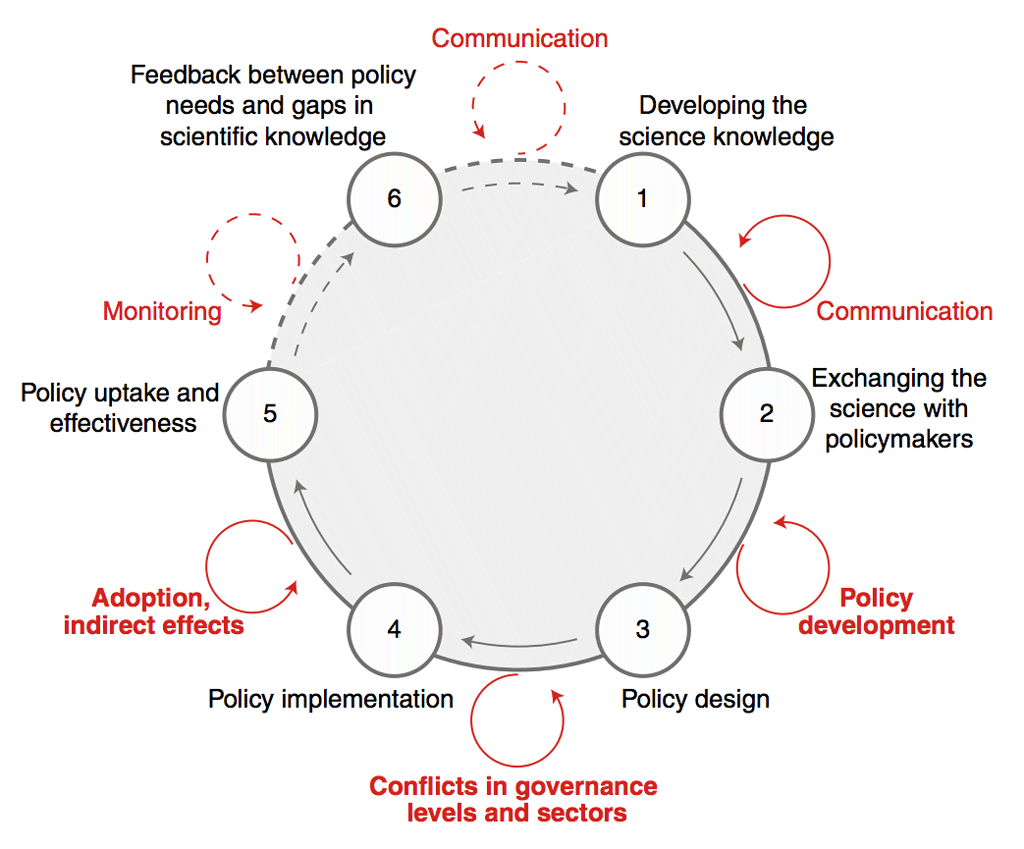
Image - Illustration of time lags within the science–policy exchange cycle. Science-based policymaking is a cyclical process that involves potential time lags (shown in red) at each step that may also reduce the ultimate impact of the policies. Time lags highlighted in bold are those focused on here. Monitoring of policy impacts and feedbacks to new scientific research (shown as dashed lines) are particularly uncertain processes that might not only involve time lags, but might also effectively not take place. Source: Brown et al. (2019) (note)
soil conservation schemesforest protection subsidies
Another issue that must be overcome for effective land use policy is that of “time lags”.As the illustration below highlights, many steps are required to turn scientific advancements into policy. And each step – from communicating new science and developing appropriate policy to implementing and adopting it – can experience its own time lag (shown in red) along the way.Even when policies are implemented and land-use change starts to occur, one further process introduces substantial further delays: the adoption of new practices by individual farmers and foresters.This process is never immediate, smooth or even rational. Instead, land managers wait, hedge their bets, cleave to the known, and learn from their neighbours – even when this means that they may miss economic opportunities.The uptake of bioenergy crops, and has consistently occurred over decades rather than months, and there exist no obvious mechanisms by which mitigation policies can escape this behavioural “sand trap”.

§ ‘Win-win’ strategies

REDD+recent “greening” of China and IndiaGrain for Greenrapid spread of genetically modified crops

Article information

Brown, C. et al. (2019) Achievement of Paris climate goals unlikely due to time lags in the land system, Nature Climate Change, doi:10.1038/s41558-019-0400-5

As things stand, we can envision the land system that we need, but not yet how to get there, while years are lost exploring dead ends and false hopes. Together, these issues make achieving the 1.5C goal highly unlikely.Nevertheless, the blind spots, time lags and reversals of land-based mitigation are not impossible to navigate, given knowledge of their existence.Win-win and nature-based mitigation strategies really do exist and have great potential. For instance, when tropical forests protect indigenous peoples’ livelihoods, sequester carbon and maintain biological diversity (potentially supported by schemes such as the United Nations programme), or where agricultural technology increases yields while reducing environmental impacts (as is to some extent apparent in the , in particular).Mitigation policies can also be designed to fit into a broad spectrum of policy objectives, provided they take account of the social and economic origins of those objectives. China’s major “” programme provides examples for both sides here, having substantial successes that were, nevertheless, sometimes at the cost of the programme’s social acceptability.And land-use changes can have huge impacts over short periods of time if they are perceived to provide clear benefits to the people – often smallholder farmers – who have to implement them. One example of rapid, albeit controversial, change is the in many parts of the world.In each case, a crucial step towards desired changes in the land system is to recognise its cross-sectoral and fundamentally social nature.Policies that treat land use as a distinct problem to be optimised have failed time and again. To achieve a goal as ambitious as that agreed in Paris, we need to get to grips with the messy, human nature of land-based mitigation. In that regard, the real negotiations may have only just begun.

🗂️ back to the index