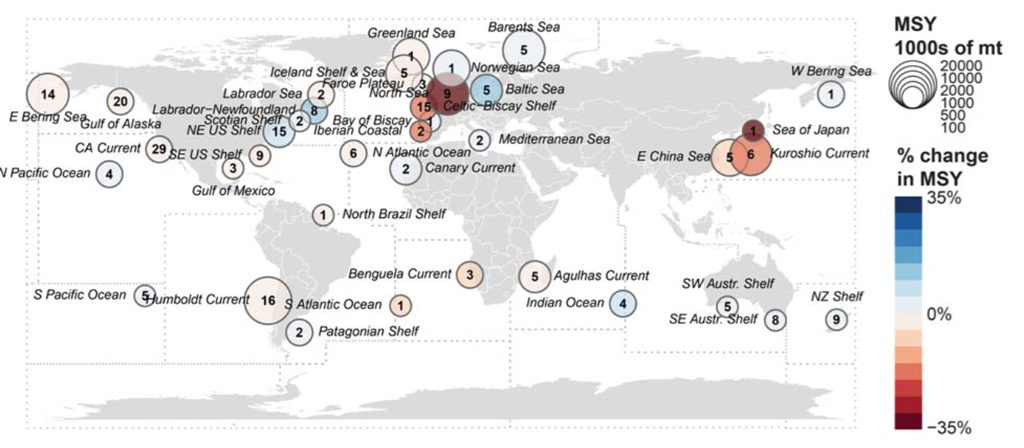
Warming of the world’s oceans has caused the total amount of fish that can be caught sustainably to fall by an average of 4% globally since the 1930s, a study finds.Damage to harvests has been particularly severe around the UK in the North and Irish seas, the data shows, where the maximum sustainable yield has dropped by up to 35%. Fish particularly affected in the North Sea include Atlantic cod, sole and haddock.The risk posed by warming is compounded by overfishing, which presents “a one-two punch” for fish, the lead author tells Carbon Brief. “Overfishing makes fisheries more vulnerable to warming, and continued warming will hinder efforts to rebuild overfished populations.”The findings show that the threat of climate change to the world’s fish stocks is “not something for the distant future”, another scientist tells Carbon Brief.
“We used maps of ocean temperature over time to see if ocean warming has influenced the growth of 235 marine fish and invertebrate populations around the world.
“Our results suggest that the overall effect has been a 4% loss in food provisioning potential around the world through to 2010. In some regions, like the East China Sea and North Sea, losses in food provisioning potential have been much higher, up to 15-35%.”
“It’s important to be clear that we couldn’t assess all fisheries globally and were only able to assess a large sample. The populations we assessed generate a third of global catch.”
ocean acidificationocean deoxygenationClimate change is causing ocean temperatures to rise at an increasingly rapid rate, shows. This warming is having a striking impact on marine life, including by driving and increasing the chances of deadly .The new study, published in , looks back from 1930 to 2010 to see how ocean warming has impacted commercial fish stocks. It covers more than 235 economically important populations of fish in 38 world regions.To do this, the researchers estimated how warming has influenced the “maximum sustainable yield” – the total amount of fish that can be taken by fishing without reducing the stock for the next year – for different populations across the world.This involved using population models and ocean warming data to “hindcast” changes in fish population growth rate, explains lead author , a researcher from the . He tells Carbon Brief:However, it is important to note that the study was not able to investigate the impact of warming on every fish stock, he says:(Fish missing from the analysis include those that are relied on for smallholder fishing in tropical regions, he says. This is because historical data for these populations is scant.)It is also worth noting that the study does not look at all the ways that climate change can impact fish. For example, the research does not consider the impacts of “”, which occurs as seawater absorbs CO2, or “”, the loss of oxygen from parts of the sea.
“A value of +0.1 means a degree of warming would increase population growth rate and maximum sustainable yield by 10% and a value of -0.1 means a degree of warming would decrease population growth rate and maximum sustainable yield by 10%.”
“We suspect that North Sea fish populations have seen declines in productivity due to the impact of ocean warming on zooplankton. Other research has shown that ocean warming has resulted in more autumn-spawning zooplankton and fewer spring-spawning zooplankton, the latter of which are critical to the growth and survival of juvenile fish.”
“We see evidence that populations living at the cool end of their range have benefitted from warming – but this benefit is unlikely to persist if continued warming pushes these population past their temperature tolerance.”
“Overfishing presents a one-two punch: overfishing makes fisheries more vulnerable to warming and continued warming will hinder efforts to rebuild overfished populations.”
“Populations that were found to have responded negatively to temperature were also slow growers, large and of a greater total biomass and found mainly in Europe or the China and Japanese seas. [These] traits would attract fishing pressure. So, it’s not yet clear if the association between fishing and warming is shown to be mechanistic or caused by correlation.”
“This work provides compelling evidence that there are dangers to marine food production from warming seas – at least over the scale of 10-15 years. Whether fish population movement [into] new areas can overcome this remains to be seen.”
“Studies such as this show that climate change is not something for the distant future, but that increasing temperatures are already causing changes in the oceans.”
Article information
Free, C. M. et al. (2019) Impacts of historical warming on marine fisheries production, Science, doi/10.1126/science.aau1758
Another finding of the results is that populations that have suffered from overfishing were more likely to be threatened by ocean warming. Overfishing occurs when fishing fleets take more fish than is sustainable. At present, around one-third of the world’s fish stocks are overfished, according to the .One reason that overfishing could make fish more vulnerable to warming is that the largest and most healthy fish tend to be taken – and they are the ones most likely to be able to withstand warming, Free says:This finding is important, but it may be too early to say there is a causal link specifically between overfishing and warming, says , a fish ecologist from the who was not involved in the study. He tells Carbon Brief:Overall, the findings show how warming can impact commercial fish populations, he adds:The research reinforces the message that climate change is already having a large impact on the world’s fish, says , a marine climate change scientist at the UK government’s Centre for Environment, Fisheries and Aquaculture Science (). She tells Carbon Brief: