Halving global warming with solar geoengineering could ‘offset tropical storm risk’
Engineering the climate to reflect away sunlight could halve global warming and offset the risk of increases in tropical storms, new research suggests.The study finds that an “idealised” case of “solar geoengineering” – a group of hypothetical technologies that aim to lower warming by reflecting the sun’s rays away from the Earth – would not exacerbate extremes in temperature or water availability for most world regions.The findings stand in contrast to earlier research suggesting that solar geoengineering could, under certain circumstances, cause some regions to face amplified climate impacts.The research marks an “important step in solar geoengineering research” by looking at climate impacts that “could directly affect society”, one scientist tells Carbon Brief.However, the study “would have been more policy-relevant” if its modelling technique “represented solar geoengineering using stratospheric aerosols” – rather than an idealised scenario, another says.§ Sundown
proposed ideas for solar geoengineeringoceans to become more acidiccrops to become less nutritious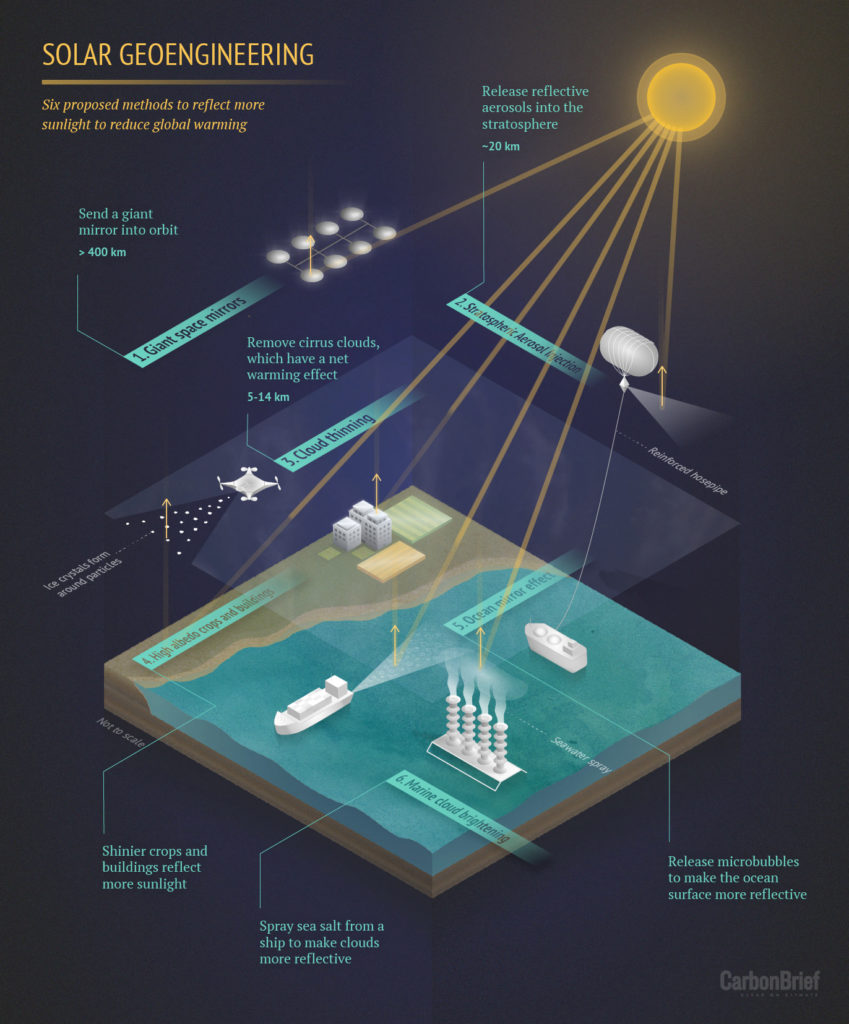
§ Dim view
GeomipHiflortropical storms“We have a case where CO2 concentrations have doubled and we turn the sun down by 1%. This is a kind of sketch of how halving warming with solar geoengineering would influence the climate.”
Prof David KeithHarvard University“While it seems reasonable to assume that less rain means that things are drier, in fact, what matters more for ecosystems and farmers is water availability: rainfall minus evaporation. Geoengineering reduces rainfall, but it also reduces evaporation by reducing temperatures. So, a decrease in rainfall can be associated with an increase in water availability.”
§ Global picture
T” “”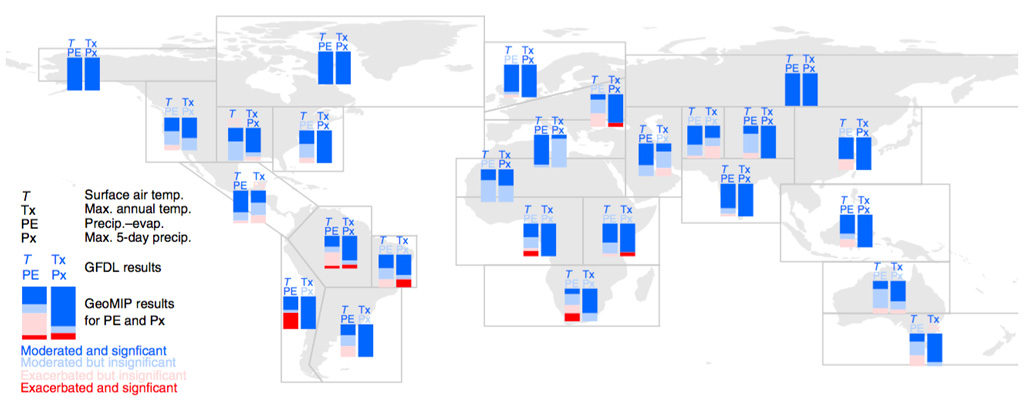
“In the few regions where half-solar geoengineering exacerbates climate change, it increases water availability. This stands in contrast to previous studies and commentary that highlighted concerns that solar geoengineering would lead to drought.”
§ Winners and losers?
“The paper is particularly important because [it uses] a higher resolution climate model that gives more credible projections for some important variables like precipitation extremes – whereas previous papers often only consider variables such as annual mean temperature and precipitation that don’t encompass many important climate impacts.”
Prof Govindasamy BalaIndian Institute of Scienceresearch“[Solar] geoengineering can markedly diminish global and regional climate change from increasing CO2 concentrations. In most regions, the impacts of climate change can be reduced by geoengineering.”
Prof Ben KravitzIndiana UniversityPacific Northwest National Laboratory“I am enjoying the fact that more studies in solar geoengineering are looking at extreme events, impacts like food and water security, and other aspects of climate change that could directly affect society. Studies like these will be an essential part of the knowledge that scientists can provide to decision makers in their deliberations about geoengineering.”
Prof Alan RobockRutgers University“Because they mimicked stratospheric geoengineering by turning down the solar constant rather than by modeling stratospheric aerosols, they ignored a large number of potential impacts, including more diffuse radiation, heating of the stratosphere and impacts on stratospheric ozone. These latter two factors would change atmospheric circulation as well as affect the potential intensity of tropical cyclones.”
Dr Anthony JonesMet Office“However, the study would have been more policy-relevant if it concentrated on a realistic global warming scenario and represented solar geoengineering using stratospheric aerosols. Nevertheless, this paper should impel policymakers to see solar geoengineering for what it is – a potentially effective method of counteracting regional climate change.”
Prof Sonia SeneviratneETH Zurich“Solar geoengineering does not solve the root cause of greenhouse gas induced global warming. This is a similar situation to taking morphine when you are very ill, it will mitigate the pain but it will not cure you – and it may make you addicted.”
Article information
Irvine, P. et al. (2019) Halving warming with idealized solar geoengineering moderates key climate hazards, Nature Climate Change, https://www.nature.com/articles/s41558-019-0398-8